'Pesticide cocktails' pollute apples across Europe: study / Photo: STEPHANE DE SAKUTIN - AFP/File

 France's debt climbs to highest since 1978: ministry

 McIlroy two shots off the lead at Wentworth after eagle on 18

 Martinez brace saves Inter in Serie A top-two clash with Roma

 Rosenior abused but guides Paris FC past old club Strasbourg

 Seven-try Lyon beat Pau, climb to Top 14 summit
 Brighton defeat a 'big lesson' against complacency for Arsenal, says Arteta

 Thousands protest inaction over climate crisis in Switzerland

 Carapaz out of cycling world championships

 'Fragile' Tottenham beaten by Aston Villa despite late rally

 Mourinho hails Real Madrid grit before Atletico derby clash
 Martin wins Austrian MotoGP sprint after Acosta crash

 Japan edge Fiji to win Pacific Nations Cup

 Black smoke, flames rising near Riyadh airport: residents to AFP
 UK actor Naomi Watts honoured at Spain film festival

 Japan emperor declares Asian Games open after turbulent build-up
 Asian Games open with unity message after troubled build-up
 Denmark hails 'binding' Greenland deal with Trump

 We don't want Games host Japan losing money, says Asian Olympic official

 Ed Sheeran returns to stage after Palestinian controversy

 Asian Games to open in Japan after troubled build-up
 Drone owners rush to offload devices ahead of Beijing ban

 Trump's beef policies irk Texas ranchers, testing their loyalty

 New to The Street Broadcasts Tonight at 6:30 PM ET Across the United States, Latin America and MENA, Featuring BioVie, Acurx Pharmaceuticals, Lantern Pharma and SafeSpace Global

 Nvidia, OpenAI CEOs to attend Xi dinner at White House

 Anthropic picks Accenture for in-house AI safety evaluation
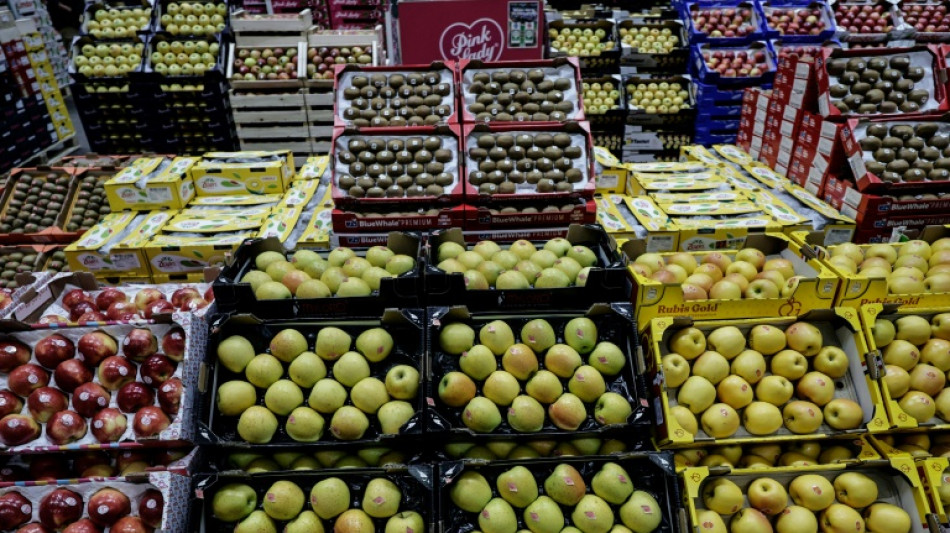
Environmental groups Thursday raised the alarm after finding toxic "pesticide cocktails" in apples sold across Europe, in a new study highlighting widespread contamination.
PAN Europe, a coalition of NGOs campaigning against pesticide use, had around 60 apples randomly purchased in 13 European countries -- including France, Spain, Italy and Poland -- analysed for chemical residues.
Eighty‑five percent of the samples contained multiple pesticide residues, the organisations said, with some apples showing traces of up to seven different chemicals.
In 71 percent of cases, PAN Europe detected pesticides classed among the most hazardous in the European Union -- so‑called "candidates for substitution" that the bloc aims to phase out as soon as possible.
The analysis also found that 64 percent of samples contained at least one per- and polyfluoroalkyl substance, also known as "forever chemicals", which are found throughout the environment and everyday products.
Pesticide residues are permitted in the EU below certain maximum levels. But PAN Europe warned of the "cocktail effect," when consumers are exposed to several pesticides simultaneously in a single product.
Martin Dermine, a senior official at the coalition, criticised the European Food Safety Authority (EFSA) for assessing pesticides individually rather than the risk from "multiple exposure" to several substances.
"In this report, we show that 85 percent of the apples have multiple residues, and we don't know if they are safe for consumption or not," he said, pointing to potential links with cancer and infertility.
If the same apples were sold as processed baby food, 93 percent of the samples would be banned, PAN Europe said, as their pesticide residues exceed the stricter limits set for children under three.
EU rules are tougher for baby foods to protect early development. PAN Europe advised consumers to buy organic apples or peel conventionally grown ones before eating them.
Along with bananas, apples rank among Europeans' favourite fruits, and are the most widely grown in the EU, particularly in Poland, Italy and France.
Apples are also among the most heavily treated fruits, with pesticides used in particular to fight apple scab, the main fungal threat to orchards. More than half of the numerous annual treatments carried out on the fruit -- about 35 on average -- target the disease.
W.Stewart--AT