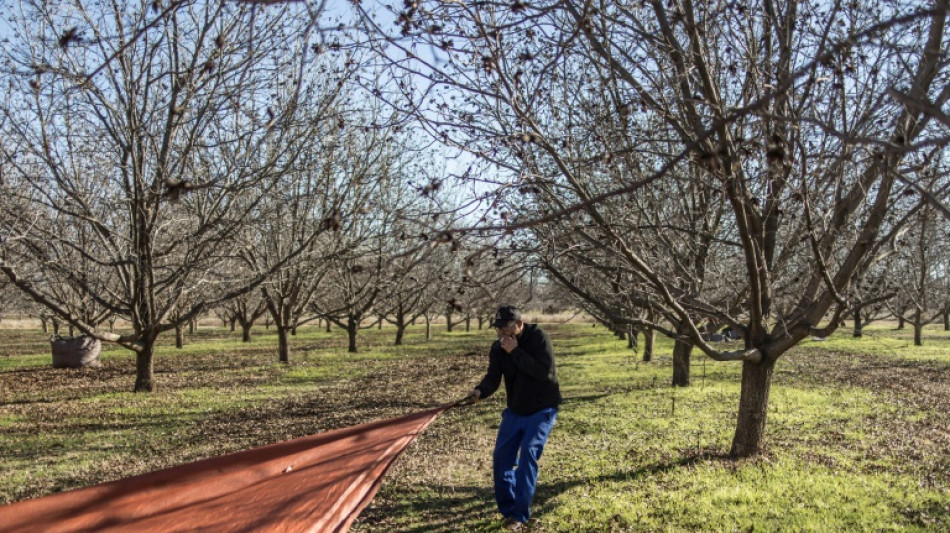
In energy-starved South Africa, whites-only town basks in solar power / Photo: MARCO LONGARI - AFP

 Carapaz out of cycling world championships

 'Fragile' Tottenham beaten by Aston Villa despite late rally

 Mourinho hails Real Madrid grit before Atletico derby clash
 Martin wins Austrian MotoGP sprint after Acosta crash

 Japan edge Fiji to win Pacific Nations Cup
 Black smoke, flames rising near Riyadh airport: residents to AFP
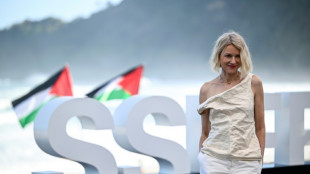 UK actor Naomi Watts honoured at Spain film festival
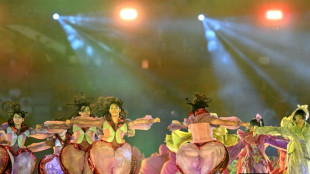 Japan emperor declares Asian Games open after turbulent build-up
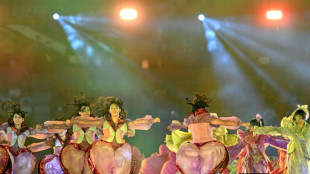 Asian Games open with unity message after troubled build-up
 Denmark hails 'binding' Greenland deal with Trump
 We don't want Games host Japan losing money, says Asian Olympic official
 Ed Sheeran returns to stage after Palestinian controversy
 Asian Games to open in Japan after troubled build-up
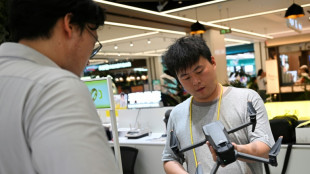 Drone owners rush to offload devices ahead of Beijing ban
 Trump's beef policies irk Texas ranchers, testing their loyalty
 Batman Appears Atop the Sydney Opera House for Batman Day 2026
 Nvidia, OpenAI CEOs to attend Xi dinner at White House
 Anthropic picks Accenture for in-house AI safety evaluation
 Balogun returns as Monaco beat Lens to continue strong Ligue 1 start

 'Pause' on overt repression in Venezuela, but reforms still needed: HRW

 Global stocks mixed as yen falls despite Bank of Japan rate hike
 Cuba hit with seventh major blackout of the year

 Murray out with concussion so Wentz will start for Vikings

 UN chief 'deeply regrets' US visa refusal to Abbas for annual meeting
 England quick Carse to face no charges over alleged nightclub assault

Most of South Africa is wallowing in endless power cuts, but a remote whites-only farming town in the country's sun-drenched centre is close to producing enough electricity to be self-sufficient.
At the end of a gravel track outside the Afrikaner town of Orania, a diamond mesh gate opens onto hundreds of photovoltaic panels mounted in rows.
In energy-starved South Africa, the small settlement of 2,500 people is the only town nationwide close to reaching energy supply autonomy and freeing itself from the failing national power grid.
"The solar farm is quite a huge game changer for us. It brings energy sustainability to the town," said Gawie Snyman, 43, who manages the municipality.
"Our big dream is to become an energy exporter".
Africa's most developed economy has in recent years been plagued by epileptic power supply, which many blame on the ageing coal-fired plants operated by the state-owned energy giant Eskom.
After weeks of some of the worst blackouts in recent years, President Cyril Ramaphosa on Monday announced energy reforms, urging South Africans to "join in a massive rollout of rooftop solar" and sell excess to the grid.
Orania, a town some 620 kilometres (380 miles) southwest of Johannesburg, was already well on its way to becoming totally energy independent in just several years' time.
- Solar independence -
Built on privately acquired land along the Orange River during the dying days of apartheid, Orania manages its affairs autonomously from the central government.
It was set up to preserve the "culture" of the Afrikaners -- descendants of the Dutch and French-Huguenot Protestant settlers who came to South Africa in the 17th century.
Town spokesman Joost Strydom, 28, said the town in the Karoo region now aimed to make the best of year-round sunshine in order to enjoy "total electricity independence".
With funding from the municipality and private investors, Orania started building its 10.5-million-rand ($620,000) solar farm in June last year.
Just 12 months later, the town was generating 841 KW of electricity per hour -- almost enough to power half the town and surrounding farms growing corn, wheat and nuts, local authorities say.
"It was the basic idea of self-sufficiency that drove us towards doing this," said Francois Joubert, the engineer who designed what has become known as the "Orasol" plant.
Standing next to a row of solar panels, the 69-year-old in a grey flat cap said Eskom had "failed dismally" to provide the town with the necessary power.
"You can't rely on anybody to supply you with basic ingredients to live here in the Karoo," he said.
"We had to do that ourselves, we had to work it out... And it's working for us."
- Thirsty pecans -
A few kilometres from the solar plant, at the De Groot Boord farm, Joubert's wife Annatjie watched as a mechanical tree shaker released pecan nuts onto a red net during early morning harvesting.
The 66-year-old former IT specialist turned farmer said a stable power supply was crucial for her orchard to flourish.
When Eskom rations electricity to prevent the grid from collapsing, her trees go thirsty as she can't pump water from the river, she explained.
Yet "it's vital to complete your irrigation cycles especially with pecans nuts because they use a lot of water," she said.
The new solar plant would allow her to do just that, she added.
As the world grapples with a food crisis sparked by Russia's invasion of Ukraine, her husband said countries could ill afford more challenges to domestic food production.
"We need to produce as much as possible of our own food, and therefore we need water... we need electricity," Joubert said.
The town was proud to be playing its part through producing clean energy, said the engineer.
"We are very glad that we can assist the green idea," he said.
T.Wright--AT



