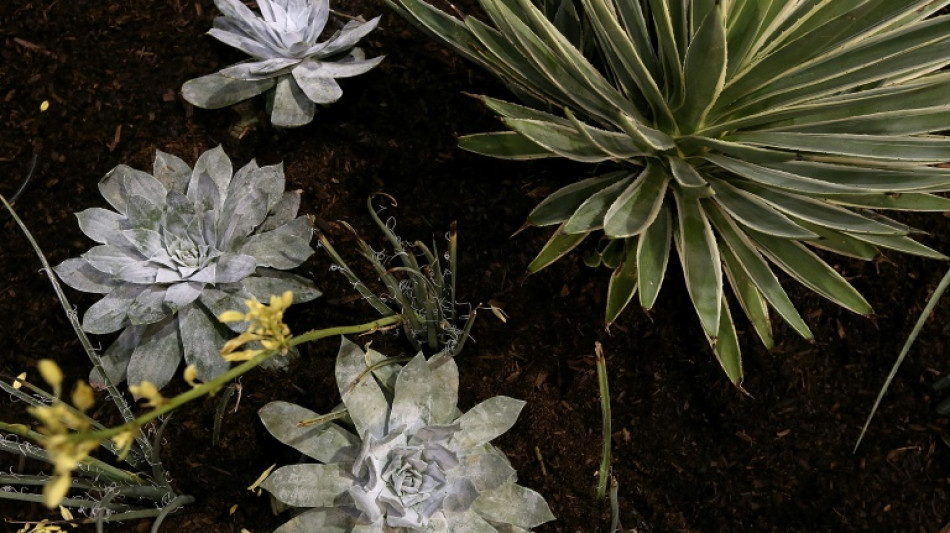
Climate, collectors blamed for S.Africa's succulents decline / Photo: JUSTIN SULLIVAN - GETTY IMAGES NORTH AMERICA/AFP/File

 Carapaz out of cycling world championships

 'Fragile' Tottenham beaten by Aston Villa despite late rally

 Mourinho hails Real Madrid grit before Atletico derby clash

 Martin wins Austrian MotoGP sprint after Acosta crash

 Japan edge Fiji to win Pacific Nations Cup
 Black smoke, flames rising near Riyadh airport: residents to AFP

 UK actor Naomi Watts honoured at Spain film festival

 Japan emperor declares Asian Games open after turbulent build-up

 Asian Games open with unity message after troubled build-up
 Denmark hails 'binding' Greenland deal with Trump

 We don't want Games host Japan losing money, says Asian Olympic official

 Ed Sheeran returns to stage after Palestinian controversy

 Asian Games to open in Japan after troubled build-up

 Drone owners rush to offload devices ahead of Beijing ban

 Trump's beef policies irk Texas ranchers, testing their loyalty

 Batman Appears Atop the Sydney Opera House for Batman Day 2026

 Nvidia, OpenAI CEOs to attend Xi dinner at White House

 Anthropic picks Accenture for in-house AI safety evaluation
 Balogun returns as Monaco beat Lens to continue strong Ligue 1 start

 'Pause' on overt repression in Venezuela, but reforms still needed: HRW

 Global stocks mixed as yen falls despite Bank of Japan rate hike

 Cuba hit with seventh major blackout of the year

 Murray out with concussion so Wentz will start for Vikings

 UN chief 'deeply regrets' US visa refusal to Abbas for annual meeting

 England quick Carse to face no charges over alleged nightclub assault

Climate change and collectors of rare plants are decimating succulents in South Africa, government researchers said Wednesday, warning hundreds of these rugged species are at risk of extinction.
Succulents growing in the country's semi-arid regions are experiencing unprecedented rates of decline following a rapid rise in global demand for collectable plants driven by Asia, according to the South African National Biodiversity Institute (SANBI), a government research body.
"Over the past three years plant material confiscated from plant traffickers by law enforcement agencies has increased annually by over 250 percent," the institute said in a statement.
SANBI said more than 200 succulents -- typically thick, fleshy plants that retain water to survive dry weather conditions -- have been added to an International Union for Conservation of Nature (IUCN) Red List of threatened species, which was updated last week.
Unique species growing in the Succulent Karoo -- a region shared between South Africa and Namibia which includes some of the world's most biodiverse desert and semi-desert areas -- are particularly sought after, it said.
The plants are often sold on social media, it added.
"People buying these plants, most of them don't realize that they're breaking the law," said Craig Hilton-Taylor, who heads the IUCN's Red List unit.
"They're completely ignorant or naive about illegal plant trade... they just think, 'Oh, that's a nice thing to buy for my house or my garden'," he said.
Global warming is also contributing to the decline, the institute said.
The region has suffered from a prolonged, severe drought over the past decade.
This has taken a toll on many species in the region, including the critically endangered giant quiver tree. Its population is set to decline 90 percent by 2080, SANBI said.
"A combination of illegal collection, long-term droughts related to climate change, and ongoing land degradation as a result of livestock overgrazing and mining are creating a devastating storm causing unprecedented loss of biodiversity in the world's richest desert ecosystem," it said.
P.A.Mendoza--AT