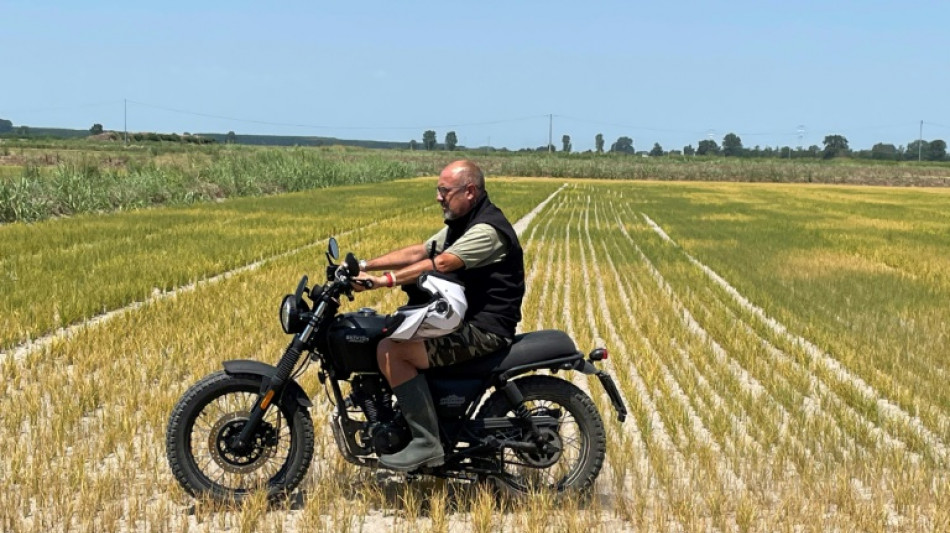
Italy's famous Po Valley rice paddies decimated by drought / Photo: Brigitte HAGEMANN - AFP

 Carapaz out of cycling world championships

 'Fragile' Tottenham beaten by Aston Villa despite late rally

 Mourinho hails Real Madrid grit before Atletico derby clash

 Martin wins Austrian MotoGP sprint after Acosta crash

 Japan edge Fiji to win Pacific Nations Cup
 Black smoke, flames rising near Riyadh airport: residents to AFP
 UK actor Naomi Watts honoured at Spain film festival
 Japan emperor declares Asian Games open after turbulent build-up

 Asian Games open with unity message after troubled build-up
 Denmark hails 'binding' Greenland deal with Trump
 We don't want Games host Japan losing money, says Asian Olympic official

 Ed Sheeran returns to stage after Palestinian controversy

 Asian Games to open in Japan after troubled build-up
 Drone owners rush to offload devices ahead of Beijing ban

 Trump's beef policies irk Texas ranchers, testing their loyalty

 Batman Appears Atop the Sydney Opera House for Batman Day 2026
 Nvidia, OpenAI CEOs to attend Xi dinner at White House

 Anthropic picks Accenture for in-house AI safety evaluation
 Balogun returns as Monaco beat Lens to continue strong Ligue 1 start

 'Pause' on overt repression in Venezuela, but reforms still needed: HRW

 Global stocks mixed as yen falls despite Bank of Japan rate hike

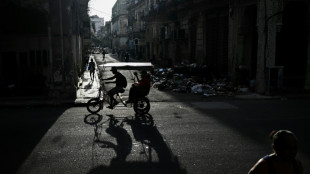 Cuba hit with seventh major blackout of the year

 Murray out with concussion so Wentz will start for Vikings

 UN chief 'deeply regrets' US visa refusal to Abbas for annual meeting
 England quick Carse to face no charges over alleged nightclub assault

The roar of Dario Vicini's motorcycle cuts through the silence as he drives across his rice paddy to survey the destruction wrought by Italy's worst drought in 70 years.
His fields are nothing but desolation, with rice stems slowly dying in the sandy ground.
"Under normal circumstances, I would never have been able to ride my motorcycle over the field," Vicini explained to AFP.
"At this time of year, the plants would be up to my knees and the rice field would be flooded," he said.
"Here, they're tiny, because the water needed to irrigate them has never arrived."
Vicini's "Stella" farm, located in the village of Zeme in the Po Valley, 70 kilometres (43 miles) southwest of Milan, is part of Italy's "golden triangle" of rice paddies.
Europe's leading rice-growing region -- which supplies Italy and the world with the country's famous arborio for risotto and many other varieties -- stretches west from Pavia in Lombardy to Vercelli and Novara in Piedmont.
Vicini said the area's last "decent rain" came in December.
"It's the fault of climate change," said the 58-year-old farmer, who estimates his income has fallen by 80 to 90 percent.
Enrico Sedino, another farmer in the area, is even more worried.
"If there's no more water, I can lose up to 100 percent of my turnover," he said.
Around the rice paddies, cracks are visible in the parched earth and the feeble, stunted rice shoots are covered with a thin layer of dust.
The small irrigation canals that run alongside the fields are dry, or nearly so.
The waters of the Po River -- Italy's longest river whose flat drainage basin is the wide, fertile plain perfect for growing rice -- are this year at a historically low level not seen since 1952.
The water, when it comes, arrives in dribs and drabs.
- Lunar landscape -
Zeme Mayor Massimo Saronni, a rice farmer himself for three decades, said that not only is the harvest suffering "but the whole ecosystem is withering away".
Before, the rice paddies resounded with the song of crickets and the croaking of frogs, while clouds of dragonflies flittered above the fields. Freshwater birds like grey herons and white ibises fed on insects.
Now, "being in the countryside with such a heavy silence, it's depressing, you feel like you're on the moon!" he said.
Vicini's 50 hectares are irrigated through the Cavour Canal, which carries the waters of the Po, while other rice paddies in the Pavia region are fed by Lake Maggiore or Lake Como.
But regional authorities have warned that those lakes' reserves could run out by the end of July.
Early this month, Italy's national government declared a state of emergency in five regions -- Emilia-Romagna, Friuli-Venezia Giulia, Lombardy, Veneto and Piedmont -- four of which are supplied by the Po.
Farmers are forced to abandon some fields to deal with others. "just like the doctor who during the Covid-19 pandemic chose those with a chance of being saved," Saronni noted, bitterly.
- 'Apocalyptic' -
The Po's historically low water levels have had catastrophic consequences for Italy's more than 4,000 rice farms, spread over 220,000 hectares (543,630 acres).
Sixty percent of the 1.5 million tonnes of rice produced in Italy each year are exported. Among the more than 200 varieties are the famous Carnaroli, Arborio, Roma and Baldo brands, essential for the preparation of typical risotto dishes.
Rice consumption rose in 2020 when millions of Italians were forced by the coronavirus lockdown to cook at home.
But now, the country risks a rice shortage, warned Stefano Greppi, president of Pavia's branch of Italy's agricultural association Coldiretti.
"The situation is desperate, not to say apocalyptic," said the rice farmer, estimating the economic damage as "incalculable... millions of millions of euros".
"If there is no harvest this year, there is a risk that many companies will close down or go bankrupt".
H.Romero--AT



