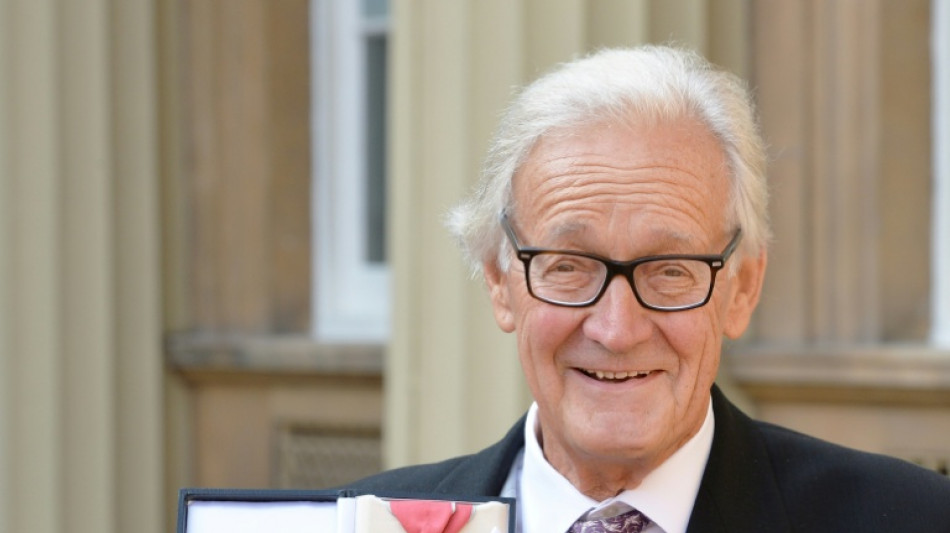
Save the Elephants founder Iain Douglas-Hamilton dies at 83 / Photo: John Stillwell - POOL/AFP

 France's debt climbs to highest since 1978: ministry

 McIlroy two shots off the lead at Wentworth after eagle on 18

 Martinez brace saves Inter in Serie A top-two clash with Roma

 Rosenior abused but guides Paris FC past old club Strasbourg

 Seven-try Lyon beat Pau, climb to Top 14 summit

 Brighton defeat a 'big lesson' against complacency for Arsenal, says Arteta

 Thousands protest inaction over climate crisis in Switzerland

 Carapaz out of cycling world championships

 'Fragile' Tottenham beaten by Aston Villa despite late rally

 Mourinho hails Real Madrid grit before Atletico derby clash
 Martin wins Austrian MotoGP sprint after Acosta crash

 Japan edge Fiji to win Pacific Nations Cup

 Black smoke, flames rising near Riyadh airport: residents to AFP
 UK actor Naomi Watts honoured at Spain film festival

 Japan emperor declares Asian Games open after turbulent build-up

 Asian Games open with unity message after troubled build-up

 Denmark hails 'binding' Greenland deal with Trump

 We don't want Games host Japan losing money, says Asian Olympic official

 Ed Sheeran returns to stage after Palestinian controversy

 Asian Games to open in Japan after troubled build-up

 Drone owners rush to offload devices ahead of Beijing ban

 Trump's beef policies irk Texas ranchers, testing their loyalty

 New to The Street Broadcasts Tonight at 6:30 PM ET Across the United States, Latin America and MENA, Featuring BioVie, Acurx Pharmaceuticals, Lantern Pharma and SafeSpace Global

 Nvidia, OpenAI CEOs to attend Xi dinner at White House

 Anthropic picks Accenture for in-house AI safety evaluation
Scottish conservationist Iain Douglas-Hamilton, who pioneered new understandings of African elephants and made protecting the giant pachyderms a life-long passion, has died at the age of 83, his charity said Tuesday.
Save the Elephants said in a statement that Douglas-Hamilton passed away in Nairobi late Monday, calling him a "pioneering force" in elephant conservation, who "revolutionised our understanding... through his groundbreaking research".
"His work laid the foundation for modern elephant behavioural studies and conservation practices," it said.
The Scottish zoologist was born and educated in the United Kingdom, but spent much of his life in Africa, working in Uganda and Tanzania before settling with his family in Kenya.
"Iain changed the future not just for elephants, but for huge numbers of people across the globe. His courage, determination and rigour inspired everyone he met," said Frank Pope, Save the Elephants CEO.
"He never lost his lifelong curiosity with what was happening inside the minds of one of our planet's most intriguing creatures," Pope said.
Douglas-Hamilton began his work researching elephants in Tanzania before turning to pachyderm protection in the 1980s during an ivory poaching crisis.
His work documenting the scale of the crisis, using aerial monitoring to count large populations for the first time, helped gather momentum around the intergovernmental push to ban the global ivory trade in 1989.
The work was not without risk. He and his wife would sit on flak jackets in their small plane to avoid poachers' bullets.
Douglas-Hamilton, who established Save the Elephants in 1993, was also among the first to introduce GPS tracking and aerial survey techniques, with his methods now considered standard practice in wildlife conservation.
He and his wife, Oria, published two award-winning books about elephants, and he was recognised with an Order of the British Empire (OBE) in 1992 and a Commander of the British Empire (CBE) in 2015.
B.Torres--AT



