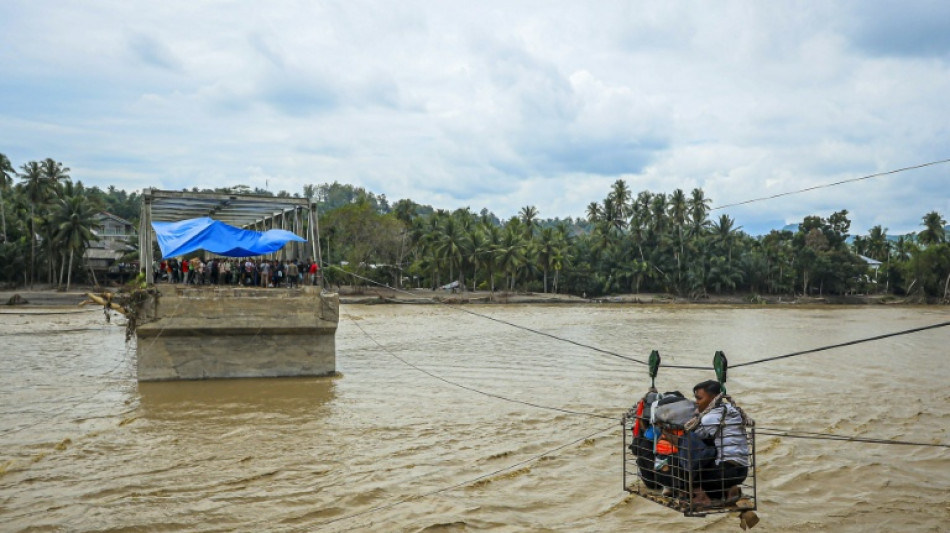
Frustration in Indonesia as flood survivors await aid / Photo: AMANDA JUFRIAN - AFP

 Toulouse edge Vannes, Lyon beat Pau to take Top 14 summit

 Germans arrested for Louvre stunt in Mona Lisa hall

 Saudi-led coalition says Houthis fired ballistic missile at Riyadh

 France's debt climbs to highest since 1978: ministry

 McIlroy two shots off the lead at Wentworth after eagle on 18

 Martinez brace saves Inter in Serie A top-two clash with Roma

 Rosenior abused but guides Paris FC past old club Strasbourg

 Seven-try Lyon beat Pau, climb to Top 14 summit

 Brighton defeat a 'big lesson' against complacency for Arsenal, says Arteta

 Thousands protest inaction over climate crisis in Switzerland

 Carapaz out of cycling world championships

 'Fragile' Tottenham beaten by Aston Villa despite late rally

 Mourinho hails Real Madrid grit before Atletico derby clash

 Martin wins Austrian MotoGP sprint after Acosta crash

 Japan edge Fiji to win Pacific Nations Cup
 Black smoke, flames rising near Riyadh airport: residents to AFP

 UK actor Naomi Watts honoured at Spain film festival
 Japan emperor declares Asian Games open after turbulent build-up

 Asian Games open with unity message after troubled build-up
 Denmark hails 'binding' Greenland deal with Trump
 We don't want Games host Japan losing money, says Asian Olympic official
 Ed Sheeran returns to stage after Palestinian controversy

 Asian Games to open in Japan after troubled build-up
 Drone owners rush to offload devices ahead of Beijing ban

 Trump's beef policies irk Texas ranchers, testing their loyalty

Officials in Indonesia and Sri Lanka battled Wednesday to reach survivors of deadly flooding in remote, cut-off regions as the toll in the disaster that hit four countries topped 1,300.
In Indonesia, there is growing frustration among survivors of catastrophic flooding and landslides over the pace of the rescue effort and aid delivery.
Humanitarian groups said the scale of the challenge was almost unprecedented even for a country that has faced no shortage of natural disasters.
Monsoon rains paired with two rare tropical storm systems, sometimes known in the region as cyclones, dumped record deluges across Sri Lanka, and parts of Indonesia's Sumatra, southern Thailand and northern Malaysia last week.
In Indonesia, the toll hit 753 on Wednesday, but the number of missing also increased to 650.
The rising figures reflect information that is only trickling in as many regions remain either physically cut off by flood damage or isolated by electricity and communications failures, or both.
"It's very challenging logistically to respond," said Ade Soekadis, executive director of Mercy Corps Indonesia, an aid group.
"The extent of the damage and the size of the affected area is really huge."
The group is hoping to send hygiene equipment and water both from Jakarta and locally.
He said reports of food and water shortages were already "very concerning" and the situation will be "more problematic as time goes by".
- 'Like an earthquake' -
At an evacuation centre in Padan, 52-year-old Reinaro Waruwu told AFP he was "disappointed" in the government's immediate response and the slow arrival of aid.
"Some waited a day and night before receiving help, so they couldn't be saved," he said, surrounded by evacuees sitting on mats on the floor in the hall-turned-shelter.
"I am frustrated, it doesn't need to be said twice. The response was not quick," he added.
Like many, he described the arrival of floodwaters and landslides as a disaster without precedent.
"It came like an earthquake.. I thought 'Well, if I am going to die, then so be it,'" he said, beginning to sob heavily.
He managed to escape the rising waters, but his neighbours were buried alive in debris.
Traumatised, he could not even eat on arrival, and since then food has been patchily available, though vegetables arriving on Tuesday offered a "semblance of hope", he said.
Nearby, Hamida Telaumbaunua, 37, described watching her entire kitchen swept away by floodwaters.
"My heart... this was the first time I experienced such a flood," she said.
Her home was lost entirely, along with everything but the few possessions she took when she left.
"It's hard to think about what lies ahead. Maybe as long as we're still here, it's okay, but later... I don't know what will happen."
The weather system that hit Indonesia also brought heavy rains to Thailand, killing at least 176 people, and Malaysia, where two people were killed.
- Sri Lanka 'open' for tourists -
Though floods are common in Asia during monsoon season, climate change is making heavy rain events more frequent because a warmer atmosphere holds more moisture.
Warmer oceans can also turbocharge storm systems.
A separate weather system, Cyclone Ditwah, brought torrential rain and deadly floods and landslides to much of Sri Lanka last week.
At least 465 people were killed, and authorities have estimated the disaster's cost at up to $7 billion.
"Our initial estimate is that we will need about six to seven billion dollars for the reconstruction," said Prabath Chandrakeerthi, the Commissioner-General of Essential Services.
Another 366 people are unaccounted for, including in some of the hardest-hit regions that remain largely inaccessible.
Chandrakeerthi said existing laws that allow a person to be declared dead only after being missing for six months could be shortened to expedite the issuance of death certificates.
The government has said it will offer 25,000 rupees ($83) to families to help clean their homes. Those who lost homes will receive up to $8,000.
Over 1.5 million people have been affected, with over 200,000 in state-run shelters.
Despite the disaster, the tourism-reliant country welcomed a luxury cruiseliner to Colombo port on Tuesday, authorities said.
The arrival sends "a clear message to the world: Sri Lanka is safe, open, and ready to embrace visitors once again," the country's tourist board said.
burs-sah/kaf
P.Smith--AT



