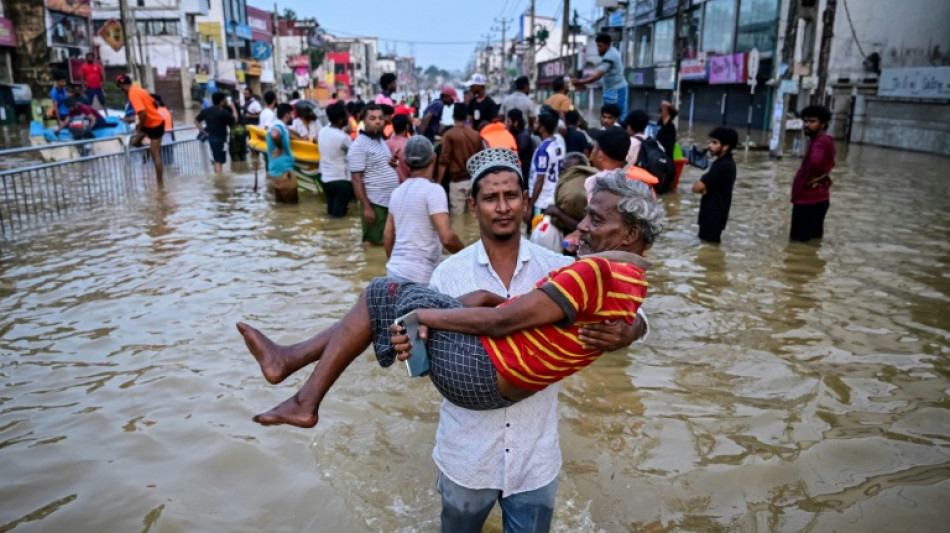
Asia floods toll tops 1,000 deaths as troops aid survivors / Photo: Ishara S. KODIKARA - AFP

 Toulouse edge Vannes, Lyon beat Pau to take Top 14 summit

 Germans arrested for Louvre stunt in Mona Lisa hall

 Saudi-led coalition says Houthis fired ballistic missile at Riyadh

 France's debt climbs to highest since 1978: ministry

 McIlroy two shots off the lead at Wentworth after eagle on 18

 Martinez brace saves Inter in Serie A top-two clash with Roma

 Rosenior abused but guides Paris FC past old club Strasbourg

 Seven-try Lyon beat Pau, climb to Top 14 summit

 Brighton defeat a 'big lesson' against complacency for Arsenal, says Arteta

 Thousands protest inaction over climate crisis in Switzerland

 Carapaz out of cycling world championships

 'Fragile' Tottenham beaten by Aston Villa despite late rally

 Mourinho hails Real Madrid grit before Atletico derby clash

 Martin wins Austrian MotoGP sprint after Acosta crash

 Japan edge Fiji to win Pacific Nations Cup

 Black smoke, flames rising near Riyadh airport: residents to AFP

 UK actor Naomi Watts honoured at Spain film festival
 Japan emperor declares Asian Games open after turbulent build-up

 Asian Games open with unity message after troubled build-up
 Denmark hails 'binding' Greenland deal with Trump
 We don't want Games host Japan losing money, says Asian Olympic official
 Ed Sheeran returns to stage after Palestinian controversy

 Asian Games to open in Japan after troubled build-up
 Drone owners rush to offload devices ahead of Beijing ban

 Trump's beef policies irk Texas ranchers, testing their loyalty

The toll in deadly flooding and landslides across parts of Asia climbed past 1,000 on Monday as hardest-hit Sri Lanka and Indonesia deployed military personnel to help survivors.
Separate weather systems brought torrential, extended rainfall to the entire island of Sri Lanka and large parts of Indonesia's Sumatra, southern Thailand and northern Malaysia last week.
Much of the region is currently in its monsoon season but climate change is producing more extreme rain events and turbocharging storms.
The relentless rains left residents clinging to rooftops awaiting rescue by boat or helicopter, and cut entire villages off from assistance.
Arriving in North Sumatra on Monday, Indonesian President Prabowo Subianto said "the worst has passed, hopefully".
The government's "priority now is how to immediately send the necessary aid", with particular focus on several cut-off areas, he added.
Prabowo has come under increasing pressure to declare a national emergency in response to flooding and landslides that have killed at least 502 people, with more than 500 still missing.
Unlike his Sri Lankan counterpart, Prabowo has also avoided publicly calling for international assistance.
The toll is the deadliest in a natural disaster in Indonesia since a massive 2018 earthquake and subsequent tsunami killed more than 2,000 people in Sulawesi.
The government has sent three warships carrying aid and two hospital ships to some of the worst-hit areas, where many roads remain impassable.
At an evacuation centre in North Aceh, 28-year-old Misbahul Munir described walking through water that reached his neck to get back to his parents.
"Everything in the house was destroyed because it was submerged," he told AFP.
"I have only the clothes I am wearing," he said in tears.
"In other places, there were a lot of people who died. We are grateful that we are healthy."
- 'Everything went under' -
In Sri Lanka, the government called for international aid and used military helicopters to reach people stranded by flooding and landslides triggered by Cyclone Ditwah.
At least 355 people have been killed, Sri Lankan officials said on Monday, with another 366 still missing.
Floodwaters in the capital Colombo peaked overnight.
Now that the rain has stopped, there were hopes that waters would begin receding. Some shops and offices have reopened.
The floodwaters came as a surprise to some around Colombo.
"Every year we experience minor floods, but this is something else," delivery driver Dinusha Sanjaya, 37, told AFP.
"It is not just the amount of water, but how quickly everything went under."
Officials said the extent of the damage in the worst-affected central region was only just being revealed as relief workers cleared roads blocked by fallen trees and mudslides.
President Anura Kumara Dissanayake, who declared a state of emergency to deal with the disaster, called the flooding the "largest and most challenging natural disaster in our history."
The losses and damage are the worst in Sri Lanka since the devastating 2004 Asian tsunami that killed around 31,000 people there and left more than a million homeless.
- Anger in Thailand -
By Sunday afternoon, rain had subsided across Sri Lanka but low-lying areas of the capital were flooded and authorities were bracing for a major relief operation.
Military helicopters have been deployed to airlift stranded residents and to deliver food. One crashed just north of Colombo on Sunday, killing the pilot.
The annual monsoon season often brings heavy rain, triggering landslides and flash floods.
But the flooding that hit Indonesia, Thailand and Malaysia was also exacerbated by a rare tropical storm that dumped heavy rain on Sumatra island in particular.
Climate change has also increased the intensity of storms, and produced more heavy rain events because a warmer atmosphere holds more moisture.
The government has rolled out relief measures, but there has been growing public criticism of the flood response, and two local officials have been suspended over their alleged failures.
Across the border in Malaysia, where heavy rains also inundated large stretches of land in Perlis state, two people were killed.
burs-sah-abh/ami
A.O.Scott--AT



