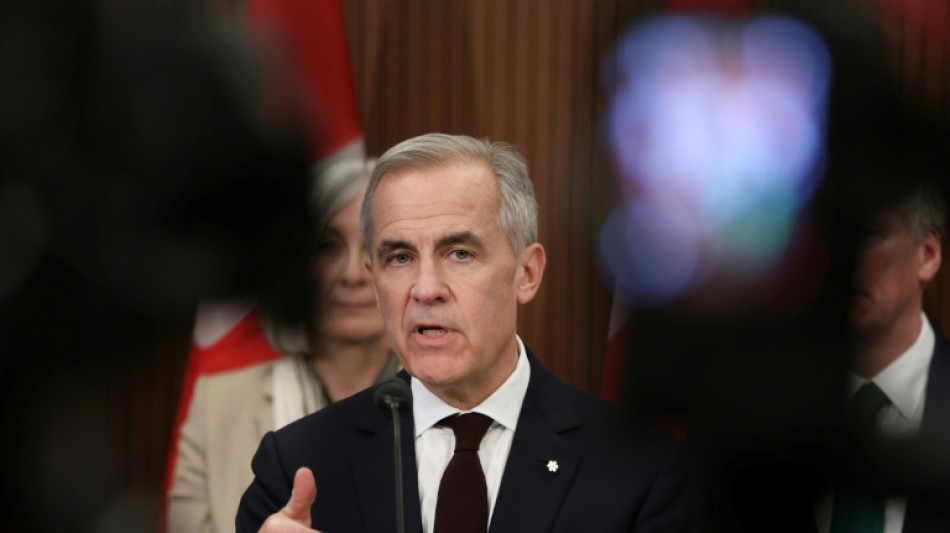
Canada PM under fire for alleged climate U-turn / Photo: Dave Chan - AFP/File

 Toulouse edge Vannes, Lyon beat Pau to take Top 14 summit

 Germans arrested for Louvre stunt in Mona Lisa hall

 Saudi-led coalition says Houthis fired ballistic missile at Riyadh

 France's debt climbs to highest since 1978: ministry

 McIlroy two shots off the lead at Wentworth after eagle on 18
 Martinez brace saves Inter in Serie A top-two clash with Roma

 Rosenior abused but guides Paris FC past old club Strasbourg
 Seven-try Lyon beat Pau, climb to Top 14 summit
 Brighton defeat a 'big lesson' against complacency for Arsenal, says Arteta

 Thousands protest inaction over climate crisis in Switzerland

 Carapaz out of cycling world championships

 'Fragile' Tottenham beaten by Aston Villa despite late rally

 Mourinho hails Real Madrid grit before Atletico derby clash

 Martin wins Austrian MotoGP sprint after Acosta crash

 Japan edge Fiji to win Pacific Nations Cup

 Black smoke, flames rising near Riyadh airport: residents to AFP

 UK actor Naomi Watts honoured at Spain film festival
 Japan emperor declares Asian Games open after turbulent build-up

 Asian Games open with unity message after troubled build-up
 Denmark hails 'binding' Greenland deal with Trump

 We don't want Games host Japan losing money, says Asian Olympic official
 Ed Sheeran returns to stage after Palestinian controversy

 Asian Games to open in Japan after troubled build-up

 Drone owners rush to offload devices ahead of Beijing ban
 Trump's beef policies irk Texas ranchers, testing their loyalty

Critics accuse Canadian Prime Minister Mark Carney of betraying the fight against climate change.
Others say he is facing reality and has no choice but boost polluting sectors that are vital to an economy being punished by US President Donald Trump's trade war.
But there is no dispute that since replacing former prime minister Justin Trudeau in March Carney has repositioned his Liberal Party on the environment.
Immediately after taking office, Carney scrapped Trudeau's unpopular carbon tax on individuals.
He then launched a Major Projects Office to fast-track initiatives he said would strengthen Canada's economic sovereignty, creating a bulwark against the impacts of Trump's tariffs.
Mining and natural gas projects -- criticized by some environmental advocates -- were among the early picks.
But the most dramatic development came on Thursday, when Carney struck a deal with the conservative-led energy-producing Alberta province to advance a new oil pipeline, while increasing overall oil and gas production.
"Canada and Alberta are striking a new partnership to build a stronger, more sustainable, and more independent Albertan and Canadian economy," Carney said.
"We will make Canada an energy superpower, drive down our emissions and diversify our export markets.”
The deal marked a clear pivot for Carney's Liberal Party and a departure from the policies that defined Trudeau's decade in power.
Alberta Premier Danielle Smith, who loathed Trudeau's policies, said this month that "the tone of federal government has done a 180 in the last year."
Steven Guilbeault, a member of Carney's cabinet, who was also Trudeau's environment minister, agreed.
He resigned Thursday, hours after the pipeline deal was signed.
Guilbeault said he entered politics "to champion the fight against climate change," but that key green policies he implemented with Trudeau were being "dismantled" under Carney.
- Climate policy 'erosion'? -
Carney, a former central banker, worked on climate issues before joining politics in January, but has emphasized market-driven solutions to environmental challenges.
In 2019, he became a UN envoy focused on mobilizing public and private finance to help achieve the goals of the Paris Accords.
He then joined the massive Canadian multinational firm Brookfield, steering private capital to aid climate action.
The Alberta pipeline plan is in its infancy and may never move forward.
But Carney's memorandum of understanding with Alberta to advance an initiative that involves piping bitumen to Canada's northwest Pacific coast and building a massive port to accommodate oil tankers has drawn outrage.
Carney said the plan could be a win-win.
Increased oil exports to Asia would reduce Canada's economic dependence on an unreliable United States, he said.
And, he stressed, the deal requires oil companies to pay a steep industrial carbon tax, which could help fund cleaner energy sources, while the impact of rising emissions would be offset through carbon capture -- a controversial technology.
Sierra Club Canada's communications chief, Conor Curtis, told AFP there has been an "erosion of climate policy," under the new Liberal government.
"A new oil pipeline is not necessary. We are in the middle of a global transition to renewable energy," he said in an interview before Thursday's signing.
- 'Profound disruptions' -
Tim McMillan, the former president of the Canadian Association of Petroleum Producers, said Carney had no choice but to embrace the oil sector.
"After 10 years of cancelled projects and lowering GDP per capita and standards of living in Canada, we're at a point, especially with the US tariff threats, that Canada needs to look at our strengths," McMillan told AFP.
"Oil and gas are at the top of that list."
Even Guilbeault, a prominent environmental activist before entering politics, acknowledged Carney was in a tough spot, conceding that Trump had triggered "profound disruptions" in Canada's key economic relationship.
"Despite this difficult economic context, I remain one of those for whom environmental issues must remain front and center," he said.
A.Anderson--AT



