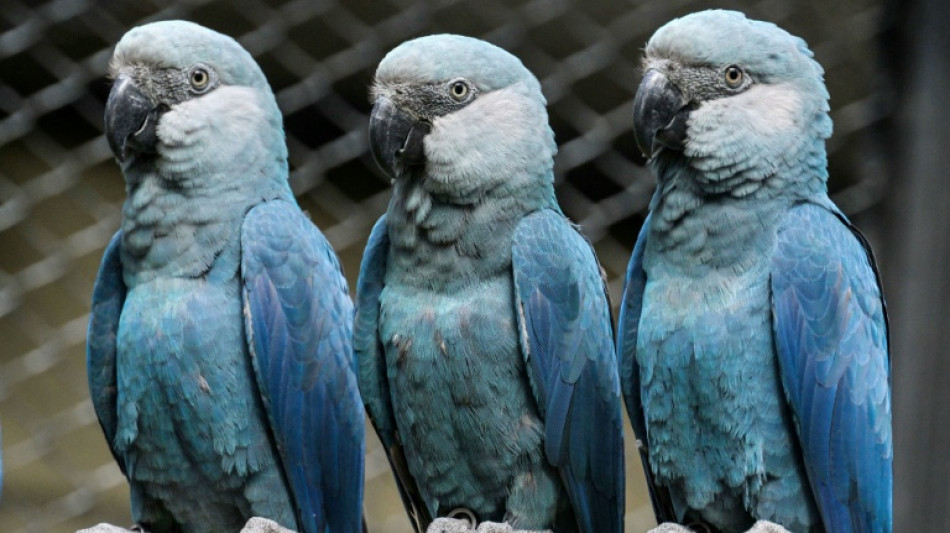
Lethal virus hits last rare blue macaws in Brazil wild / Photo: Nelson ALMEIDA - AFP

 Toulouse edge Vannes, Lyon beat Pau to take Top 14 summit

 Germans arrested for Louvre stunt in Mona Lisa hall

 Saudi-led coalition says Houthis fired ballistic missile at Riyadh

 France's debt climbs to highest since 1978: ministry

 McIlroy two shots off the lead at Wentworth after eagle on 18

 Martinez brace saves Inter in Serie A top-two clash with Roma

 Rosenior abused but guides Paris FC past old club Strasbourg

 Seven-try Lyon beat Pau, climb to Top 14 summit

 Brighton defeat a 'big lesson' against complacency for Arsenal, says Arteta

 Thousands protest inaction over climate crisis in Switzerland

 Carapaz out of cycling world championships

 'Fragile' Tottenham beaten by Aston Villa despite late rally

 Mourinho hails Real Madrid grit before Atletico derby clash

 Martin wins Austrian MotoGP sprint after Acosta crash

 Japan edge Fiji to win Pacific Nations Cup

 Black smoke, flames rising near Riyadh airport: residents to AFP

 UK actor Naomi Watts honoured at Spain film festival

 Japan emperor declares Asian Games open after turbulent build-up

 Asian Games open with unity message after troubled build-up

 Denmark hails 'binding' Greenland deal with Trump

 We don't want Games host Japan losing money, says Asian Olympic official

 Ed Sheeran returns to stage after Palestinian controversy

 Asian Games to open in Japan after troubled build-up

 Drone owners rush to offload devices ahead of Beijing ban

 Trump's beef policies irk Texas ranchers, testing their loyalty

The only wild specimens of a rare blue parrot which had only recently been returned to its natural habitat in Brazil have been diagnosed with a lethal, incurable virus, the government said in a statement sent to AFP Thursday.
The disease strikes a major blow to a program seeking to return the Spix's macaw -- featured in the 2011 animated film "Rio" -- to its semi-arid natural habitat in northeast Brazil, 25 years after they were declared extinct in the wild.
The species is one of the world's rarest birds.
Brazil's conservation agency, ICMBio, told AFP that since a group of Spix's macaws arrived in the country from Germany in 2020, around 20 had been freed and only 11 had survived.
Now all of the survivors have tested positive for circovirus, which causes beak and feather disease in parrots.
"The disease has no cure and kills the bird in most cases," ICMbio said in a statement.
Another 21 birds still in captivity at a breeding centre in the state of Bahia also tested positive.
Investigations are underway to determine the origin of the virus, which poses no danger to humans.
The film "Rio" is about a Spix macaw that is raised in captivity in the United States and returns to Brazil to try save its species.
Real-life efforts to save the parrot are more worthy of a high-stakes drama, marked by concerns over unscrupulous breeders and sales to private collectors.
The Bluesky breeding center is a partner of the German Association for the Conservation of Threatened Parrots (ACTP), which holds 75 percent of the world's registered Spix's macaws, according to ICMBio.
Brazil terminated its partnership with ATCP in 2024 after the German organization sold 26 of the birds to a private zoo in India without its consent.
Brazil has repeatedly raised concerns at meetings of CITES, the global wildlife trade regulator, over loopholes that allow for the sale of captive-bred Spix's macaws and fuel demand for the fragile species.
Aside from habitat loss, demand from private collectors drove the extinction of the bird in the wild.
ICMBio has fined the BlueSky breeding centre 1.8 million reais ($336,000) for failing to implement biosafety protocols to curb the spread of the virus.
Inspectors found "extremely dirty" bird feeders encrusted with faeces, while workers were handling the birds "wearing flip-flops, shorts and t-shirts."
A.Moore--AT



