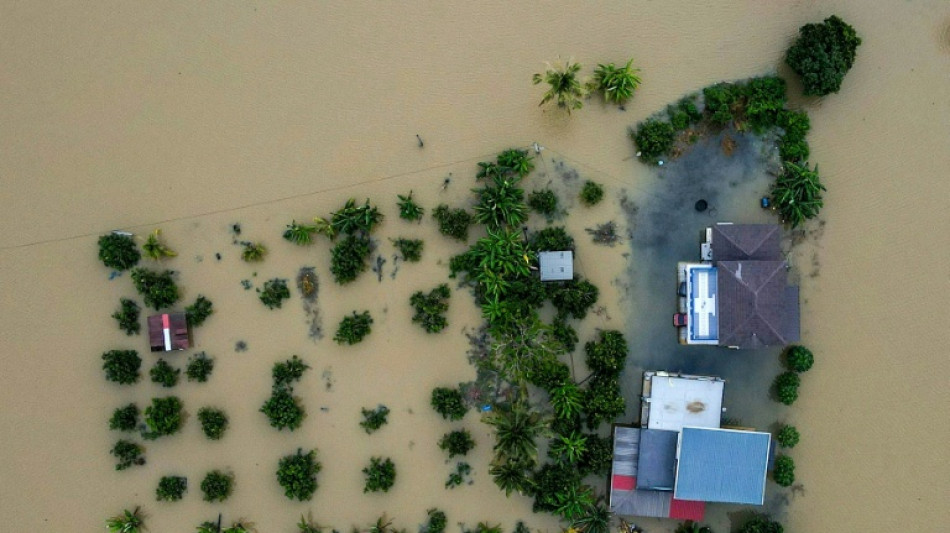
'Truly severe' floods overwhelm Southeast Asia / Photo: Mohd RASFAN - AFP

 Toulouse edge Vannes, Lyon beat Pau to take Top 14 summit

 Germans arrested for Louvre stunt in Mona Lisa hall

 Saudi-led coalition says Houthis fired ballistic missile at Riyadh

 France's debt climbs to highest since 1978: ministry

 McIlroy two shots off the lead at Wentworth after eagle on 18

 Martinez brace saves Inter in Serie A top-two clash with Roma

 Rosenior abused but guides Paris FC past old club Strasbourg
 Seven-try Lyon beat Pau, climb to Top 14 summit

 Brighton defeat a 'big lesson' against complacency for Arsenal, says Arteta

 Thousands protest inaction over climate crisis in Switzerland

 Carapaz out of cycling world championships

 'Fragile' Tottenham beaten by Aston Villa despite late rally

 Mourinho hails Real Madrid grit before Atletico derby clash

 Martin wins Austrian MotoGP sprint after Acosta crash

 Japan edge Fiji to win Pacific Nations Cup

 Black smoke, flames rising near Riyadh airport: residents to AFP

 UK actor Naomi Watts honoured at Spain film festival
 Japan emperor declares Asian Games open after turbulent build-up

 Asian Games open with unity message after troubled build-up
 Denmark hails 'binding' Greenland deal with Trump

 We don't want Games host Japan losing money, says Asian Olympic official

 Ed Sheeran returns to stage after Palestinian controversy

 Asian Games to open in Japan after troubled build-up
 Drone owners rush to offload devices ahead of Beijing ban

 Trump's beef policies irk Texas ranchers, testing their loyalty

Authorities across Indonesia, Thailand and Malaysia worked on Thursday to reach residents trapped in floods that have killed dozens of people across the region in recent days.
The toll from floods and landslides rose to 19 in Indonesia's North Sumatra, which has been battered by heavy rain for days, with dozens still missing.
Road access to some areas has been cut off by debris, with communications and electricity down too, national search and rescue agency official Emy Freezer told AFP.
Heavy rain in Aceh has also forced the evacuation of thousands of people.
"This flood is truly severe," said 47-year-old Ibnu Sina, whose home in Aceh's second city Lhokseumawe was inundated.
The region's main highway was now impassable, he told AFP, leaving the region "completely paralysed".
"The regional (governments) are overwhelmed," he said.
The same weather system has caused enormous flooding in southern Thailand, particularly in Hat Yai, near the border with Malaysia.
Entire districts were submerged by flooding that pushed desperate residents onto rooftops.
Authorities said on Wednesday that 33 people had been killed across seven southern provinces.
Floodwaters began to recede in Hat Yai on Thursday but Kamban Wongpanya, 67, said she was not able to return home yet.
"The water rose to the ceiling of the second floor," she told AFP, explaining that she had to be rescued by boat.
"The water inside my house has dropped by half, but there are still strong-flowing floodwaters on the road to my house. I can't return home yet."
Many residents lost homes and livelihoods in the floods, which began last week in Thailand.
The region is experiencing its annual monsoon season, but scientists have shown that climate change produces more intense bouts of rain because a warmer atmosphere holds more moisture.
Warmer oceans also fuel more intense and wetter storm systems.
- 'Waist-deep' -
Hat Yai shop owner Chayaphol Promkleng thought at first that his business would be spared because initial flooding was "only ankle-deep".
He returned the following day to find his shop "flooded to waist-deep level".
"There was nothing I could do. I left the shop to save my life."
Thailand's government announced a compensation package this week for affected families of around $280 per household.
But Chayaphol said he lost everything.
"I have to start from zero."
Across the border, Malaysia's Civil Defence forces used boats to evacuate elderly or frail residents trapped in homes in the town of Kangar in Perlis state.
Two people have been killed in flooding in Malaysia so far, with authorities warning more heavy rain was expected in coming days.
Ali Mat Isa told AFP he carried his bedridden wife up the stairs on Wednesday night as floodwaters rushed into their home.
"I couldn't move to the flood relief centre because of my wife's condition," he said as he was helped into a boat in waist-high, murky brown floodwaters.
"It rose fast. I only managed to move the electrical items. Everything else, I left behind."
The frequency of flooding has increased in northern Malaysia in recent years, with urbanisation, poor drainage systems and deforestation among the contributing factors, said Renard Siew, climate change adviser to the Kuala Lumpur-based Centre for Governance and Political Studies.
"So, in some ways, we are anticipating that things are only going to get worse from here on," he told AFP.
burs-sah/sco/pbt
H.Gonzales--AT



