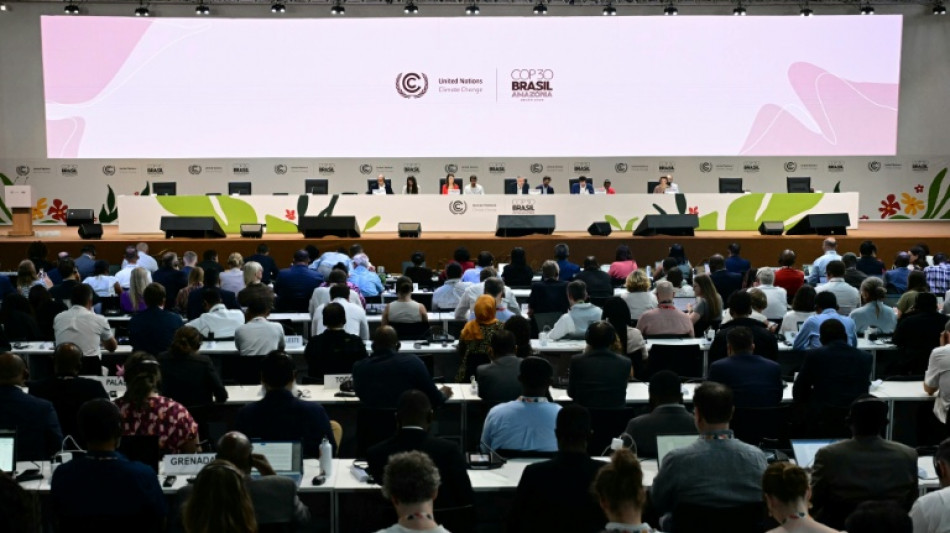
UN climate summit nears end as EU accepts watered-down deal / Photo: Pablo PORCIUNCULA - AFP/File

 Toulouse edge Vannes, Lyon beat Pau to take Top 14 summit

 Germans arrested for Louvre stunt in Mona Lisa hall

 Saudi-led coalition says Houthis fired ballistic missile at Riyadh

 France's debt climbs to highest since 1978: ministry

 McIlroy two shots off the lead at Wentworth after eagle on 18

 Martinez brace saves Inter in Serie A top-two clash with Roma

 Rosenior abused but guides Paris FC past old club Strasbourg

 Seven-try Lyon beat Pau, climb to Top 14 summit

 Brighton defeat a 'big lesson' against complacency for Arsenal, says Arteta

 Thousands protest inaction over climate crisis in Switzerland

 Carapaz out of cycling world championships

 'Fragile' Tottenham beaten by Aston Villa despite late rally

 Mourinho hails Real Madrid grit before Atletico derby clash

 Martin wins Austrian MotoGP sprint after Acosta crash

 Japan edge Fiji to win Pacific Nations Cup

 Black smoke, flames rising near Riyadh airport: residents to AFP

 UK actor Naomi Watts honoured at Spain film festival

 Japan emperor declares Asian Games open after turbulent build-up

 Asian Games open with unity message after troubled build-up

 Denmark hails 'binding' Greenland deal with Trump

 We don't want Games host Japan losing money, says Asian Olympic official

 Ed Sheeran returns to stage after Palestinian controversy

 Asian Games to open in Japan after troubled build-up

 Drone owners rush to offload devices ahead of Beijing ban

 Trump's beef policies irk Texas ranchers, testing their loyalty

Nations neared a deal at the UN climate summit Saturday after the EU accepted a text with only an implicit nod to phasing out fossil fuels following fraught negotiations with oil producers and emerging countries.
Nearly 200 nations had been holding talks for two weeks in the Brazilian Amazon city of Belem, with sleepless nights in the final days to produce a text that needs to pass by consensus.
The European Union and other nations had pushed for a deal that would call for a "roadmap" to phase out fossil fuels but the words do not appear in the text.
Instead, the draft calls on countries to "voluntarily" accelerate their climate action and recalls the consensus reached at COP28 in Dubai. That 2023 deal called for the world to transition away from fossil fuels.
The EU, which had warned that the summit could end without a deal if fossil fuels were not addressed, accepted the watered-down language.
"We're not going to hide the fact that we would have preferred to have more, to have more ambition on everything," EU climate commissioner Wopke Hoekstra told reporters.
"We should support it because it is at least going in the right direction," said Hoekstra.
More than 30 countries including European nations, emerging economies and small island states had signed a letter warning Brazil they would reject any deal without a plan to move away from oil, gas and coal.
But a member of an EU delegation told AFP that the 27-nation bloc was "isolated" and cast as the "villains" at the talks.
The push to phase out oil, coal and gas -- the main drivers of global warming -- grew out of frustration over a lack of follow-through on the COP28 agreement to transition away from fossil fuels.
French ecological transition minister Monique Barbut had accused oil-rich Saudi Arabia and Russia, along with coal producer India and "many" other emerging countries, of refusing language on a fossil-fuel phaseout.
She said Saturday the text was bland but that there was "nothing extraordinarily bad in it."
The draft deal caps a chaotic two weeks in Belem, with Indigenous protesters breaching the venue and blocking its entrance last week and a fire erupting inside the compound on Thursday, forcing a mass evacuation.
- Money and trade -
Finishing without a deal would be a black eye for Brazilian President Luiz Inacio Lula da Silva, who had staked political capital in the success of what he called the "COP of truth."
It was also a major test for international cooperation when US President Donald Trump decided to shun COP30.
"We also have to weigh the backdrop of geopolitics, and in the end there is no other process we have," German environment state secretary Jochen Flasbarth told AFP.
Developing nations, for their part, had pushed the EU and other developed economies to pledge more money to help them adapt to the impact of climate change, such as floods and droughts, and move toward a low-carbon future.
The EU had resisted such appeals but the draft deal calls for efforts to "at least triple" adaptation finance by 2035.
"Intergovernmental negotiations work on a minimum common denominator, but our fight will continue," a negotiator from Bangladesh told AFP in a muted reception of the terms.
The EU had also rejected language on trade in the text, as demanded by China and other emerging countries. Trade appears in the final draft.
O.Ortiz--AT



