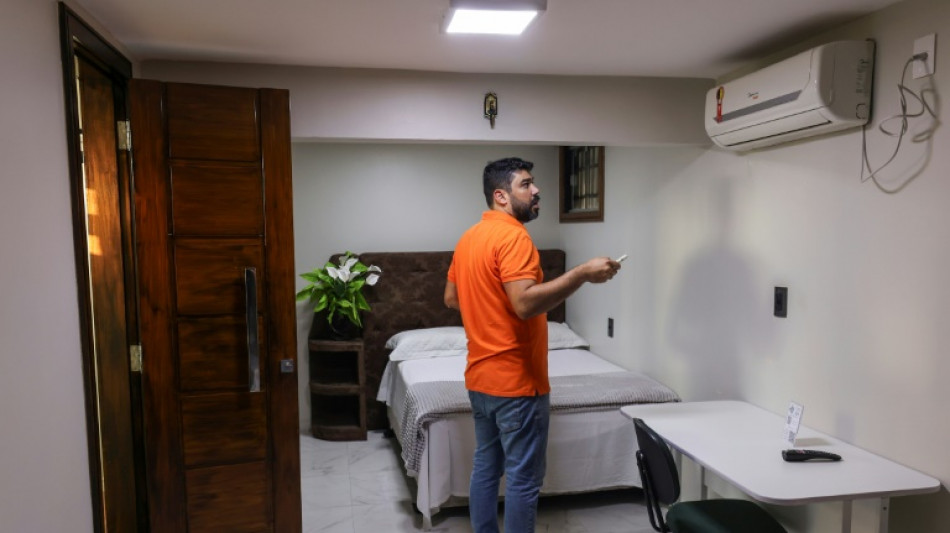
Demand for air con set to triple by 2050, warns UN / Photo: Anderson Coelho - AFP

 Ed Sheeran set to return to stage after Palestinian controversy

 Toulouse edge Vannes, Lyon beat Pau to take Top 14 summit

 Germans arrested for Louvre stunt in Mona Lisa hall

 Saudi-led coalition says Houthis fired ballistic missile at Riyadh

 France's debt climbs to highest since 1978: ministry

 McIlroy two shots off the lead at Wentworth after eagle on 18

 Martinez brace saves Inter in Serie A top-two clash with Roma

 Rosenior abused but guides Paris FC past old club Strasbourg

 Seven-try Lyon beat Pau, climb to Top 14 summit

 Brighton defeat a 'big lesson' against complacency for Arsenal, says Arteta

 Thousands protest inaction over climate crisis in Switzerland

 Carapaz out of cycling world championships

 'Fragile' Tottenham beaten by Aston Villa despite late rally

 Mourinho hails Real Madrid grit before Atletico derby clash

 Martin wins Austrian MotoGP sprint after Acosta crash

 Japan edge Fiji to win Pacific Nations Cup

 Black smoke, flames rising near Riyadh airport: residents to AFP

 UK actor Naomi Watts honoured at Spain film festival

 Japan emperor declares Asian Games open after turbulent build-up

 Asian Games open with unity message after troubled build-up

 Denmark hails 'binding' Greenland deal with Trump

 We don't want Games host Japan losing money, says Asian Olympic official

 Ed Sheeran returns to stage after Palestinian controversy

 Asian Games to open in Japan after troubled build-up

 Drone owners rush to offload devices ahead of Beijing ban

Global demand for air conditioning could more than triple by 2050, the United Nations warned on Tuesday, calling for more sustainable cooling solutions.
The UN Environment Programme said demand could surge due to increases in population and wealth around the world, combined with more extreme heat.
Rising demand for more polluting and inefficient cooling systems "would almost double cooling-related greenhouse gas emissions over 2022 levels", said UNEP.
UNEP launched its Global Cooling Watch 2025 report on the sidelines of the COP30 UN climate summit in Belem in the Brazilian Amazon.
"Installed cooling capacity is on a trajectory to triple by 2050... Yet billions will still lack adequate protection from heat. We must reimagine cooling -- not as a source of emissions, but as a cornerstone of heat resilience and sustainable development," it said.
The most rapid growth in cooling demand is projected in Africa and South Asia.
"As deadly heat waves become more regular and extreme, access to cooling must be treated as essential infrastructure alongside water, energy and sanitation," UNEP chief Inger Andersen said in a statement.
"But we cannot air condition our way out of the heat crisis, which would drive greenhouse gas emissions higher and raise costs."
UNEP highlighted so-called "passive cooling" options, including better wall and roof designs, shading, solar off-grid solutions and ventilation.
The potential impact on indoor temperatures from passive cooling strategies range from 0.5 to 8 degrees Celsius.
"Passive, energy efficient and nature-based solutions can help meet our growing cooling needs and keep people, food-chains and economies safe from heat as we pursue global climate goals," said Andersen.
The Cooling Report suggested adopting such measures could reduce emissions to 64 percent below the levels otherwise expected in 2050.
O.Ortiz--AT



