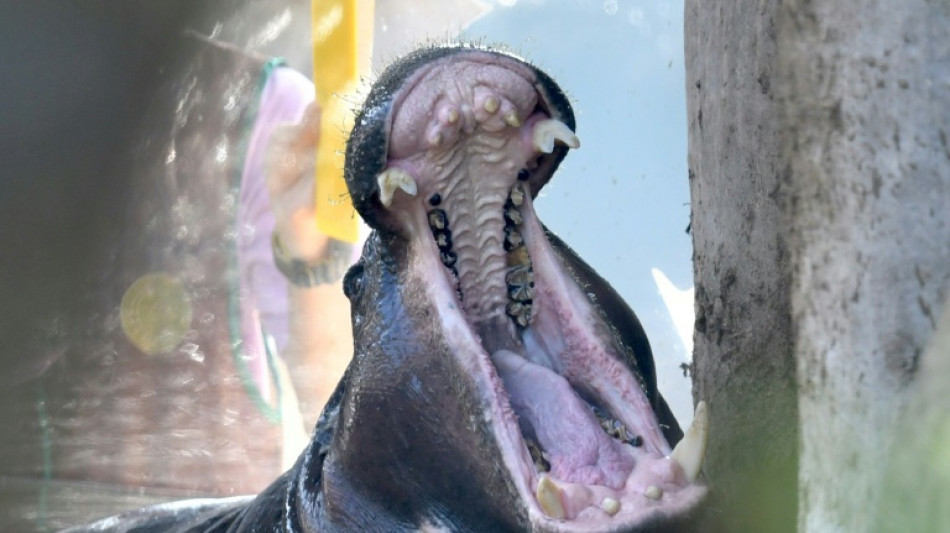
Hippos and humans learning to live in peace in DR Congo

 Martin wins Austrian MotoGP sprint after Acosta crash

 Japan edge Fiji to win Pacific Nations Cup

 Black smoke, flames rising near Riyadh airport: residents to AFP

 UK actor Naomi Watts honoured at Spain film festival

 Japan emperor declares Asian Games open after turbulent build-up

 Asian Games open with unity message after troubled build-up
 Denmark hails 'binding' Greenland deal with Trump

 We don't want Games host Japan losing money, says Asian Olympic official

 Ed Sheeran returns to stage after Palestinian controversy

 Asian Games to open in Japan after troubled build-up

 Drone owners rush to offload devices ahead of Beijing ban

 Trump's beef policies irk Texas ranchers, testing their loyalty

 Kennedy Center: future unclear for iconic Washington arts hub

 Trump claims 'infinite' Greenland security deal with Denmark

 Helicopters battle wildfire threatening Ecuador's capital

 Brentford batter Chelsea to undo Alonso's promising start

 Kane hits Bundesliga century as Bayern rout Union

 Trump says CNN, MS NOW, Politico banned from White House

 Hushing and hedging: US companies retreat on climate

 Springboks to face Fiji before 2027 Rugby World Cup

 Nigeria miners struggled to breathe in cell before 37 died: survivors

 McIlroy on the charge at PGA Championship as Reed withdraws

 McIlroy on the charge at PGA Championship

 Crisis-wracked Volkswagen warns of 10-bn-euro hit to profits

 Costa Rica's Grynspan tops third informal poll for UN chief: diplomat

Just how do you calm down a rampaging hippopotamus? Or even a herd of angry hippos.
On the banks of the Ruzizi river that divides the Democratic Republic of Congo from Burundi, the villagers badly need to work it out after a spate of deaths -- human and hippo.
Despairing environmental activists arrived this week to try to help both sides to learn to live together in peace.
"In December, the hippos laid waste three hectares of fields that my neighbour had planted," said Jeannette Chandazi, at Kamanyola, in DR Congo's South-Kivu province.
Kamanyola and the neighbouring village of Katogota have seen seven people killed and six more injured by hippos since 2019, said David Wiragi, of a local civil society environmental group.
The problem, he told AFP, "is that people have encroached on the sides of the river", in areas where the giant semi-aquatic mammals habitually forage for food.
"They attack people and in turn people hunt them," Wiragi said.
The province's environment bureau chief Innocent Bayubasire added: "These areas have been transformed into fields, there are even some structures that have been built."
Officially it is illegal to occupy a 100-metre strip of land along the river banks, but the law is ignored.
"People have to be made aware that these hippopotamuses should not be treated as enemies, and understand that these places are opportunities for tourism and job creation," said Josue Aruna, president of the environmental civil society for South-Kivu.
The Ruzizi plain has not escaped the plague of armed groups that have roamed Kivu for more than 25 years sowing death and destruction -- all the more reason to develop the area and provide jobs for youngsters tempted to take up arms and target tourists.
For now, Aruna notes, there is "a mass extermination of these animals, killed by the people here as well as by soldiers, looking for hippo hides and teeth to sell".
Aruna said at least three hippos are killed every month on the Ruzizi and its outlet Lake Tanganyika.
Working with the provincial government in Bukavu, Aruna organised a "touristic" and awareness visit to the site on the occasion of World Wetlands Day on February 2.
"We've been working on this question for three years now," trying to preserve the biodiversity of the Albertine Rift, the western branch of the East African Rift valley, and ensure it can be a "refuge for giant African hippopotamuses".
Hippo observation points will be set up, and a test site is already under construction.
Ch.Campbell--AT