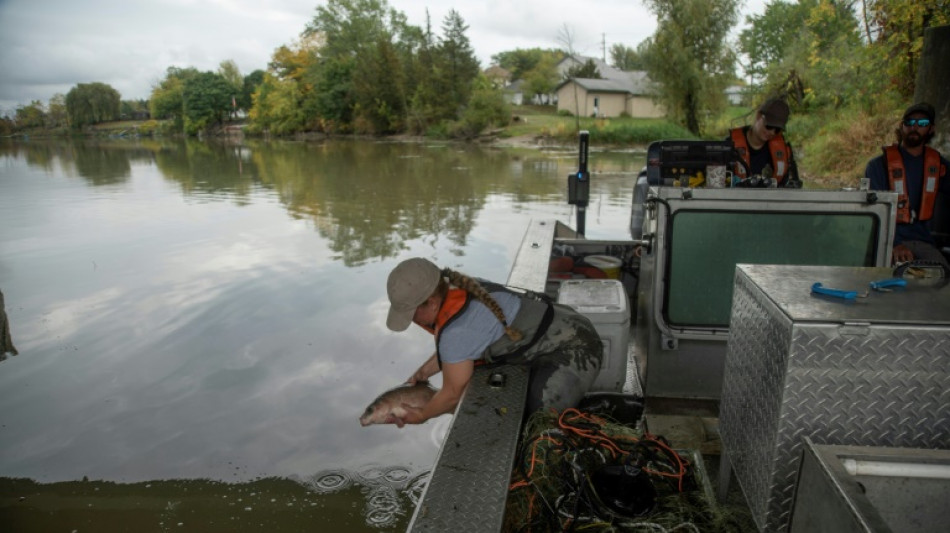
Americans, Canadians unite in battling 'eating machine' carp / Photo: Jorge Uzon - AFP

 Ed Sheeran set to return to stage after Palestinian controversy

 Toulouse edge Vannes, Lyon beat Pau to take Top 14 summit

 Germans arrested for Louvre stunt in Mona Lisa hall

 Saudi-led coalition says Houthis fired ballistic missile at Riyadh

 France's debt climbs to highest since 1978: ministry

 McIlroy two shots off the lead at Wentworth after eagle on 18
 Martinez brace saves Inter in Serie A top-two clash with Roma

 Rosenior abused but guides Paris FC past old club Strasbourg

 Seven-try Lyon beat Pau, climb to Top 14 summit

 Brighton defeat a 'big lesson' against complacency for Arsenal, says Arteta

 Thousands protest inaction over climate crisis in Switzerland

 Carapaz out of cycling world championships

 'Fragile' Tottenham beaten by Aston Villa despite late rally

 Mourinho hails Real Madrid grit before Atletico derby clash

 Martin wins Austrian MotoGP sprint after Acosta crash

 Japan edge Fiji to win Pacific Nations Cup

 Black smoke, flames rising near Riyadh airport: residents to AFP

 UK actor Naomi Watts honoured at Spain film festival

 Japan emperor declares Asian Games open after turbulent build-up

 Asian Games open with unity message after troubled build-up

 Denmark hails 'binding' Greenland deal with Trump

 We don't want Games host Japan losing money, says Asian Olympic official

 Ed Sheeran returns to stage after Palestinian controversy

 Asian Games to open in Japan after troubled build-up

 Drone owners rush to offload devices ahead of Beijing ban

Finally, something to unite President Donald Trump, his Democratic opponents and the Canadians he's threatening to annex: a ferociously hungry carp.
Invasive carp, sometimes called Asian carp, were introduced in the United States in the 1970s. And they've never stopped spreading -- and eating everything in their path -- since.
"They're eating machines," said Trisiah Tugade, an aquatic biologist with Canada's Invasive Carp Program, as she and her team glided along the Grand River -- a Lake Erie tributary -- looking for fish that specialists fear will devastate the Great Lakes.
Because they can eat up 40 percent of their bodyweight daily, invasive carps were initially seen as a tool to control nuisance algae in confined areas, like aquaculture ponds.
But they escaped, likely during floods, and made their way north, including through the Illinois River. That has raised the specter of the devastating eater establishing itself in the Great Lakes, the world's largest freshwater system by surface area.
"There is nothing that I have seen that scares ecologists more than looking at what the impacts would potentially be if the species of Asian carp that are in the Illinois River get into the Great Lakes and form a breeding population," University of Michigan Great Lakes water policy expert Mike Shriberg told AFP.
It's a threat that has got the attention of Trump, who calls the fish "a threat" and specialists on both sides of the border.
- Shock treatment -
Each year, Canadian experts search for carp in Great Lakes tributaries considered favorable for spawning and feeding -- often grassy areas with warmer, shallow water.
In the Grand River, Tugade and senior biologist Alex Price oversaw an electrofishing mission.
The team lowered two roads into the water that released non-lethal pulsating charges, stunning the fish and allowing them to be brought with nets into a tank onboard.
Fish were identified, measured and -- if not deemed invasive -- released into the muddy water.
Since the program's launch in 2012, only a few dozen invasive carp have been captured in Canadian waters.
James Hall, whose Hall'emin Sport Fishing business takes clients out on Lake Erie, told AFP he was one of the first to catch one.
"I was wondering what it was, but I knew it was something different," he said, describing the moment he pulled a carp out of the water a decade ago.
Hall said he put the fish on ice and called government's carp hotline.
Invasive carp "have been very rare to catch, which is great," said Price, while insisting vigilance was essential given the gravity of the threat.
"They can breed multiple times a year and produce hundreds of thousands of eggs in a single event," he told AFP.
"Within the first year of life, they can be too big for our natural predators to eat," he added.
- Blown apart? -
Shriberg described the Great Lakes as "the great uniters" across US political parties and between Canada and the United States.
Defending them against invasive species has been a bipartisan priority in states on their shores, several of which have historically been US electoral swing states -- like Michigan, Ohio, Pennsylvania and Wisconsin -- he said.
Trump's May White House memo confirming his support for efforts against "the economic and ecological threat of invasive carp," drew cross-party praise.
"We're in the most politically contentious times that I've seen in my lifetime," Shriberg said, calling Trump's "quiet" memo an affirmation of the rare bipartisan nature of Great Lakes policy.
But that path forward is uncertain.
Trump's trade war and annexation threats have strained US-Canada relations. Earlier this year the president reportedly told former prime minister Justin Trudeau that he wanted to revise treaties governing the Great Lakes.
Shriberg noted cooperative management of the waterway has defined US-Canada relations, but said "the Trump administration's hostility towards Canada ... threatens to blow that apart."
If the battle against invasive carp were to fail, the consequences would be both dire and unpredictable, he added.
"It would cause dramatic changes in the ecological balance of the water," Shriberg said.
And if they ever became established in the Great Lakes, "I don't believe that you'd have any chance of actually eliminating the population," he said.
D.Lopez--AT



