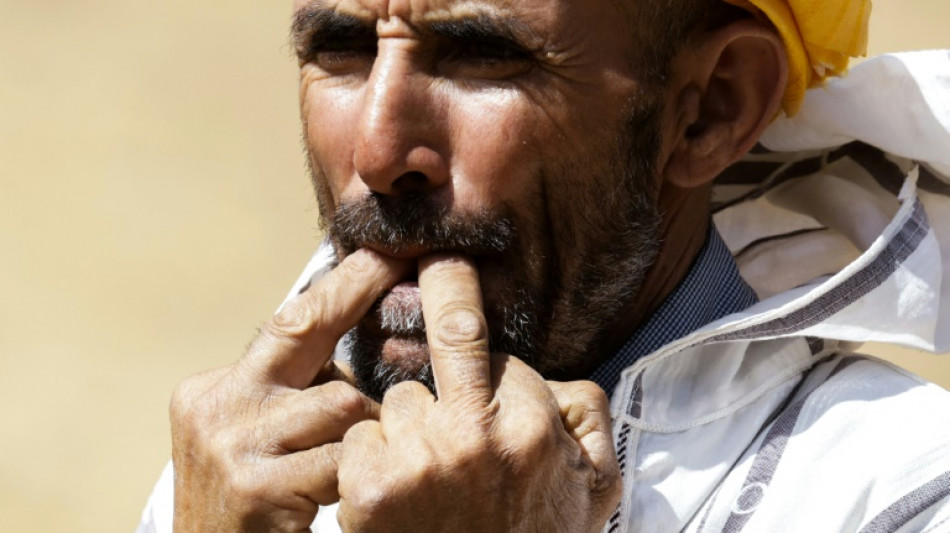
Morocco High Atlas whistle language strives for survival / Photo: Abdel Majid BZIOUAT - AFP

 Singer Ed Sheeran says Gaza situation 'unjustifiable' following controversy

 In 'Tenzing', a Sherpa mountaineer gets his due

 Ed Sheeran set to return to stage after Palestinian controversy

 Toulouse edge Vannes, Lyon beat Pau to take Top 14 summit

 Germans arrested for Louvre stunt in Mona Lisa hall

 Saudi-led coalition says Houthis fired ballistic missile at Riyadh

 France's debt climbs to highest since 1978: ministry

 McIlroy two shots off the lead at Wentworth after eagle on 18

 Martinez brace saves Inter in Serie A top-two clash with Roma

 Rosenior abused but guides Paris FC past old club Strasbourg
 Seven-try Lyon beat Pau, climb to Top 14 summit

 Brighton defeat a 'big lesson' against complacency for Arsenal, says Arteta

 Thousands protest inaction over climate crisis in Switzerland

 Carapaz out of cycling world championships

 'Fragile' Tottenham beaten by Aston Villa despite late rally

 Mourinho hails Real Madrid grit before Atletico derby clash

 Martin wins Austrian MotoGP sprint after Acosta crash

 Japan edge Fiji to win Pacific Nations Cup

 Black smoke, flames rising near Riyadh airport: residents to AFP

 UK actor Naomi Watts honoured at Spain film festival
 Japan emperor declares Asian Games open after turbulent build-up

 Asian Games open with unity message after troubled build-up
 Denmark hails 'binding' Greenland deal with Trump

 We don't want Games host Japan losing money, says Asian Olympic official

 Ed Sheeran returns to stage after Palestinian controversy

In Morocco's High Atlas mountains, shepherds Hammou Amraoui and his son hardly need words to speak. Across peaks, they whistle at each other in a centuries-old language, now jeopardised by rural flight.
"The whistle language is our telephone," joked Hammou, 59, the elder of a family known for the tradition in Imzerri, a hamlet in the remote commune of Tilouguit, about a two-hour drive from the nearest city.
In Tilouguit, Hammou said people learn it "like we learn to walk or to talk".
The Assinsg language replaces spoken words with sharp whistles that can carry for nearly three kilometres (two miles) in the mountains, according to researchers.
"The principle of the language is simple: the words are said in whistles and the key to understanding it is practice," said Hammou's 33-year-old son, Brahim.
"It makes it easier for us to communicate, especially when we're herding our livestock," he added.
Moroccan heritage researcher Fatima Zahra Salih described the whistle language as a cultural "treasure".
For five years, she has studied it to prepare a case for its recognition and protection by the UN's cultural agency UNESCO.
Whistle communication has been documented on nearly every continent, including the Spanish Canary Islands off Morocco's Atlantic coast.
"A little more than 90 languages have a whistled form, documented in scientific publications," said Julien Meyer, a linguist who specialises in the phenomenon.
In Morocco, it has so far only been documented in the Beni Mellal-Khenifra region of the central High Atlas mountain range, but Salih said she cannot rule out its existence elsewhere.
- Moving away -
Getting to Imzerri requires a climb along a dirt track winding through oak trees.
The village counts roughly 50 houses, none with running water or electricity.
Many families have moved away, threatening the survival of the whistle language.
"Our region is magnificent, but we live in isolation and difficult conditions," said Aicha Iken, 51, who learnt to whistle as a child while tending livestock. "Many of our neighbours have left."
Poverty in Azilal province, where Imzerri lies, has dropped in recent years, but was still double the national average in 2024, at 17 percent.
Yet some families are determined to hold onto their land -- and their whistling tradition.
Brahim Amraoui has made sure his 12-year-old son, Mohamed, was one of the few children in the hamlet who knows how to whistle.
"At first, it was very hard," said Mohamed, who dreams of becoming a pilot. "I could not understand everything, but after two years it's getting better."
His father said it was important to teach him the language, "even if he chooses a different profession".
"My goal is for the whistle language to be preserved," he added.
Since 2022, Brahim has led a small association dedicated to safeguarding the practice.
- Whistle language 'disappearing' -
It isn't just the villagers' migration to urban areas that has put the language at risk of vanishing.
"The whistle language is disappearing little by little because of environmental degradation," said Meyer.
Drought has gripped Morocco for seven straight years.
In November 2024, for the first time in their history, the Amraoui shepherds left their village to take their livestock on a nearly 350-kilometre journey east in search of pasture. They only came home seven months later.
"The move was painful, but we had no choice," Hammou recalled. "We had nothing left to feed our animals."
Salih said it was due to "climate change", which has "disrupted their pastoral way of life", where there used to be fixed seasonal pastures near their home they could travel between.
"For the first time, they had to practice nomadism," she said of the Amraouis.
The shepherd family has pinned its hopes on potential rainfall this fall, hoping they would not be forced to move again.
But while they wonder whether they will have to, Salih insists on the "urgent need to safeguard" the whistle language before more people leave it behind alongside rural life.
E.Flores--AT