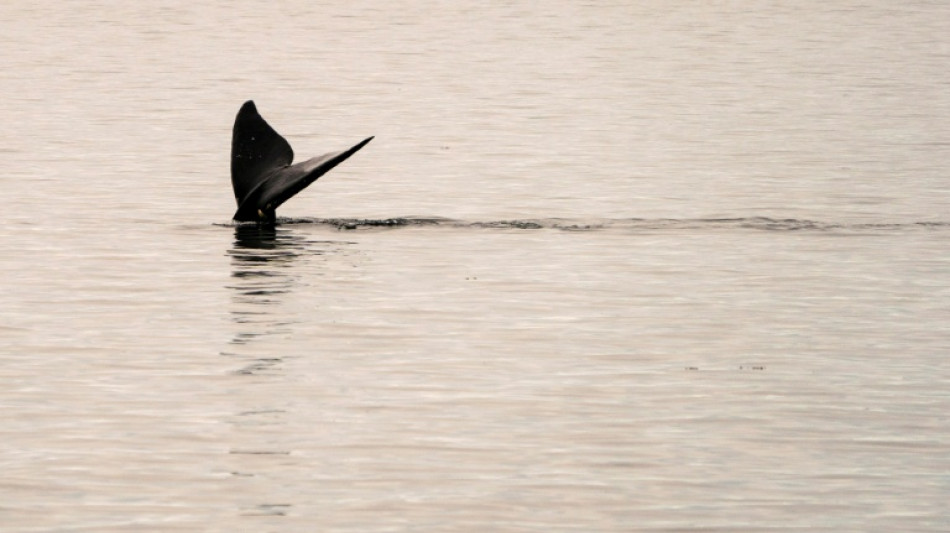
Canada wildlife decline 'most severe' in decades: WWF / Photo: Don EMMERT - AFP/File

 Singer Ed Sheeran says Gaza situation 'unjustifiable' following controversy

 In 'Tenzing', a Sherpa mountaineer gets his due

 Ed Sheeran set to return to stage after Palestinian controversy

 Toulouse edge Vannes, Lyon beat Pau to take Top 14 summit

 Germans arrested for Louvre stunt in Mona Lisa hall

 Saudi-led coalition says Houthis fired ballistic missile at Riyadh

 France's debt climbs to highest since 1978: ministry

 McIlroy two shots off the lead at Wentworth after eagle on 18

 Martinez brace saves Inter in Serie A top-two clash with Roma

 Rosenior abused but guides Paris FC past old club Strasbourg

 Seven-try Lyon beat Pau, climb to Top 14 summit

 Brighton defeat a 'big lesson' against complacency for Arsenal, says Arteta

 Thousands protest inaction over climate crisis in Switzerland

 Carapaz out of cycling world championships

 'Fragile' Tottenham beaten by Aston Villa despite late rally

 Mourinho hails Real Madrid grit before Atletico derby clash

 Martin wins Austrian MotoGP sprint after Acosta crash

 Japan edge Fiji to win Pacific Nations Cup

 Black smoke, flames rising near Riyadh airport: residents to AFP

 UK actor Naomi Watts honoured at Spain film festival

 Japan emperor declares Asian Games open after turbulent build-up

 Asian Games open with unity message after troubled build-up
 Denmark hails 'binding' Greenland deal with Trump

 We don't want Games host Japan losing money, says Asian Olympic official

 Ed Sheeran returns to stage after Palestinian controversy

Biodiversity in Canada has plunged 10 percent over the last half century, with hundreds of species facing extinction, the World Wildlife Fund (WWF) said in a report Monday.
"On average, every species group included — birds, fish, mammals, and reptiles and amphibians — is trending in the wrong direction," the WWF said in a statement as it released the 2025 Living Planet report for Canada.
While certain populations, like sea otters, are improving, the conservation group said 52 percent of all species studied for this year's Canada report are declining, including the rare snow owl.
"This is the most severe decline we've observed since reporting started," WWF Vice President for Canada, James Snider, wrote.
WWF said that between 1970 and 2022, biodiversity in Canada had decreased by 10 percent.
Species globally assessed as at-risk of extinction in Canada, such as the North Atlantic right whale and leatherback sea turtle, declined by 43 percent, according to the report.
Regions such as the boreal forest with lower levels of human presence saw smaller decreases, while habitats in Canada's grasslands declined 62 percent.
Last year, WWF reported a global wildlife population decline of 73 percent since 1970.
Conservation expert Jessica Curie, who worked on the report, told AFP that habitat reduction -- largely because of agricultural expansion -- "is one of the main drivers of biodiversity loss."
The report notes Canada's economic reliance on its vast natural resources, but says conservation needs to be front-of-mind in management of industrial or infrastructure projects.
One successful example she pointed to was projects reducing shipping noise to protect whale populations off Canada's west coast.
WWF noted that actions to reverse population loss were already laid out in Global Biodiversity Framework (GBF) agreement signed in 2022 at COP 15 in Montreal.
Canada aims to meet those targets by protecting 30 percent of its lands and oceans and restoring 30 percent of degraded lands by 2030.
W.Nelson--AT



