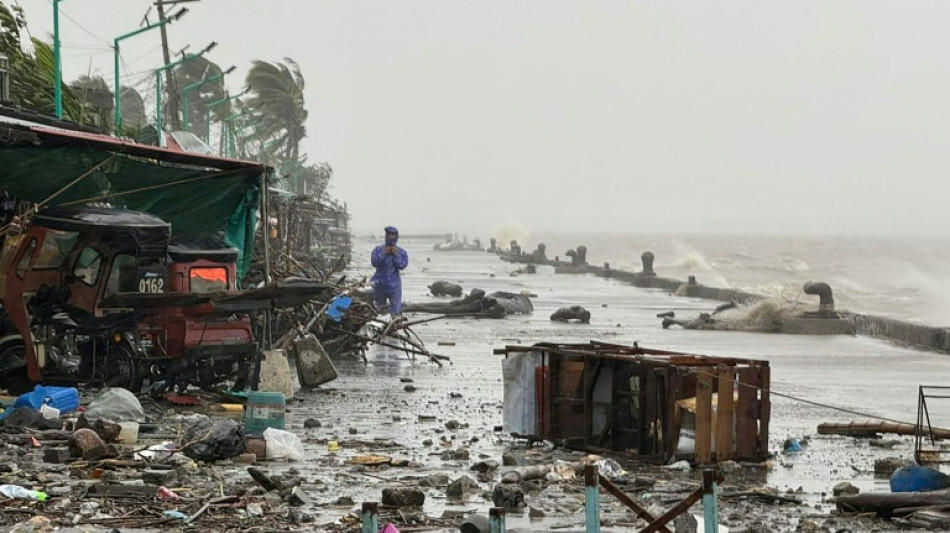
China prepares to evacuate 400,000 as super typhoon makes landfall in Philippines / Photo: John Dimain - AFP

 Singer Ed Sheeran says Gaza situation 'unjustifiable' following controversy

 In 'Tenzing', a Sherpa mountaineer gets his due

 Ed Sheeran set to return to stage after Palestinian controversy

 Toulouse edge Vannes, Lyon beat Pau to take Top 14 summit

 Germans arrested for Louvre stunt in Mona Lisa hall

 Saudi-led coalition says Houthis fired ballistic missile at Riyadh

 France's debt climbs to highest since 1978: ministry

 McIlroy two shots off the lead at Wentworth after eagle on 18

 Martinez brace saves Inter in Serie A top-two clash with Roma

 Rosenior abused but guides Paris FC past old club Strasbourg

 Seven-try Lyon beat Pau, climb to Top 14 summit

 Brighton defeat a 'big lesson' against complacency for Arsenal, says Arteta

 Thousands protest inaction over climate crisis in Switzerland

 Carapaz out of cycling world championships

 'Fragile' Tottenham beaten by Aston Villa despite late rally

 Mourinho hails Real Madrid grit before Atletico derby clash

 Martin wins Austrian MotoGP sprint after Acosta crash

 Japan edge Fiji to win Pacific Nations Cup

 Black smoke, flames rising near Riyadh airport: residents to AFP

 UK actor Naomi Watts honoured at Spain film festival
 Japan emperor declares Asian Games open after turbulent build-up

 Asian Games open with unity message after troubled build-up
 Denmark hails 'binding' Greenland deal with Trump

 We don't want Games host Japan losing money, says Asian Olympic official

 Ed Sheeran returns to stage after Palestinian controversy

The Chinese city of Shenzhen began preparing to evacuate 400,000 people while residents of the northern Philippines sought shelter from gale-force winds Monday as Super Typhoon Ragasa continued on a collision course with southern China.
The typhoon made landfall on the Philippines' Calayan Island, part of the sparsely populated Babuyan chain, at 3 pm (0700 GMT), according to the Philippine weather service.
As of 2 pm (0600 GMT), maximum sustained winds of 215 kilometres per hour were reported at the storm's center, with gusts reaching as high as 295 kph, the national weather service said.
"I woke up because of the strong wind. It was hitting the windows, and it sounded like a machine that was switched on," said Tirso Tugagao, a resident of Aparri, a coastal town in northern Cagayan province.
Cagayan disaster chief Rueli Rapsing told AFP his team was prepared for "the worst".
Just over 10,000 Filipinos were evacuated across the country, with schools and government offices closed Monday in the Manila region and across 29 other provinces.
A much larger operation will take place in China's Shenzhen, where authorities said late Sunday they planned to move hundreds of thousands of people from coastal and low-lying regions.
Multiple other cities in Guangdong province announced classes and work would be cancelled, and public transportation suspended because of the typhoon.
Hong Kong-based Cathay Pacific said it expected to cancel more than 500 flights as Ragasa threatened the financial hub.
A spokeswoman for the airline said passenger flights in and out of Hong Kong International Airport would be halted from 6 pm Tuesday, "resuming during daytime hours on Thursday".
- 'Extremely torrential' -
In Taiwan, the state weather service predicted a chance of "extremely torrential rain" in the country's east.
"Its storm radius is quite large, about 320 (kilometres). Although the typhoon's centre is still some distance away, its wide, strong wind field and outer circulation are already affecting parts of Taiwan."
James Wu, a local fire department officer, told AFP that evacuations were ongoing in mountainous areas near Pingtung.
"What worries us more is that the damage could be similar to what happened during Typhoon Koinu two years ago," he added, describing a storm that saw utility poles collapse and sheet-metal roofs sent flying into the air.
Philippine government weather specialist John Grender Almario said Sunday that "severe flooding and landslides" could be expected in the northern areas of the main island Luzon.
The threat of flooding from Ragasa comes just a day after thousands of Filipinos took to the streets to protest a growing corruption scandal involving flood control projects that were shabbily constructed or never completed.
The Philippines is the first major landmass facing the Pacific cyclone belt, and the archipelago is hit by an average of 20 storms and typhoons each year, putting millions of people in disaster-prone areas in a state of constant poverty.
Scientists warn that storms are becoming more powerful as the world warms due to the effects of human-driven climate change.
H.Thompson--AT



