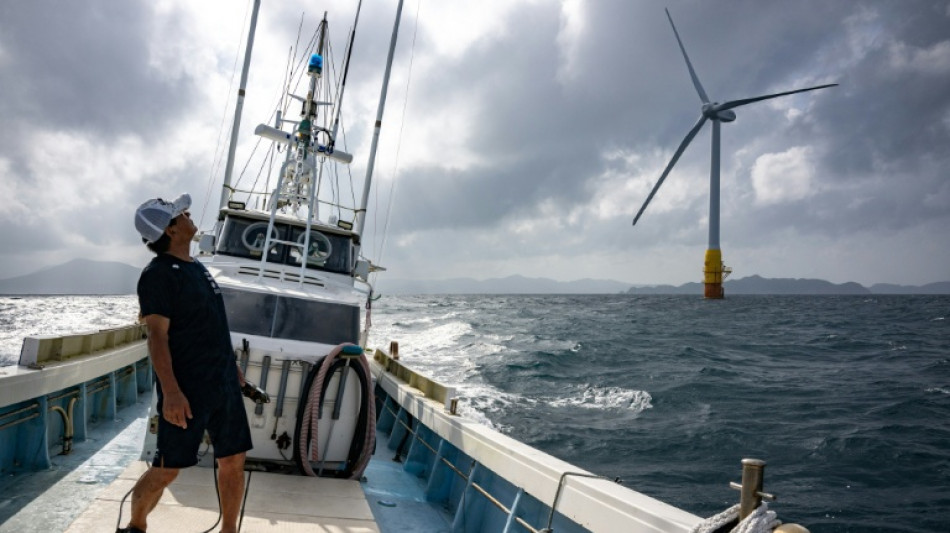
Floating wind power sets sail in Japan's energy shift / Photo: Philip FONG - AFP

 Singer Ed Sheeran says Gaza situation 'unjustifiable' following controversy

 In 'Tenzing', a Sherpa mountaineer gets his due

 Ed Sheeran set to return to stage after Palestinian controversy

 Toulouse edge Vannes, Lyon beat Pau to take Top 14 summit

 Germans arrested for Louvre stunt in Mona Lisa hall

 Saudi-led coalition says Houthis fired ballistic missile at Riyadh

 France's debt climbs to highest since 1978: ministry

 McIlroy two shots off the lead at Wentworth after eagle on 18

 Martinez brace saves Inter in Serie A top-two clash with Roma

 Rosenior abused but guides Paris FC past old club Strasbourg

 Seven-try Lyon beat Pau, climb to Top 14 summit

 Brighton defeat a 'big lesson' against complacency for Arsenal, says Arteta

 Thousands protest inaction over climate crisis in Switzerland

 Carapaz out of cycling world championships

 'Fragile' Tottenham beaten by Aston Villa despite late rally

 Mourinho hails Real Madrid grit before Atletico derby clash

 Martin wins Austrian MotoGP sprint after Acosta crash

 Japan edge Fiji to win Pacific Nations Cup

 Black smoke, flames rising near Riyadh airport: residents to AFP

 UK actor Naomi Watts honoured at Spain film festival

 Japan emperor declares Asian Games open after turbulent build-up

 Asian Games open with unity message after troubled build-up

 Denmark hails 'binding' Greenland deal with Trump

 We don't want Games host Japan losing money, says Asian Olympic official

 Ed Sheeran returns to stage after Palestinian controversy

Close to a small fishing port in southwestern Japan, the slim white turbines of the country's first commercial-scale floating wind farm glimmer offshore, months before a key project in Tokyo's green-energy strategy begins.
Still heavily reliant on imported fossil fuels, Japan has declared offshore wind energy a "trump card" in its drive to make renewables its top power source by 2040, and reach carbon neutrality a decade later.
That's despite rising project costs and fears over inadequate infrastructure to produce turbines en masse.
Floating turbines are particularly well suited to Japan as its deep coastal waters make fixing them to seabeds tricky, while the country is also prone to natural disasters.
"Floating structures are relatively stable even in the case of earthquakes or typhoons," said Kei Ushigami, head of marine renewable energy for construction company Toda, a key player in the project.
The eight turbines -- sitting five kilometres (three miles) off the coast of the Goto Islands in waters up to 140 metres deep -- will officially start turning in January.
It's hoped they'll aid the archipelago in reaching ambitious new targets laid out this year that should see wind's contribution to the energy mix soar to between four and eight percent by 2040 -- up from around one percent today.
But it's a long, hard road ahead for resource-scarce Japan -- the world's fifth-largest carbon dioxide emitter -- to wean itself off fossil fuels.
In 2024, 65 percent of its electricity needs were met by coal and hydrocarbon-powered thermal plants, while just over a quarter came from renewables, according to Japan's Institute for Sustainable Energy Policies.
- Herculean task -
Costs are also rising sharply, and at the end of August Japanese conglomerate Mitsubishi pulled out of three key wind power projects deemed no longer profitable.
Other project operators have asked for better support from the government.
"It is important for the government to address shortcomings in the current bidding system, which failed to anticipate rapid global inflation after bids were awarded," said Yoko Mulholland from the think tank E3G.
The streamlining of regulatory processes and easing construction restrictions would "shorten lead times and also lower capital expenditure", she told AFP.
Hidenori Yonekura, from the New Energy and Industrial Technology Development Organization, sees the nascent floating wind energy as a path to eventually lower costs, by installing more turbines in Japan's vast Exclusive Economic Zone of 4.5 million square kilometres.
The task, however, appears Herculean: to meet the 2040 wind target, around 200 15-megawatt turbines a year need to go up.
But "the infrastructure is not yet in place", warned Yonekura. "Japan lacks turbine manufacturers and large production sites."
- Fishers' livelihoods -
Construction companies also face technical challenges with these still-novel systems: defects discovered in the floating structure of a wind turbine at Goto meant Toda had to make replacements, delaying the project by two years.
Coexistence with local industries, especially fishing, is also crucial.
Toda said it had conducted an environmental assessment and found a pilot project had "no negative impact on fish".
Fishermen also receive part of the revenue from electricity sales and some of the property taxes generated by the project, while some have been hired to monitor the construction site with their vessels.
But according to Takuya Eashiro, head of the Fukue fishing cooperative in Goto, the wind project was imposed "from the top" and presented as "a done deal".
Nevertheless, "fishermen understand the importance of such a project for Japan", he said.
The National Federation of Fisheries Co-operative Associations protested to the government after Mitsubishi withdrew, reminding them that fishermen had worked with these projects, hoping for positive economic impacts.
As fishing becomes less viable owing to warming sea temperatures, "some hope their children or grandchildren will find jobs in wind turbine maintenance", said Eashiro.
O.Ortiz--AT



