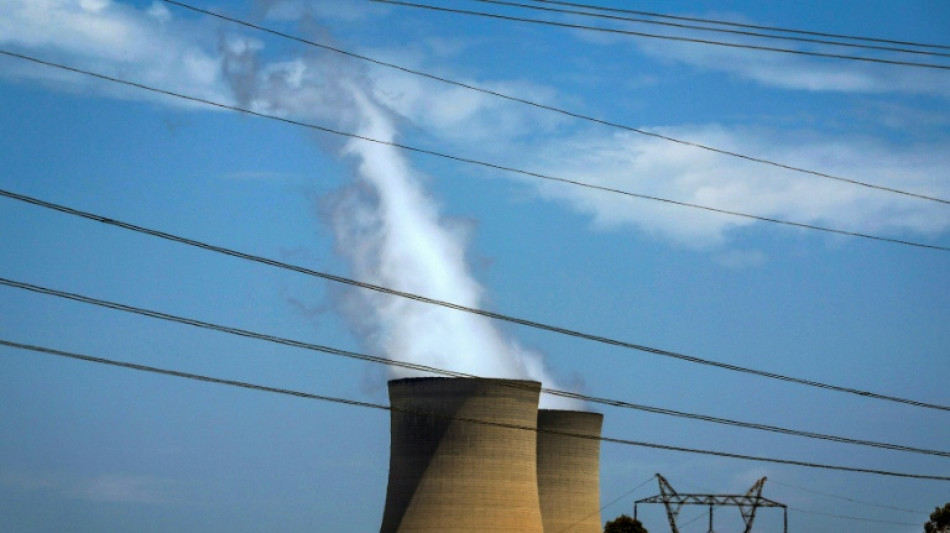
Australia unveils 'anti-climactic' new emissions cuts / Photo: DAVID GRAY - AFP

 Singer Ed Sheeran says Gaza situation 'unjustifiable' following controversy

 In 'Tenzing', a Sherpa mountaineer gets his due

 Ed Sheeran set to return to stage after Palestinian controversy

 Toulouse edge Vannes, Lyon beat Pau to take Top 14 summit

 Germans arrested for Louvre stunt in Mona Lisa hall

 Saudi-led coalition says Houthis fired ballistic missile at Riyadh

 France's debt climbs to highest since 1978: ministry

 McIlroy two shots off the lead at Wentworth after eagle on 18

 Martinez brace saves Inter in Serie A top-two clash with Roma

 Rosenior abused but guides Paris FC past old club Strasbourg

 Seven-try Lyon beat Pau, climb to Top 14 summit

 Brighton defeat a 'big lesson' against complacency for Arsenal, says Arteta

 Thousands protest inaction over climate crisis in Switzerland

 Carapaz out of cycling world championships

 'Fragile' Tottenham beaten by Aston Villa despite late rally

 Mourinho hails Real Madrid grit before Atletico derby clash

 Martin wins Austrian MotoGP sprint after Acosta crash

 Japan edge Fiji to win Pacific Nations Cup

 Black smoke, flames rising near Riyadh airport: residents to AFP

 UK actor Naomi Watts honoured at Spain film festival

 Japan emperor declares Asian Games open after turbulent build-up

 Asian Games open with unity message after troubled build-up
 Denmark hails 'binding' Greenland deal with Trump

 We don't want Games host Japan losing money, says Asian Olympic official

 Ed Sheeran returns to stage after Palestinian controversy

Australia pledged Thursday to slash planet-warming greenhouse gas emissions by up to 70 percent from 2005 levels over the next decade, a target activists warned was not ambitious enough.
Under the landmark Paris climate accord, each country must provide a headline figure to the United Nations for cutting heat-trapping emissions by 2035, and a detailed blueprint for getting there.
A leading coal exporter, Australia's pledge has been closely watched given its bid to host next year's UN climate summit alongside Pacific island neighbours threatened by rising seas.
The announcement also comes days after a national climate risk assessment warned rising oceans and flooding caused by climate change would threaten the homes and livelihoods of over a million Australians by 2050.
One prominent climate scientist described the new target as "baffling," given those findings and Australia's bid to host climate talks.
"Australia needs to cut its emissions at a pace associated with a 1.5C compatible emission reduction pathway and that properly aligns with bringing emissions to net zero by 2050 in Australia," said Bill Hare, head of the Climate Analytics research group.
"This requires strong government policy action now."
Climate activists and experts say Australia needs to slash emissions by at least 76 percent from 2005 levels to keep global temperatures from rising over 1.5C higher than pre-industrial levels.
But Prime Minister Anthony Albanese described the goal as a "responsible target backed by the science".
His government said it would fund a new Aus$5 million ($3.3 billion) "Net Zero Plan" to help firms transition to green energy.
It will also help Australians buy more zero emissions vehicles and access clean energy.
The target is "not likely to please anyone," said Jacqueline Peel, a climate specialist at the University of Melbourne Law School.
And given the risks outlined in this week's assessment, "this 'achievable' target feels very anticlimactic," she added.
- 'Apocalyptic scenarios' -
Anote Tong, former president of Pacific nation Kiribati, told AFP Australia's goals were undermined by its reliance on fossil fuel.
"The problem has been (Australia's) high volume of fossil fuel exports and ongoing substantial subsidies to the fossil fuel industry," said Tong, often called the founding father of the Pacific climate movement.
"These recent decisions by the government become more stark in contrast to the recently released Climate Risk Assessment Report which predicts apocalyptic scenarios, even for Australian citizens, if unheeded," he said.
Global emissions have been rising but need to almost halve by the end of the decade to limit global warming to safer levels agreed under the Paris deal.
Australia's previous 2030 commitment was to cut emissions by 43 percent of 2005 levels.
Countries were meant to submit updated targets earlier this year but only 10 of nearly 200 countries required did so on time, according to a UN database tracking the submissions.
Australia has poured billions into solar power, wind turbines and green manufacturing and pledged to make the nation a renewable energy superpower.
But its green ambitions are at odds with its deep entanglement with lucrative fossil fuel industries, and it remains one of the world's biggest coal exporters.
P.A.Mendoza--AT



