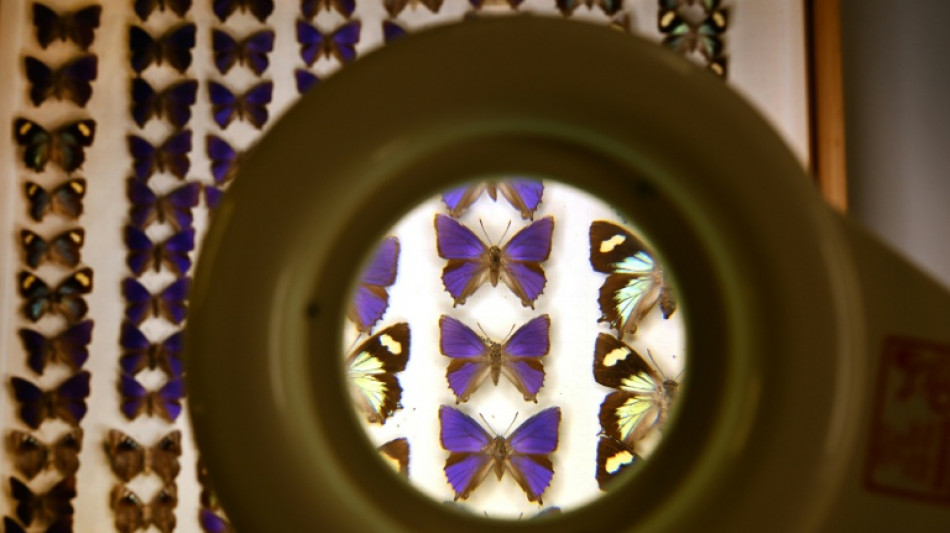
Australian scientists grapple with 'despicable' butterfly heist / Photo: William WEST - AFP

 Singer Ed Sheeran says Gaza situation 'unjustifiable' following controversy

 In 'Tenzing', a Sherpa mountaineer gets his due

 Ed Sheeran set to return to stage after Palestinian controversy

 Toulouse edge Vannes, Lyon beat Pau to take Top 14 summit

 Germans arrested for Louvre stunt in Mona Lisa hall

 Saudi-led coalition says Houthis fired ballistic missile at Riyadh

 France's debt climbs to highest since 1978: ministry

 McIlroy two shots off the lead at Wentworth after eagle on 18

 Martinez brace saves Inter in Serie A top-two clash with Roma

 Rosenior abused but guides Paris FC past old club Strasbourg

 Seven-try Lyon beat Pau, climb to Top 14 summit
 Brighton defeat a 'big lesson' against complacency for Arsenal, says Arteta

 Thousands protest inaction over climate crisis in Switzerland

 Carapaz out of cycling world championships

 'Fragile' Tottenham beaten by Aston Villa despite late rally

 Mourinho hails Real Madrid grit before Atletico derby clash
 Martin wins Austrian MotoGP sprint after Acosta crash

 Japan edge Fiji to win Pacific Nations Cup
 Black smoke, flames rising near Riyadh airport: residents to AFP
 UK actor Naomi Watts honoured at Spain film festival

 Japan emperor declares Asian Games open after turbulent build-up
 Asian Games open with unity message after troubled build-up
 Denmark hails 'binding' Greenland deal with Trump

 We don't want Games host Japan losing money, says Asian Olympic official

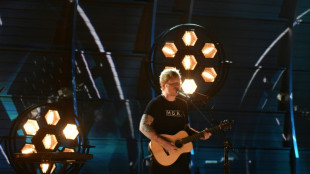 Ed Sheeran returns to stage after Palestinian controversy

Almost eight decades after Colin Wyatt stole and then vandalised thousands of precious Australian butterfly specimens, scientists are still untangling his web of deception.
Between 1946 and 1947, the British ski champion and acclaimed painter charmed his way into museums in Melbourne, Sydney and Adelaide and pilfered 3,000 of the insects.
He then painted their wings to make them look like different species and stripped labels to erase vital records about which specimen belonged to which museum.
His motive remains a mystery -- Wyatt later blamed the breakdown of his marriage.
Wyatt died in a plane crash in 1975 and most of his collection was sold to museums -- sending his mislabelled insects to all corners of the globe.
Decades on, lepidopterists are still struggling to repair the damage.
"He created such a taxonomic mess, it will never really be able to be sorted out," Museums Victoria's head of strategic collection management Maryanne McCubbin told AFP.
"I just get so angry. It is a despicable criminal act and it has huge scientific consequences," she said.
"He had no right to steal collections that we hold on behalf of the public."
The numbers are staggering.
In Melbourne, Wyatt smuggled 827 lepidopterans -- winged insects that include butterflies and moths -- out of the museum in tin containers in a single weekend.
He stole another 1,500 butterflies from a museum in Sydney as well as 603 from the Adelaide Museum.
Those butterflies now must be affixed with a label designating them as having "passed through C. W. Wyatt Theft coll. 1946–1947".
- 'A really vindictive theft' -
"It was a really vindictive theft," Victoria Museum collection manager of terrestrial invertebrates Simon Hinkley told AFP.
"Never in my lifetime have I seen something like this."
Wyatt posted the almost 3,000 stolen butterflies back to Britain before fleeing.
The plundered pieces included holotypes -- the original specimen from when the species was first officially described.
There were also samples of rare metallic blue butterflies that often fly at the top of trees -- caught by a net-wielding collector who strapped himself to tree trunks, local media reported at the time.
The empty museum drawers were not discovered until later.
But it did not take long for the museums to narrow down a suspect and contact London authorities.
Police found Wyatt at home with the stolen Australian butterflies, part of a collection nearing 40,000, TIME magazine reported at the time.
A British judge let him off with a 100 pound fine, equivalent to 5,000 pounds ($6,800) today.
The Australian specimens were repatriated, with staff from the three facilities taking more than nine days to sort the colourful fliers and return them home.
- From Munich to Melbourne -
Since the heist, museums have used taxonomists to examine butterfly collections and identify where specimen label data does not match their knowledge of that species -- a never-ending puzzle.
But not all of them made it back and Wyatt's stolen butterflies are still being found.
A precious holotype butterfly was discovered in Munich in 2022, mislabelled for almost eight decades.
It was only after a skilled entomologist spotted the Peacock Jewel and realised that it belonged to the Melbourne facility that the butterfly was returned.
The flying jewel, which has iridescent peacock-green and orange wings, will be hand-delivered to Melbourne.
In another case, a lepidopterist in Canberra found a butterfly had been painted to resemble another species and mislabelled.
Hinkley said he wonders how many more specimens are incorrectly labelled.
"If I could go back and meet him and get him before he did that, I'd be keen to ask him why he did it," he said.
"The damage he did was significant," he said.
"What he did messes with the whole collection... you can't trust anything that has been through his hands."
E.Rodriguez--AT



