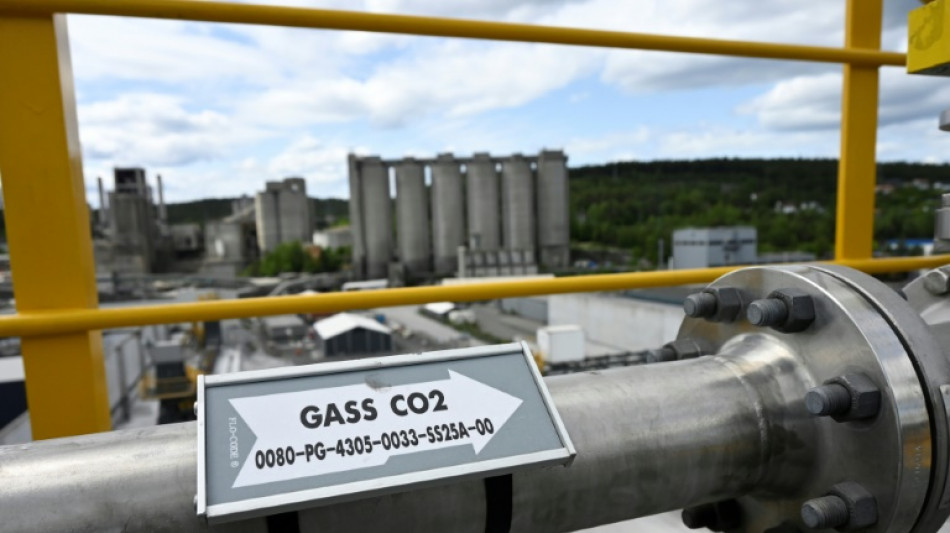
Treat carbon storage like 'scarce resource': scientists / Photo: Jonathan KLEIN - AFP

 Singer Ed Sheeran says Gaza situation 'unjustifiable' following controversy

 In 'Tenzing', a Sherpa mountaineer gets his due

 Ed Sheeran set to return to stage after Palestinian controversy

 Toulouse edge Vannes, Lyon beat Pau to take Top 14 summit

 Germans arrested for Louvre stunt in Mona Lisa hall

 Saudi-led coalition says Houthis fired ballistic missile at Riyadh

 France's debt climbs to highest since 1978: ministry

 McIlroy two shots off the lead at Wentworth after eagle on 18

 Martinez brace saves Inter in Serie A top-two clash with Roma

 Rosenior abused but guides Paris FC past old club Strasbourg

 Seven-try Lyon beat Pau, climb to Top 14 summit

 Brighton defeat a 'big lesson' against complacency for Arsenal, says Arteta

 Thousands protest inaction over climate crisis in Switzerland

 Carapaz out of cycling world championships

 'Fragile' Tottenham beaten by Aston Villa despite late rally

 Mourinho hails Real Madrid grit before Atletico derby clash

 Martin wins Austrian MotoGP sprint after Acosta crash

 Japan edge Fiji to win Pacific Nations Cup

 Black smoke, flames rising near Riyadh airport: residents to AFP

 UK actor Naomi Watts honoured at Spain film festival

 Japan emperor declares Asian Games open after turbulent build-up

 Asian Games open with unity message after troubled build-up

 Denmark hails 'binding' Greenland deal with Trump

 We don't want Games host Japan losing money, says Asian Olympic official

 Ed Sheeran returns to stage after Palestinian controversy

The amount of carbon dioxide that can be stored underground is vastly overestimated, new research said Wednesday, challenging assumptions about the "limitless" potential this approach holds to reducing global warming.
Carbon capture and storage (CCS) is complex and costly, and critics say it cannot meet the urgent need to slash planet-heating emissions and meet the world's climate targets.
One approach works by avoiding emissions at a polluting source -- such as a factory smokestack. Another, known as direct air capture, pulls CO2 from the atmosphere.
But both require the CO2 captured to be injected into rock and locked away underground for centuries or millennia in deep geologic formations.
At present, carbon capture plays a vanishingly small part in addressing the climate crisis. But scientists and policymakers consider it a necessary tool to help bring future warming down to safer levels.
However, in a new paper published in the prestigious journal Nature, a team of international scientists has sharply revised down the global capacity for safely and practically storing carbon underground.
They estimated a global storage limit of around 1,460 billion tonnes of CO2 -- nearly 10 times below scientific and industry assumptions.
This "reality check" should better inform decision-makers considering carbon capture in their long-term climate policies, the study's senior author, Joeri Rogelj, told AFP.
"This is a study that helps us understand -- and actually really corrects -- the working assumption of how much carbon, or CCS capacity, would be available if one takes a practical and a prudent approach," said Rogelj, an expert in carbon capture from Imperial College London.
- 'Scarce resource' -
To reach this revised figure, the team -- led by the International Institute for Applied Systems Analysis -- took existing assumptions about carbon storage and ruled out locations deemed risky or economically unviable.
This included, for example, injecting CO2 below major civilian centres, into zones of known seismic activity, or many hundreds of metres beneath the oceans.
The findings underscored that carbon storage should be treated as "a scarce resource that needs to be deployed strategically to maximise climate benefits rather than... a limitless commodity", the study said.
This storage limit could be breached by 2200, the authors said, noting they could not account for possible advances in carbon capture, or other technologies, in future.
Fully exhausting this capacity could lower global temperatures by 0.7C -- but that should be reserved for future generations who may need it most, the authors said.
The IPCC, the UN's expert scientific panel on climate change, says carbon capture is one option for reducing emissions, including in heavy polluting sectors like cement and steel.
But it remains infinitesimal: Rogelj said the amount of carbon captured every year at present amounted to approximately one-thousandth of global annual CO2 emissions.
G.P.Martin--AT



