Evicted from their forests, Kenyan hunter-gatherers fight for their rights / Photo: Tony KARUMBA - AFP

 IOC president impressed by 'beautiful' Asian Games wooden huts

 First Asian Games gold goes to Japan as China's 13-year-old Yu lights up pool

 Data centre command hub keeps AI up and running

 Pope Leo in France: the issues on the table

 Packing for a pope: behind the scenes on foreign trips

 Republicans find transgender issues a powerful political weapon in midterm campaigning

 German state elections threaten new shock waves for Merz

 Chile's Bachelet quits race to be next UN chief

 Raphinha treble fires perfect Barca to win at Sevilla

 Thiam makes winning heptathlon return at Decastar meet

 Czechs beat USA to qualify for Davis Cup finals

 Dortmund sink Stuttgart to climb to Bundesliga summit

 Trump says will not tolerate attempts to slow AI growth

 'It has to stop': runners protest women's murders in S.Africa district

 Fire erupts near Riyadh airport as Houthis claim strikes

 Cuba works to restore power after another blackout

 England thrash Sri Lanka again to return to top of T20 rankings

 Arsenal thrashed by Brighton, sorry Spurs lose again

 South Korea, Austria qualify for Davis Cup finals

 Seare shocks Ingebrigtsen to win world 5km gold

 Brigitte Bardot widower slams sale of star's belongings

 Aston Villa compound Tottenham's misery despite late rally

 Asian Games offer 'deepest apologies' for South Korea anthem blunder

 Inter Milan and Italy icon Mazzola dies aged 83

 Saudi capital issues first air raid alert since renewed fighting in Yemen

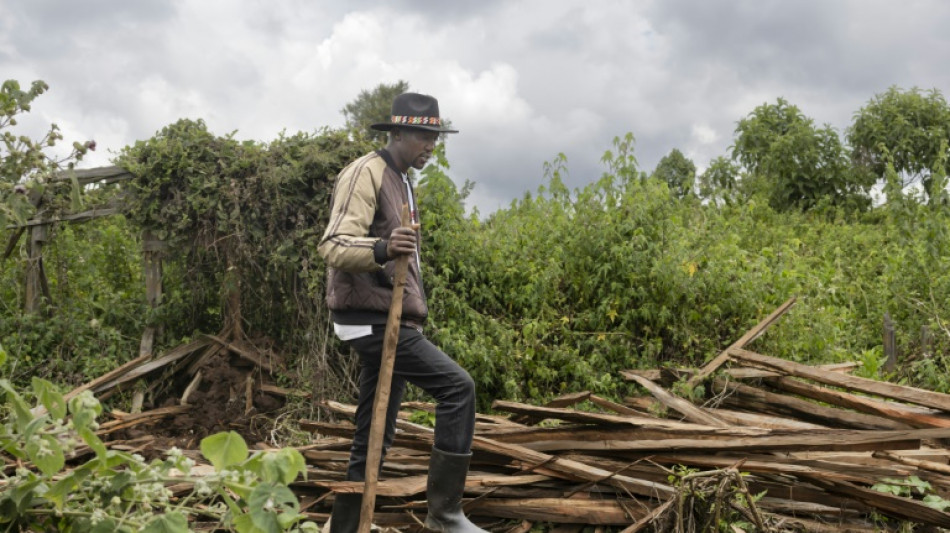
Fred Ngusilo stoops to pick up a leather pouch, once used to collect honey, and a discarded shoe from the Mau forest floor, painful reminders that his Ogiek hunter-gatherer community once quietly flourished in southern Kenya, before they were evicted and their homes destroyed.
Ngusilo belongs to the Ogiek group, which is among the last hunter-gatherer communities in Africa and one of the most marginalised in Kenya.
He described how their ancestral lands were seized by the government in the name of conservation at the end of 2023, when men armed with hammers and axes suddenly appeared, violently evicting them from their homes.
"When I come here, I feel that I'm so sad. Tears are coming out of my eyes," Ngusilo said, his eyes resting on the remains of his father and grandfather's house.
Behind the 38-year-old human rights activist, bees buzz, and some of his community peacefully weave their cattle through the trees -- despite a ban on livestock, brutally enforced by Kenyan Forestry Service (KFS) rangers.
In December, a herder drowned while fleeing from the rangers, Ngusilo said.
The calm of the Mau Forest contrasts with stories of decades of persecution and dispossession recounted by its indigenous people -- all in the name of conservation.
The African Court on Human and Peoples' Rights (AfCHPR) ruled in 2017 and 2022 that the evictions were illegal, ordering Nairobi to pay reparations equivalent to more than $1 million and to recognise their ancestral lands.
But Kenya has still not complied.
- 'We are suffering greatly' -
Deprived of their livelihoods, they recount a difficult daily existence that is slowly but surely destroying their traditions and their language.
"Before, in the forest, we could survive -- eat honey, hunt, live," Ngusilo's grandmother, Janet Sumpet Ngusilo, 87, said.
"Now, out here, we are suffering greatly."
At a festival earlier this month, hundreds of community members rallied to keep the ceremonies and traditional songs alive, but also to remember what they have lost.
"I survived on meat and honey. Young people today don't know that life," said Salaton Nadumwangop, describing how he would sleep beneath the trees.
"The forest is our life," the 55-year-old Nadumwangop, dressed in traditional costume and a fur hat pinned with beads evoking bees, told AFP.
- Existential threat -
A government representative at the festival, Josphat Lodeya, promised the verdicts of the AfCHPR court would be implemented.
Lodeya, who heads the department for minorities and marginalised people, said the government was doing what it should.
"It is the same thing I have heard many times, so let us wait and see," said Daniel Kobei, head of the Ogiek People's Development Program.
But despite the assurances, which the crowd clung to hopefully, Nadumwangop said the Ogiek -- whom he described as a "small people" -- knew they lacked power.
"Even if we try to vote, they consider us worthless. So they despise us," he said.
Ngusilo believes the authorities are "trying to sell us out," saying that he would die to return home.
During a visit to his family home earlier that week, AFP reporters witnessed him receive multiple calls from what he said were KFS rangers, threatening to arrest him for being there.
KFS could not be reached by AFP for comment by publication.
More than 20 percent of the Mau has disappeared since the 1980s, according to various studies, with rights groups and elders accusing rapacious local officials.
Several community members have also alleged that carbon credit projects are behind the evictions at the end of 2023.
These allegations are difficult to prove, although several lawyers and observers consider them plausible.
For Nadumwangop, he remains worried about his people's future.
"If things continue like this, the Ogiek will disappear. We will be completely lost."
H.Gonzales--AT