Rescuers resume search after Italian glacier collapse kills six / Photo: Pierre TEYSSOT - AFP

 Carapaz out of cycling world championships

 'Fragile' Tottenham beaten by Aston Villa despite late rally

 Mourinho hails Real Madrid grit before Atletico derby clash
 Martin wins Austrian MotoGP sprint after Acosta crash

 Japan edge Fiji to win Pacific Nations Cup

 Black smoke, flames rising near Riyadh airport: residents to AFP

 UK actor Naomi Watts honoured at Spain film festival

 Japan emperor declares Asian Games open after turbulent build-up

 Asian Games open with unity message after troubled build-up

 Denmark hails 'binding' Greenland deal with Trump

 We don't want Games host Japan losing money, says Asian Olympic official

 Ed Sheeran returns to stage after Palestinian controversy

 Asian Games to open in Japan after troubled build-up

 Drone owners rush to offload devices ahead of Beijing ban

 Trump's beef policies irk Texas ranchers, testing their loyalty

 Batman Appears Atop the Sydney Opera House for Batman Day 2026
 Nvidia, OpenAI CEOs to attend Xi dinner at White House

 Anthropic picks Accenture for in-house AI safety evaluation
 Balogun returns as Monaco beat Lens to continue strong Ligue 1 start

 'Pause' on overt repression in Venezuela, but reforms still needed: HRW

 Global stocks mixed as yen falls despite Bank of Japan rate hike

 Cuba hit with seventh major blackout of the year

 Murray out with concussion so Wentz will start for Vikings

 UN chief 'deeply regrets' US visa refusal to Abbas for annual meeting
 England quick Carse to face no charges over alleged nightclub assault
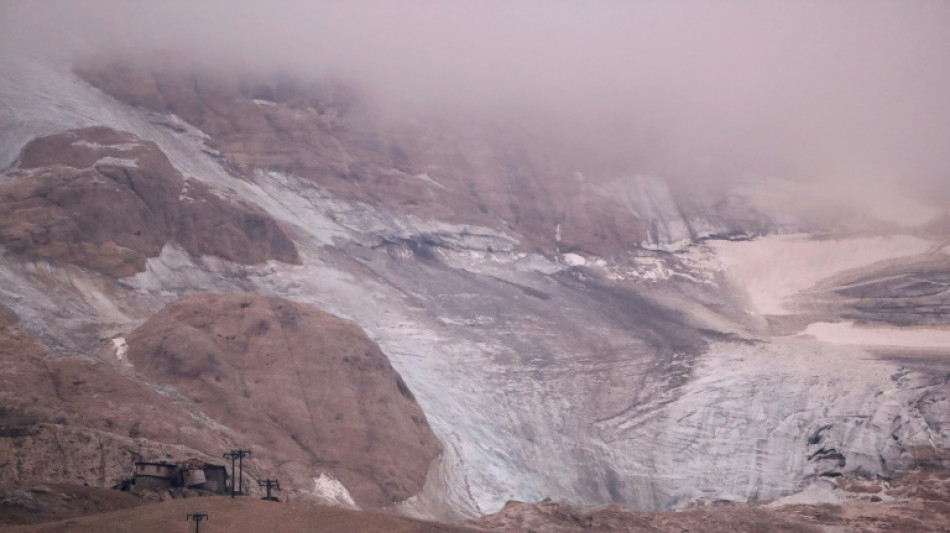
Rescuers were to resume the search for survivors on Monday after an avalanche set off by the collapse of the largest glacier in the Italian Alps killed at least six people and injured eight others.
Authorities said they did not know "the total number of climbers" hit when the glacier collapsed Sunday on Marmolada, the highest mountain in the Italian Dolomites.
The disaster struck one day after a record-high temperature of 10 degrees Celsius (50 degrees Fahrenheit) was recorded at the glacier's summit.
"An avalanche of snow, ice and rock hit an access path at a time when there were several roped parties, some of whom were swept away," emergency services spokeswoman Michela Canova told AFP.
Six people had been confirmed dead and eight were injured, she added while "the total number of climbers involved is not yet known".
Two of the injured were taken to hospital in Belluno, another in a more serious condition was taken to Treviso and five to Trento.
She did not specify the nationalities of the victims, but Italian media reported that foreign nationals were among them.
The Alpine rescue corps has activated a toll-free number for people to report friends or relatives who had not returned from an excursion to the glacier.
Several helicopters were scrambled to take part in the initial rescue operation but the search for survivors had to be suspended at nightfall and would resume early Monday.
Rescuers in the nearby Veneto region of northeast Italy said they had deployed all their Alpine teams, including sniffer dogs.
Italian Prime Minister Mario Draghi expressed his "sincerest condolences" to the victims and their families on Twitter.
Massimo Frezzotti, a science professor at Roma Tre University, told AFP the collapse was caused by unusually warm weather linked to global warming, with precipitation down 40-50 percent during a dry winter.
"The current conditions of the glacier correspond to mid-August, not early July," he said.
- Further collapses feared -
Images filmed from a refuge close to the incident show snow and rock hurtling down the mountain's slopes and causing a thunderous noise.
Other footage shot by tourists on their mobile phones showed the greyish avalanche sweep away everything in its path.
The mountain rescue team released images showing rescuers and helicopters at the scene to take victims from the valley to the village of Canazei.
Their task was made harder because the bodies were trapped under a layer of ice and rock.
A team of psychologists was on hand to support the relatives of the victims. The Trento public prosecutor's office has opened an investigation to determine the causes of the tragedy.
Experts quoted by the Corriere della Sera daily said they feared further collapses of ice.
Glacier specialist Renato Colucci told the Italian agency AGI that the phenomenon was "bound to repeat itself", because "for weeks the temperatures at altitude in the Alps have been well beyond normal values".
The recent warm temperatures had produced a large quantity of water from the melting glacier that accumulated at the bottom of the block of ice and caused it to collapse, he added.
The Marmolada glacier is the largest in the Dolomites mountain range, which is part of the Italian Alps and situated on the northern face of Marmolada.
The glacier, nicknamed "the queen of the Dolomites", feeds the Avisio river and overlooks Lake Fedaia in the autonomous Italian province of Trento.
According to a March report by the UN Intergovernmental Panel on Climate Change (IPCC), melting ice and snow is one of 10 major threats caused by global warming, disrupting ecosystems and infrastructure.
The traditional way of life of people such as the Sami in Finland's Lapland, who raise reindeer, has already been affected.
Thawing permafrost is also hampering economic activity in Canada and Russia.
A.Taylor--AT



