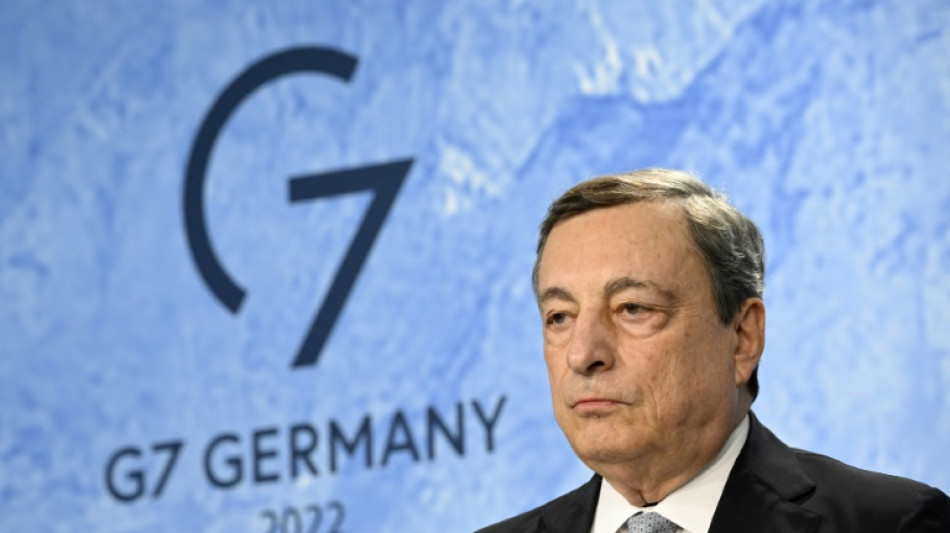
G7 disappoints with fossil fuel 'loophole' / Photo: Tobias SCHWARZ - AFP

 Carapaz out of cycling world championships

 'Fragile' Tottenham beaten by Aston Villa despite late rally

 Mourinho hails Real Madrid grit before Atletico derby clash

 Martin wins Austrian MotoGP sprint after Acosta crash

 Japan edge Fiji to win Pacific Nations Cup

 Black smoke, flames rising near Riyadh airport: residents to AFP

 UK actor Naomi Watts honoured at Spain film festival

 Japan emperor declares Asian Games open after turbulent build-up

 Asian Games open with unity message after troubled build-up

 Denmark hails 'binding' Greenland deal with Trump

 We don't want Games host Japan losing money, says Asian Olympic official

 Ed Sheeran returns to stage after Palestinian controversy

 Asian Games to open in Japan after troubled build-up

 Drone owners rush to offload devices ahead of Beijing ban

 Trump's beef policies irk Texas ranchers, testing their loyalty

 Batman Appears Atop the Sydney Opera House for Batman Day 2026

 Nvidia, OpenAI CEOs to attend Xi dinner at White House

 Anthropic picks Accenture for in-house AI safety evaluation

 Balogun returns as Monaco beat Lens to continue strong Ligue 1 start

 'Pause' on overt repression in Venezuela, but reforms still needed: HRW

 Global stocks mixed as yen falls despite Bank of Japan rate hike
 Cuba hit with seventh major blackout of the year
 Murray out with concussion so Wentz will start for Vikings

 UN chief 'deeply regrets' US visa refusal to Abbas for annual meeting
 England quick Carse to face no charges over alleged nightclub assault

Leaders of the Group of Seven rich nations on Tuesday watered down a key pledge on ending fossil fuel financing abroad, as the need to tackle global warming clashed with fears over energy shortages.
The G7 countries -- Britain, Canada, France, Germany, Italy, Japan and the United States -- ended a summit in the Bavarian Alps by reaffirming their goal to reduce reliance on dirty fossil fuels and speed up the green energy transition.
But after three days of haggling, they also agreed to allow public investment in new international fossil fuel projects under certain conditions, as countries scramble to break free from Russian oil, coal and gas following the invasion of Ukraine.
German Chancellor and summit host Olaf Scholz "promised a crucial boost for international climate action and he didn't deliver," said Friederike Roder, vice president at the non-profit group Global Citizen.
An alliance of civil society organisations including Oil Change International also issued a scathing verdict, condemning the "loopholes" on gas that made it into the final communique.
The text reiterates that G7 nations will still halt new public investments in overseas fossil fuel projects by the end of 2022.
But given the "exceptional circumstances" of the Ukraine war, "publicly supported investment in the gas sector can be appropriate as a temporary response".
Observers said Germany and Italy, heavily reliant on Russian energy, had pushed hard for the amended text.
Like other European countries, they are racing to stockpile gas before winter and diversify suppliers as they brace for Russia to turn off the energy taps altogether after it recently slowed deliveries.
- 'Emergency' -
Germany has already decided to reactivate mothballed coal-fired plants to offset the Russian shortfall, and is eyeing a new gas project in Senegal.
Pressed by reporters about the fossil fuel relapse, Scholz stressed the latest moves were temporary and would not derail Germany's climate targets or slow its shift towards renewables.
Italian Prime Minister Mario Draghi acknowledged the "worry" about a return to dirty fossil fuels.
"We don't want to go back on our commitments," he said at a press conference.
"Even though we access new sources of gas supply, these are replacing Russian sources. We are not increasing the long-term supply of gas," he said, describing the current energy upheaval as "an emergency".
All G7 leaders reaffirmed the commitment from the Paris pact to limit global temperature increases to 1.5 degrees Celsius and to achieve net-zero emissions by 2050.
They also repeated a pledge to largely decarbonise their electricity sectors by 2035.
Among the few new promises in the final statement is the commitment to "a highly decarbonised road sector by 2030".
The announcement of climate partnerships with emerging countries such as India, Indonesia and Vietnam to help finance their clean energy transitions was welcomed by campaigners.
The partnerships "can have transformational potential", the NGO Germanwatch said.
US President Joe Biden and his counterparts also agreed to set up an international "climate club", Scholz's flagship proposal at the summit.
Focused heavily on the industrial sector, the club's aim is to coordinate climate action while avoiding competitive disadvantages, for instance through sharing technology or agreeing common standards on carbon pricing or green hydrogen.
But some critics said the idea remained vague.
- 'Huge gap' -
G7 leaders pledged to "intensify" efforts to mobilise climate financing for poor countries, many of which are already feeling the catastrophic impacts of extreme heatwaves, droughts and floods.
A long-standing goal to spend $100 billion a year from 2020 on helping vulnerable nations adapt to climate change remains unmet, however.
Environmental campaigners said the G7 had done little to provide fresh momentum for the United Nations COP27 climate summit in Egypt in November.
"Chancellor Scholz has failed to mobilise new climate commitments from G7 leaders, leaving a huge gap for them to fill in the next four months to have credibility come COP27," said Alex Scott from the climate think tank E3G.
S.Jackson--AT



