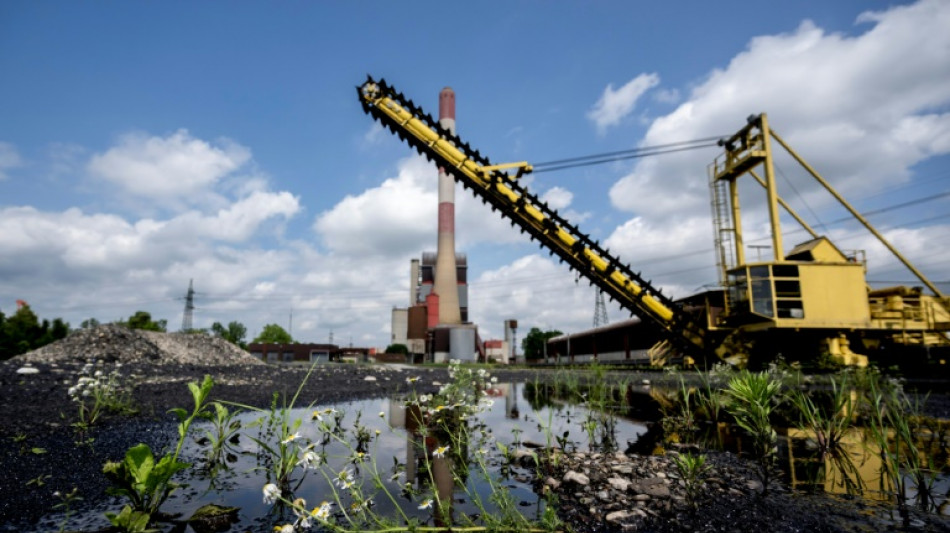
'Unimaginable': Austria prepares to reopen coal power station / Photo: JOE KLAMAR - AFP

 Carapaz out of cycling world championships

 'Fragile' Tottenham beaten by Aston Villa despite late rally

 Mourinho hails Real Madrid grit before Atletico derby clash

 Martin wins Austrian MotoGP sprint after Acosta crash

 Japan edge Fiji to win Pacific Nations Cup
 Black smoke, flames rising near Riyadh airport: residents to AFP

 UK actor Naomi Watts honoured at Spain film festival
 Japan emperor declares Asian Games open after turbulent build-up

 Asian Games open with unity message after troubled build-up
 Denmark hails 'binding' Greenland deal with Trump
 We don't want Games host Japan losing money, says Asian Olympic official
 Ed Sheeran returns to stage after Palestinian controversy

 Asian Games to open in Japan after troubled build-up
 Drone owners rush to offload devices ahead of Beijing ban

 Trump's beef policies irk Texas ranchers, testing their loyalty

 Batman Appears Atop the Sydney Opera House for Batman Day 2026
 Nvidia, OpenAI CEOs to attend Xi dinner at White House

 Anthropic picks Accenture for in-house AI safety evaluation
 Balogun returns as Monaco beat Lens to continue strong Ligue 1 start

 'Pause' on overt repression in Venezuela, but reforms still needed: HRW

 Global stocks mixed as yen falls despite Bank of Japan rate hike

 Cuba hit with seventh major blackout of the year

 Murray out with concussion so Wentz will start for Vikings

 UN chief 'deeply regrets' US visa refusal to Abbas for annual meeting
 England quick Carse to face no charges over alleged nightclub assault

At the Mellach coal power plant in southern Austria, spider webs have taken over the conveyor belts, and plants and flowers have sprung up around the vast lot that once stored coal.
The plant, Austria's last coal-fuelled power station, was closed in the spring of 2020, but now the government -- nervous that Russia may cut its crucial gas deliveries further -- has decided to get the site ready again in case it's needed.
"I never would have imagined that we would restart the factory," Peter Probst, a 55-year-old welder, told AFP during a visit of the plant.
"It's really sad to be so dependent on gas," he added.
Europe had been trying to move away from coal in the fight against climate change.
But as Russia has cut gas deliveries in the wake of sanctions the West has imposed on it for the war in Ukraine, European countries are turning back to coal.
Today, the Mellach plant's white and red chimney stands out amid fields of corn and pumpkins, the city of Graz in the distance.
Inside, the walls are black, and coal dust clings to the doors and railings.
Some 450,000 tonnes of coal were stored at the plant before its closure as Austria's conservative-Greens coalition aimed to have all electricity come from renewable resources by 2030.
Site manager Christof Kurzmann-Friedl says the plant operated by supplier Verbund can be ready again in "about four months" -- just in time to help tackle any gas shortages in winter.
- 'Emergency measure' -
Chancellor Karl Nehammer insisted on Monday that the plant would only go online if necessary, while Austria holds on to its goals to reduce emissions.
"It's really an emergency measure," the conservative told foreign correspondents at a briefing.
"It's really something that shows how extraordinary our times are... We must prepare for any eventuality."
The 230 megawatt power plant would take over from the nearby gas-fired plant, also operated by Verbund, which currently supplies heating to Graz's 300,000 inhabitants, according to Kurzmann-Friedl.
He warned, however, that the site must still be readied, hooking up all the equipment again, in addition to hiring qualified personnel and above all finding enough coal.
Before, the coal mainly came from mines in Poland's Silesia region, which the Polish government is aiming to shut.
Because coal prices have risen by as much as three times since 2020, the power produced by the plant will also be more expensive, Kurzmann-Friedl said.
Criticism has already flared with the opposition Social Democrats slamming the decision to reactivate the coal plant as "an act of desperation by the Greens".
"Will the next step be the reactivation of Zwentendorf?" the opposition asked, referring to the country's only nuclear power plant.
The Alpine nation of nine million people has been fiercely anti-nuclear with an unprecedented vote in 1978 against nuclear energy that prevented the plant from ever opening.
L.Adams--AT



