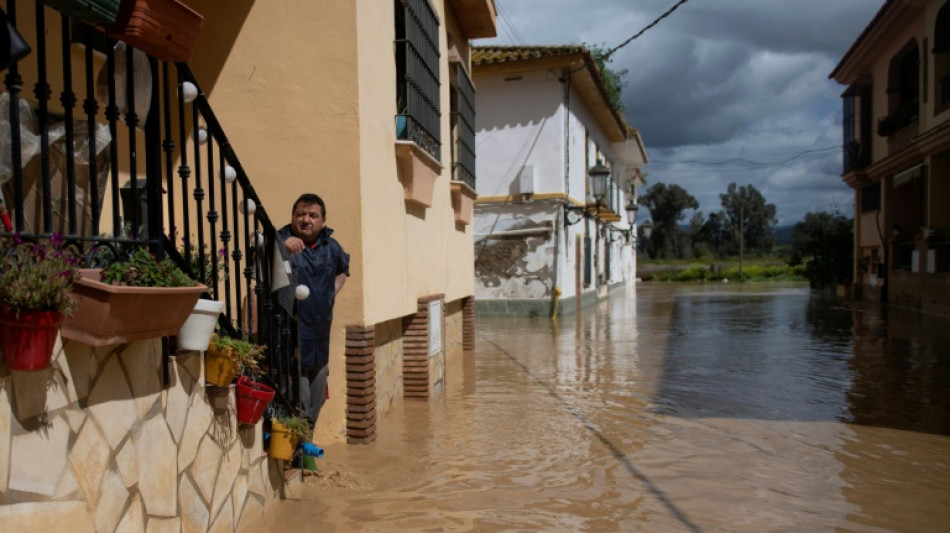
Global temperatures at near historic highs in March: EU monitor / Photo: JORGE GUERRERO - AFP

 Drones hit Moscow as Russians go to the polls

 New England boss Fleming says 'wrong' to ask Stokes to end retirement

 Germans vote in elections threatening fresh blow to Merz

 US fears rapid escalation in Mideast after Houthis attack Riyadh

 Japan triathlete Hojo wins first gold of Asian Games

 IOC president impressed by 'beautiful' Asian Games wooden huts

 First Asian Games gold goes to Japan as China's 13-year-old Yu lights up pool

 Data centre command hub keeps AI up and running

 Pope Leo in France: the issues on the table

 Packing for a pope: behind the scenes on foreign trips

 Republicans find transgender issues a powerful political weapon in midterm campaigning

 German state elections threaten new shock waves for Merz

 Chile's Bachelet quits race to be next UN chief

 Raphinha treble fires perfect Barca to win at Sevilla

 Thiam makes winning heptathlon return at Decastar meet

 Czechs beat USA to qualify for Davis Cup finals

 Dortmund sink Stuttgart to climb to Bundesliga summit

 Trump says will not tolerate attempts to slow AI growth

 'It has to stop': runners protest women's murders in S.Africa district

 Fire erupts near Riyadh airport as Houthis claim strikes

 Cuba works to restore power after another blackout

 England thrash Sri Lanka again to return to top of T20 rankings

 Arsenal thrashed by Brighton, sorry Spurs lose again

 South Korea, Austria qualify for Davis Cup finals

 Seare shocks Ingebrigtsen to win world 5km gold

Global temperatures hovered at historic highs in March, Europe's climate monitor said on Tuesday, prolonging an extraordinary heat streak that has tested scientific expectations.
In Europe, it was the hottest March ever recorded by a significant margin, said the Copernicus Climate Change Service, driving rainfall extremes across a continent warming faster than any other.
The world meanwhile saw the second-hottest March in the Copernicus dataset, sustaining a near-unbroken spell of record or near-record-breaking temperatures that has persisted since July 2023.
Since then, virtually every month has been at least 1.5 degrees Celsius (2.7 degrees Fahrenheit) hotter than it was before the industrial revolution when humanity began burning massive amounts of coal, oil and gas.
March was 1.6C (2.9F) above pre-industrial times, prolonging an anomaly so extreme that scientists are still trying to fully explain it.
"That we're still at 1.6C above preindustrial is indeed remarkable," said Friederike Otto of the Grantham Institute for Climate Change and the Environment at Imperial College London.
"We're very firmly in the grip of human-caused climate change," she told AFP.
- Contrasting extremes -
Scientists warn that every fraction of a degree of global warming increases the intensity and frequency of extreme weather events such as heatwaves, heavy rainfall and droughts.
Climate change is not just about rising temperatures but the knock-on effect of all that extra heat being trapped in the atmosphere and seas by greenhouse gases like carbon dioxide and methane.
Warmer seas mean higher evaporation and greater moisture in the atmosphere, causing heavier deluges and feeding energy into cyclones, but also affecting global rainfall patterns.
March in Europe was 0.26C (0.47F) above the previous hottest record for the month set in 2014, Copernicus said.
It was also "a month with contrasting rainfall extremes" across the continent, said Samantha Burgess of the European Centre for Medium-Range Weather Forecasts, which runs the Copernicus climate monitor.
Some parts of Europe experienced their "driest March on record and others their wettest" for about half a century, Burgess said.
Elsewhere in March, scientists said that climate change intensified an extreme heatwave across Central Asia and fuelled conditions for extreme rainfall which killed 16 people in Argentina.
- Persistent heat -
The spectacular surge in global heat pushed 2023 and then 2024 to become the hottest years on record.
Last year was also the first full calendar year to exceed 1.5C: the safer warming limit agreed by most nations under the Paris climate accord.
This represented a temporary, not permanent breach, of this longer-term target, but scientists have warned that the goal of keeping temperatures below that threshold is slipping further out of reach.
Scientists had expected that the extraordinary heat spell would subside after a warming El Nino event peaked in early 2024, and conditions gradually shifted to a cooling La Nina phase.
But global temperatures have remained stubbornly high, sparking debate among scientists about what other factors could be driving warming to the top end of expectations.
The European Union monitor uses billions of measurements from satellites, ships, aircraft and weather stations to aid its climate calculations.
Its records go back to 1940, but other sources of climate data -- such as ice cores, tree rings and coral skeletons -- allow scientists to expand their conclusions using evidence from much further in the past.
Scientists say the current period is likely the warmest the Earth has been for the last 125,000 years.
W.Moreno--AT



