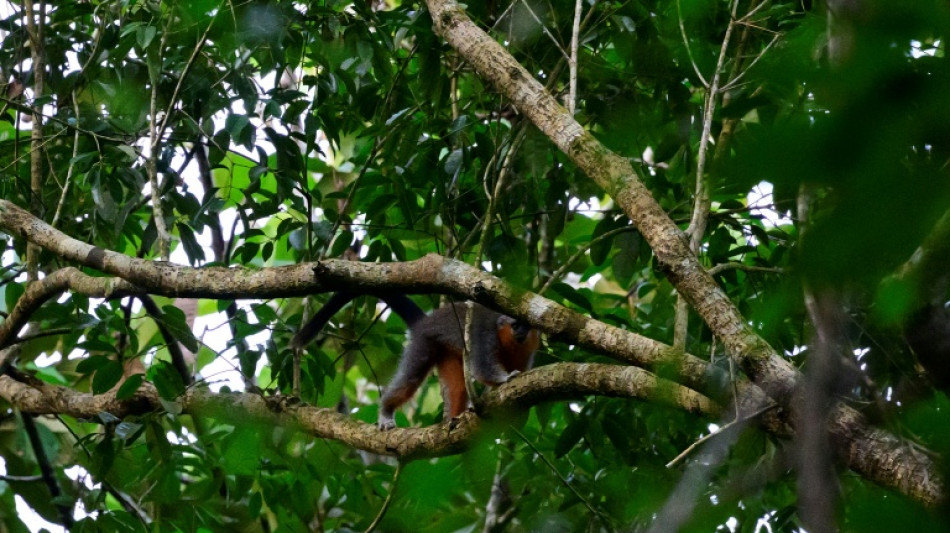
The race to save the Amazon's bushy-bearded monkeys / Photo: Pablo PORCIUNCULA - AFP

 Drones hit Moscow as Russians go to the polls

 New England boss Fleming says 'wrong' to ask Stokes to end retirement

 Germans vote in elections threatening fresh blow to Merz

 US fears rapid escalation in Mideast after Houthis attack Riyadh

 Japan triathlete Hojo wins first gold of Asian Games

 IOC president impressed by 'beautiful' Asian Games wooden huts

 First Asian Games gold goes to Japan as China's 13-year-old Yu lights up pool

 Data centre command hub keeps AI up and running

 Pope Leo in France: the issues on the table

 Packing for a pope: behind the scenes on foreign trips

 Republicans find transgender issues a powerful political weapon in midterm campaigning

 German state elections threaten new shock waves for Merz

 Chile's Bachelet quits race to be next UN chief

 Raphinha treble fires perfect Barca to win at Sevilla

 Thiam makes winning heptathlon return at Decastar meet

 Czechs beat USA to qualify for Davis Cup finals

 Dortmund sink Stuttgart to climb to Bundesliga summit

 Trump says will not tolerate attempts to slow AI growth

 'It has to stop': runners protest women's murders in S.Africa district

 Fire erupts near Riyadh airport as Houthis claim strikes

 Cuba works to restore power after another blackout

 England thrash Sri Lanka again to return to top of T20 rankings

 Arsenal thrashed by Brighton, sorry Spurs lose again

 South Korea, Austria qualify for Davis Cup finals

 Seare shocks Ingebrigtsen to win world 5km gold

One morning in 2024, Armando Schlindwein found an orange-bearded monkey on the roof of his farmhouse on the edge of the Brazilian Amazon.
Never before had he seen one of the striking creatures emerge from the forest.
The monkey, a Groves' Titi, listed as "critically endangered" by the International Union for Conservation of Nature (IUCN), had ventured far from its fast-shrinking home on a hill in a small patch of forest next to Schlindwein's house.
Deforestation was eating away at its limited domain, and the monkey was trying to find an escape route for its family.
The encounter inspired Schlindwein to launch a reforestation drive to open a corridor for the monkeys to swing tree-by-tree back into the rainforest.
"This little creature is endangered. We need to do something to preserve it," said Schlindwein, a 62-year-old small-scale farmer in Sinop municipality, located within Brazil's central Mato Grosso state.
With the help of NGOs like the Ecotono Institute and the Movement of People Affected by Dams (MAR), Schlindwein and his neighbors last year planted seeds of 47 native tree species on a deforested hectare (2.5 acres) of his land.
Within five to seven years, they hope the new growth will have tripled the available space for this particular monkey family, made up of four adults and an infant.
"Saving them is a daily task," said Schlindwein of his cheeky charges.
- 'Nowhere to go' -
Known locally as zogue-zogue and by scientists as Plecturocebus grovesi, the house cat-sized Groves' Titi is found only in Mato Grosso state, and there are just a few thousand of them left.
It was listed as one of the world's 25 most endangered primates in the 2022/3 "Primates in Peril" report of the IUCN and other environmental groups.
A 2019 study cited in the report said the zogue-zogue had lost 42 percent of its forest habitat, a figure that could reach 86 percent in a quarter-century if nothing is done to halt its destruction.
"When offspring are born and need to migrate to continue the reproductive cycle, they have nowhere to go," Gustavo Rodrigues Canale, a primatologist at the Federal University of Mato Grosso, told AFP.
"Human action leaves them trapped in small forest fragments," he said.
Schlindwein's family of monkeys is curtailed to a patch of land the size of a polo field, in a region with the ignominious title "Arc of deforestation" for having the highest rate of Amazon forest destruction.
Farmers clearing land for soybeans and other crops are chiefly blamed for the forest's fate.
The "Primates in Peril" report suggested forest loss could be mitigated by the creation of reserves "and the replacement of large areas of chemical-dependent monocultures of commodity crops by more sustainable models of land use, such as agroforests and agroecological food production."
- 'Monkeys cannot cross' -
Deforestation is not the only threat to Schlindwein's monkey family.
Locals say one side of the animals' territory has been cut off by flooding from a nearby hydroelectric plant run by a company partly owned by French energy giant EDF.
"Here, there used to be a stream with trees, but the Sinop Hydroelectric Plant (UHE)... created a large lagoon that the monkeys cannot cross," says Anthony Luiz, spokesman for MAR, next to a body of water about 300 meters (984 feet) across.
Environmentalists also accuse the company of leaving felled trees to rot in the river, killing the fish.
In the dry season, the rotting wood is exposed, feeding forest fires that hurt and displace monkeys and other animals.
Sinop Energia, which operates Sinop UHE, told AFP the plant meets "all legal and environmental requirements."
It added that it "maintains permanent monitoring of water quality, aquatic and terrestrial fauna, and vegetation regeneration in the area" and had also launched a monitoring program for threatened primates, as required by law.
G.P.Martin--AT



