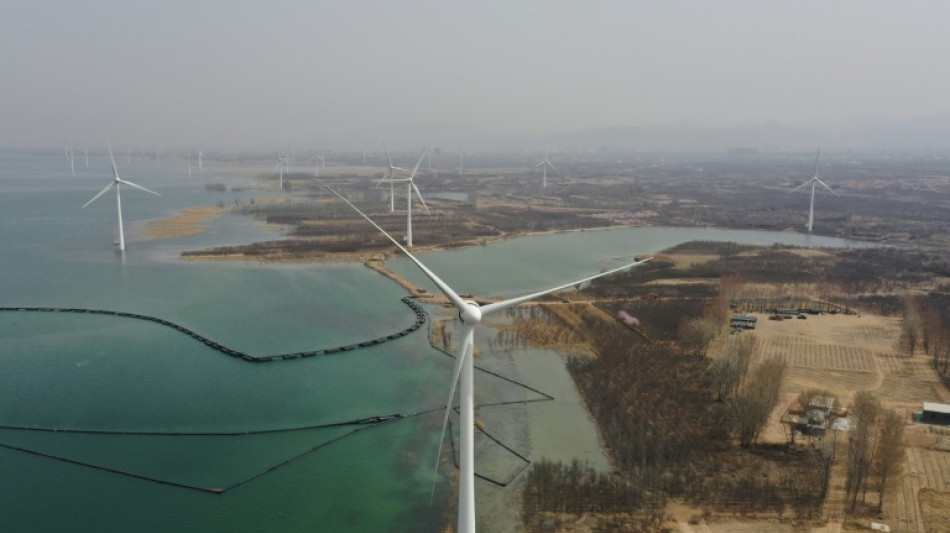
Clean energy giant Goldwind leads China's global sector push / Photo: Adek BERRY - AFP

 Drones hit Moscow as Russians go to the polls

 New England boss Fleming says 'wrong' to ask Stokes to end retirement

 Germans vote in elections threatening fresh blow to Merz

 US fears rapid escalation in Mideast after Houthis attack Riyadh

 Japan triathlete Hojo wins first gold of Asian Games

 IOC president impressed by 'beautiful' Asian Games wooden huts

 First Asian Games gold goes to Japan as China's 13-year-old Yu lights up pool

 Data centre command hub keeps AI up and running

 Pope Leo in France: the issues on the table

 Packing for a pope: behind the scenes on foreign trips

 Republicans find transgender issues a powerful political weapon in midterm campaigning

 German state elections threaten new shock waves for Merz

 Chile's Bachelet quits race to be next UN chief

 Raphinha treble fires perfect Barca to win at Sevilla

 Thiam makes winning heptathlon return at Decastar meet

 Czechs beat USA to qualify for Davis Cup finals

 Dortmund sink Stuttgart to climb to Bundesliga summit

 Trump says will not tolerate attempts to slow AI growth

 'It has to stop': runners protest women's murders in S.Africa district

 Fire erupts near Riyadh airport as Houthis claim strikes

 Cuba works to restore power after another blackout

 England thrash Sri Lanka again to return to top of T20 rankings

 Arsenal thrashed by Brighton, sorry Spurs lose again

 South Korea, Austria qualify for Davis Cup finals

 Seare shocks Ingebrigtsen to win world 5km gold

China has rushed ahead in recent years as the world's forerunner in wind energy, propelled by explosive local demand as Beijing aggressively pursues strategic and environmental targets.
Goldwind -- the country's sector champion -- is set to publish financial results for last year on Friday, offering a window into how its domestic operations and overseas expansion efforts are faring.
AFP looks at how Goldwind and its Chinese peers turned the country into the indisputable global superpower in wind:
- Recent gusts -
China has been a major player in global installed wind capacity since the late 2000s but it is only in the past few years that it has surged to the top.
Companies from mainland China accounted for six of the top seven turbine manufacturers worldwide last year, according to a report this month by BloombergNEF.
Goldwind held the top spot, followed by three more Chinese firms -- the first time European and US firms all ranked below third.
The country's global wind energy layout is lopsided, however, with the majority of its firms' growth driven by domestic demand.
"The market for wind turbines outside of China is still quite diversified," Lauri Myllyvirta, lead analyst at the Centre for Research on Energy and Clean Air (CREA), told AFP.
The situation "can stay that way if countries concerned about excessive reliance on China create the conditions for the non-Chinese suppliers to expand capacity", he added.
- Overcapacity concerns -
China's wind energy boom has fuelled fears in Western countries that a flood of cheap imports will undercut local players, including Denmark's Vestas and GE Vernova of the United States.
A report in January by the Organisation for Economic Cooperation and Development (OECD) showed Chinese wind turbine manufacturers have for decades received significantly higher levels of state subsidies than member countries.
Western critics argue that the extensive support from Beijing to spur on the domestic wind industry have led to an unfair advantage.
The European Union last April said it would investigate subsidies received by Chinese firms that exported turbines to the continent.
"We cannot allow China's overcapacity issues to distort Europe's established market for wind energy," said Phil Cole, Director of Industrial Affairs at WindEurope, a Brussels-based industry group, in response to the recent OECD report.
"Without European manufacturing and a strong European supply chain, we lose our ability to produce the equipment we need -- and ultimately our energy and national security," said Cole.
- Gold rush -
Goldwind's origin lies in the vast, arid stretches of western China, where in the 1980s a company named Xinjiang Wind Energy built its first turbine farm.
Engineer-turned-entrepreneur Wu Gang soon joined, helping transform the fledgling firm into a pioneer in China's wind energy sector, establishing Goldwind in 1998.
"Goldwind was there from the beginning," said Andrew Garrad, co-founder of Garrad Hassan, a British engineering consultancy that had early engagement with China's wind industry.
"The West was looking at China as an impoverished place in need of help," Garrad told AFP.
"It wasn't, then, an industrial power to be reckoned with."
Garrad, whose company once sold technology to several Chinese wind energy startups including Goldwind, remembers Wu paying him a visit in Bristol during the early 1990s to talk business.
The two spent three days negotiating a software sale for around £10,000 -- a sum "which, for both of us at the time, was worth having", recalled Garrad.
"He didn't have any money at all, and so he was staying at the youth hostel, sharing a room with five other people," he said.
Wu's firm would go on to strike gold, emerging in this century as a global leader in wind turbine technology and installed capacity.
- Global future? -
In recent years, as China's wind market matures, state subsidies are cut and the economy faces downward pressure, Goldwind has increasingly been looking overseas.
In 2023, the firm dropped "Xinjiang" from its official name.
The move was interpreted as an attempt to disassociate from the troubled region, where Beijing is accused of large-scale human rights abuses.
It was also seen as adopting a more outward-facing and international identity.
China's wind power manufacturers are making some headway overseas, particularly in emerging and developing countries, said Myllyvirta of the CREA.
This is particularly true "after Western manufacturers were hit by supply chain disruptions and major input prices due to Covid and Russia's invasion of Ukraine", he added.
Emerging markets affiliated with Beijing's "Belt and Road" development push seem to offer Chinese players the best chance at overseas growth, Endri Lico, analyst at Wood Mackenzie, told AFP.
"Chinese strength comes from scale... and strategic control over domestic supply chains and raw material resources," said Lico.
Western markets remain strongholds for local players, however, "due to entrenched positions, energy security concerns and protectionist policies", he added.
R.Lee--AT



