
Take 'precautionary approach' on deep-sea mining: top official tells AFP / Photo: Kenzo TRIBOUILLARD - AFP/File

 PSG president Nasser al-Khelaifi under investigation in France for conflict of interest

 China swim sensation, 13, sets Games record after Japan win early

 Drones hit Moscow as Russians go to the polls

 New England boss Fleming says 'wrong' to ask Stokes to end retirement

 Germans vote in elections threatening fresh blow to Merz

 US fears rapid escalation in Mideast after Houthis attack Riyadh

 Japan triathlete Hojo wins first gold of Asian Games

 IOC president impressed by 'beautiful' Asian Games wooden huts

 First Asian Games gold goes to Japan as China's 13-year-old Yu lights up pool

 Data centre command hub keeps AI up and running

 Pope Leo in France: the issues on the table

 Packing for a pope: behind the scenes on foreign trips

 Republicans find transgender issues a powerful political weapon in midterm campaigning

 German state elections threaten new shock waves for Merz

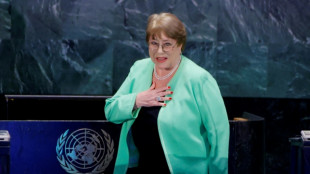 Chile's Bachelet quits race to be next UN chief

 Raphinha treble fires perfect Barca to win at Sevilla

 Thiam makes winning heptathlon return at Decastar meet

 Czechs beat USA to qualify for Davis Cup finals

 Dortmund sink Stuttgart to climb to Bundesliga summit

 Trump says will not tolerate attempts to slow AI growth

 'It has to stop': runners protest women's murders in S.Africa district

 Fire erupts near Riyadh airport as Houthis claim strikes

 Cuba works to restore power after another blackout

 England thrash Sri Lanka again to return to top of T20 rankings

 Arsenal thrashed by Brighton, sorry Spurs lose again

Rules for the emerging deep-sea mining sector should take a "precautionary approach" that protects the environment, the head of the body drafting regulations for the practice told AFP Friday.
At stake is a potential new frontier for developing mineral resources like nickel, cobalt and copper that are crucial for renewable energy technology.
But researchers and environmentalists have long warned it risks destroying habitats and species that are little understood, and could upset delicate ocean processes that affect climate change.
Regulating the industry is the responsibility of the International Seabed Authority (ISA), an independent body established under a UN convention.
Its Council aims to adopt a code this year, after more than a decade of work.
In an interview with AFP, ISA Secretary-General Leticia Carvalho said there was "no rush or delay" on finalising the rules, and urged an approach that prioritises the environment.
"We are developing regulations for an entirely new industry," said Carvalho, who took the top job this year.
"A key principle in this regard is the precautionary approach, which will help us navigate the sustainable use and management of deep-sea mineral resources."
- Divisive issue -
The world paid little attention when the ISA, created in 1994, quietly began negotiating the mining code.
But the effort has taken on new urgency.
Since July 2023, due to a legal clause invoked by the tiny Pacific island nation of Nauru, any country can apply for a mining contract in the name of a company it sponsors.
Nauru Ocean Resources Inc., a subsidiary of Canada's The Metals Company (TMC), wants to begin mining polymetallic nodules in the Pacific as soon as 2026.
It plans to file an exploitation application in June, making the need for a code governing mining all the more pressing.
Carvalho has stressed that rebuilding trust is a priority for her tenure, after her predecessor was accused of favouring mining interests and even misusing funds -- allegations the ISA Secretariat denied.
An oceanographer by training, Carvalho can only guide member states as they decide whether and how to draft a code.
The ISA's Council is deeply divided, with some member states keen to see mining start soon, and others backing a moratorium or even outright ban on seabed exploitation.
Carvalho has projected a scrupulously neutral image on the issue, emphasising the need for science-based decision-making, and equitable sharing of any profits from resources often dubbed a "common heritage of mankind."
"Without a Mining Code, the legal framework for deep-seabed mining in the Area (international seabed) would be incomplete," she said in written answers.
That could open the door to significant legal uncertainty if mining applications are filed without a code.
- 'Realm of wonder' -
Concerns about the impact of mining gained strength with the discovery last year that oxygen was being released on the ocean floor not just by living organisms, but by polymetallic nodules that would be targeted by companies.
The findings have been rejected by the TMC, even though it helped fund the research, and follow-up work is ongoing.
Mining proponents point to the growing need for minerals to drive the renewable energy transition, and the problems associated with on-land exploitation -- including environmental degradation and rights abuses.
Carvalho noted that the "dark oxygen" findings have not yet been replicated, and are the subject of debate.
And she pointed out "common misconceptions" about the prospect of deep-sea mining, including about its proposed scale, as well as what deep-sea ecosystems look like.
"Roughly 0.13 percent of the world's seabed — about 478,000 kilometres squared — could eventually be mined, a relatively small fraction compared to the vastness of the ocean floor," she said.
And while scientists are still learning about life on the seafloor, deep-sea ecosystems "tend to have lower population densities and function under vastly different environmental conditions," Carvalho said.
While running for the job last year, the Brazilian scientist emphasised her background in developing industry regulations, as well as her personal connection to the sea.
"The ocean has always been a fundamental part of who I am," she said.
It is "a realm of wonder and vast opportunities that must be responsibly managed."
L.Adams--AT