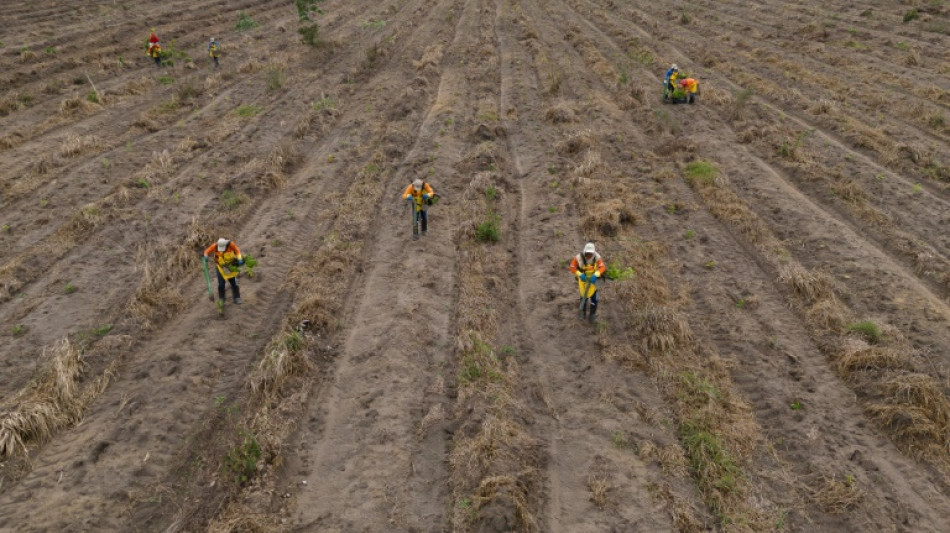
Conservation efforts can shift nature loss to more vulnerable regions: study / Photo: Pablo PORCIUNCULA - AFP

 PSG president Nasser al-Khelaifi under investigation in France for conflict of interest

 China swim sensation, 13, sets Games record after Japan win early

 Drones hit Moscow as Russians go to the polls

 New England boss Fleming says 'wrong' to ask Stokes to end retirement

 Germans vote in elections threatening fresh blow to Merz

 US fears rapid escalation in Mideast after Houthis attack Riyadh

 Japan triathlete Hojo wins first gold of Asian Games

 IOC president impressed by 'beautiful' Asian Games wooden huts

 First Asian Games gold goes to Japan as China's 13-year-old Yu lights up pool

 Data centre command hub keeps AI up and running
 Pope Leo in France: the issues on the table

 Packing for a pope: behind the scenes on foreign trips

 Republicans find transgender issues a powerful political weapon in midterm campaigning

 German state elections threaten new shock waves for Merz

 Chile's Bachelet quits race to be next UN chief

 Raphinha treble fires perfect Barca to win at Sevilla

 Thiam makes winning heptathlon return at Decastar meet

 Czechs beat USA to qualify for Davis Cup finals
 Dortmund sink Stuttgart to climb to Bundesliga summit

 Trump says will not tolerate attempts to slow AI growth

 'It has to stop': runners protest women's murders in S.Africa district

 Fire erupts near Riyadh airport as Houthis claim strikes

 Cuba works to restore power after another blackout
 England thrash Sri Lanka again to return to top of T20 rankings
 Arsenal thrashed by Brighton, sorry Spurs lose again

Could restoring the environment in one place -- say by turning farmland in Europe into a nature reserve -- harm plants and animals on the other side of the planet?
An international team of researchers on Thursday said these types of unintended consequences from well-meaning conservation efforts are more common than thought, yet are rarely considered or even properly understood.
In a new study, they warn that reducing farming and forestry in wealthy countries to meet local conservation goals can heap pressure on poorer regions to produce more food and timber.
The burden often falls on biodiversity hotspots rich in plant and animal species to make up this shortfall, said the study's lead author, Andrew Balmford.
These countries -- mostly in developing nations in Africa, Asia and South America -- are of much greater importance to nature yet pay the price for conservation gains in wealthier climes.
"In some cases, we might cause more harm than good," Balmford, from the University of Cambridge's Department of Zoology, told AFP.
The authors pointed to a case in the United States, where an effort to curb deforestation in old-growth forests simply shifted logging operations to neighbouring regions.
Balmford said a ban on domestic logging in China saw a sharp increase in timber imports from southeast Asia, a region of much higher biodiversity value.
It is a complex problem in terms of global trade, and one that is difficult to quantify.
For this study, published in the peer-reviewed journal Science, the authors applied real-world data to two hypothetical scenarios to illustrate the trap of so-called "biodiversity leakage".
- Tradeoffs -
In one, they found that rewilding a large soybean crop in Brazil would shift production elsewhere, but deliver a net gain for conservation because of the country's high biodiversity value.
But giving the same area of UK farmland back to nature would result in higher commodity imports from countries with greater plant and animal diversity, outweighing any local conservation gain.
The authors said the simple premise that intervening in one location could have knock-on impacts in another was hardly new.
Yet this uncomfortable reality had barely registered at the highest levels of government and global policymaking.
"At larger scale there is, extraordinarily, no mention of the problem" in the UN's flagship conservation policy to protect 30 percent of Earth's land and oceans by 2030, they said.
The UN's next biodiversity meeting is this month in Rome.
Balmford said Europe for example expected to set aside one-third of its land for nature and feed its people without also shifting the cost elsewhere.
"We can't always have our cake and eat it... there are some somewhat awkward tradeoffs there," he said.
Balmford said the authors -- conservation scientists and economists from over a dozen institutions -- were "passionate about conservation and very much want it to succeed".
This paper was "constructive criticism from within, but where we feel that there is a significant issue that has largely been overlooked in conservation, and that it's serious".
L.Adams--AT



