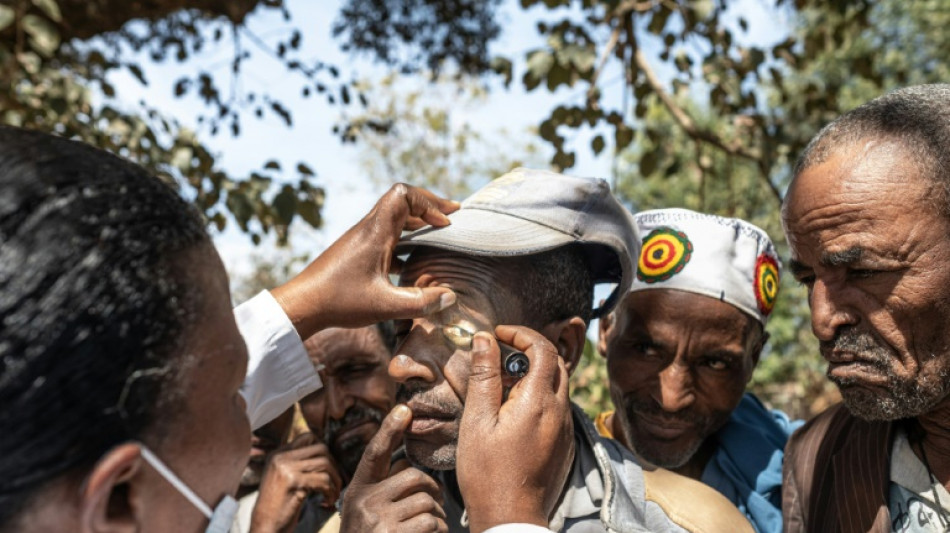
'I rip out my lashes to ease pain': Eye disease afflicts Ethiopia / Photo: Marco Simoncelli - AFP

 South Korea break Japan hearts to win Asian Games basketball gold

 Acosta takes first victory at Austrian MotoGP
 PSG president Nasser al-Khelaifi under investigation in France for conflict of interest

 China swim sensation, 13, sets Games record after Japan win early
 Drones hit Moscow as Russians go to the polls

 New England boss Fleming says 'wrong' to ask Stokes to end retirement

 Germans vote in elections threatening fresh blow to Merz

 US fears rapid escalation in Mideast after Houthis attack Riyadh

 Japan triathlete Hojo wins first gold of Asian Games

 IOC president impressed by 'beautiful' Asian Games wooden huts

 First Asian Games gold goes to Japan as China's 13-year-old Yu lights up pool

 Data centre command hub keeps AI up and running

 Pope Leo in France: the issues on the table

 Packing for a pope: behind the scenes on foreign trips

 Republicans find transgender issues a powerful political weapon in midterm campaigning

 German state elections threaten new shock waves for Merz
 Ed Sheeran set to return to stage after Palestinian controversy

 Toulouse edge Vannes, Lyon beat Pau to take Top 14 summit

 Germans arrested for Louvre stunt in Mona Lisa hall

 Saudi-led coalition says Houthis fired ballistic missile at Riyadh

 France's debt climbs to highest since 1978: ministry

 McIlroy two shots off the lead at Wentworth after eagle on 18

 Martinez brace saves Inter in Serie A top-two clash with Roma

 Rosenior abused but guides Paris FC past old club Strasbourg
 Seven-try Lyon beat Pau, climb to Top 14 summit
Scheicho Scheifa is haunted by the fear of going blind.
A disease called trachoma has turned his eyelids inwards, causing his eyelashes to scar his corneas so badly that one has already turned opaque.
The 35-year-old farmer and baker, who blinks frequently and suffers in sunshine, said the pain is so fierce he has now "stopped working entirely".
He has been mostly bound to his home in the small village of Asano, around 100 kilometres (60 miles) from Ethiopia's capital, Addis Ababa.
"Recently, I learned that the surface of my eye is wounded, and the left eye is severely damaged. The pain affects my ability to work and perform daily tasks," the father-of-two told AFP.
"Each time it flares up, I rip out my lashes to ease the pain," he added.
"The fear of going blind worries me whenever the pain strikes."
Trachoma is caused by infection with the bacterium Chlamydia trachomatis, which is spread through contact with the eyes or nose of infected people.
Flies that have touched infected people's eyes or noses can also transmit the disease.
- Two million blinded -
Women are blinded up to four times as often as men -- normally between the ages of 30 to 40 -- most likely because they are in more regular contact with children, the main reservoir of the disease.
According to the World Health Organization (WHO), trachoma is "hyperendemic in many of the poorest and most rural areas" of the world, and Africa is the most affected continent.
Around 103 million people worldwide live in the endemic areas for the disease, nearly half in Ethiopia.
Despite being in pain since childhood, Scheicho was initially reticent to undergo surgery -- which involves cutting into his eyelids and rotating the eyelashes away from his cornea -- since this had not improved his mother's condition.
He was finally convinced by Gizachew Abebe, an ophthalmologist and member of the Germany-based charity Christian Blind Mission.
The NGO has sought to inform "the community and patients to take care of their personal hygiene... a very important point to prevent trachoma", Gizachew said.
"You need to wash your face with clean water," he told a gathering of dozens of people in a small village near Asano.
That is not easy for this rural community, which is a three-hour walk to the nearest river and shares water with livestock.
- 'Hard to cut' -
The charity is working on improving access to clean water, and uses loudspeakers in markets in Butajira, the region's biggest town, to urge people to get tested for trachoma.
The least advanced cases can be treated with antibiotics or creams but more serious cases like Scheicho's require surgery.
He finally went under the knife in a small health centre without electricity in Asano, during AFP's visit.
After administering a local anaesthetic, Sister Tadelech made an incision on his upper eyelid.
"It is hard to cut," the ophthalmologist said.
But half an hour later, the operation was successfully completed.
"I feel better," a groggy Scheicho managed afterwards.
By the end of last year, 21 countries including Togo and Ghana, had eliminated trachoma as a public health problem, according to the WHO.
In Ethiopia, it could be possible to minimise the disease but "we will not eradicate" it until "people's standard of living" improves, Gizachew said.
O.Ortiz--AT



