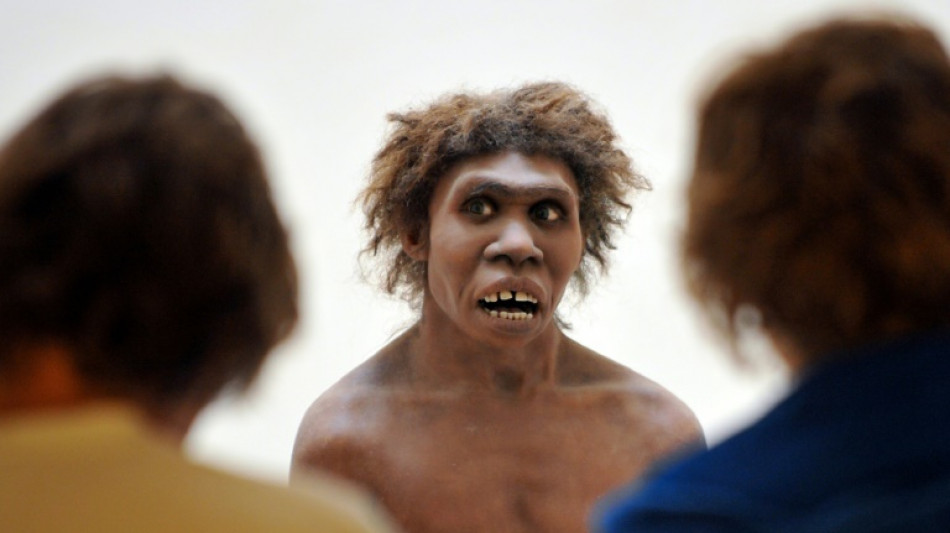
Homo erectus, not sapiens, first humans to survive desert: study / Photo: PIERRE ANDRIEU - AFP/File

 South Korea break Japan hearts to win Asian Games basketball gold

 Acosta takes first victory at Austrian MotoGP

 PSG president Nasser al-Khelaifi under investigation in France for conflict of interest

 China swim sensation, 13, sets Games record after Japan win early

 Drones hit Moscow as Russians go to the polls

 New England boss Fleming says 'wrong' to ask Stokes to end retirement

 Germans vote in elections threatening fresh blow to Merz

 US fears rapid escalation in Mideast after Houthis attack Riyadh

 Japan triathlete Hojo wins first gold of Asian Games

 IOC president impressed by 'beautiful' Asian Games wooden huts

 First Asian Games gold goes to Japan as China's 13-year-old Yu lights up pool

 Data centre command hub keeps AI up and running

 Pope Leo in France: the issues on the table

 Packing for a pope: behind the scenes on foreign trips

 Republicans find transgender issues a powerful political weapon in midterm campaigning

 German state elections threaten new shock waves for Merz

 Ed Sheeran set to return to stage after Palestinian controversy

 Toulouse edge Vannes, Lyon beat Pau to take Top 14 summit

 Germans arrested for Louvre stunt in Mona Lisa hall

 Saudi-led coalition says Houthis fired ballistic missile at Riyadh

 France's debt climbs to highest since 1978: ministry

 McIlroy two shots off the lead at Wentworth after eagle on 18

 Martinez brace saves Inter in Serie A top-two clash with Roma

 Rosenior abused but guides Paris FC past old club Strasbourg

 Seven-try Lyon beat Pau, climb to Top 14 summit

Our ancestor Homo erectus was able to survive punishingly hot and dry desert more than a million years ago, according to a new study that casts doubt on the idea that Homo sapiens were the first humans capable of living in such hostile terrain.
The moment when the first members of the extended human family called hominins adapted to life in desert or tropical forests marks "a turning point in the history of human survival and expansion in extreme environments," lead study author Julio Mercader Florin of the University of Calgary told AFP.
Scientists have long thought that only Homo sapiens, who first appeared around 300,000 years ago, were capable of living sustainably in such inhospitable regions.
The first hominins to have split off from the other great apes were believed to be limited to less hostile ecosystems, such as forest, grasslands and wetlands.
One of the world's most important prehistoric sites, Olduvai Gorge in modern-day Tanzania, was thought to home to those easier types of landscapes.
But this steep ravine in East Africa's Great Rift Valley, which has played a key role in the understanding of human evolution, was actually a desert steppe, according to the study published in the journal Communications Earth & Environment on Thursday.
After collecting archaeological, geological and palaeoclimatic data, the international team of researchers were able to reconstruct the gorge's ecosystem over the years.
Fossilised pollen of the Ephedra shrub -- which commonly lives in arid areas -- as well as traces of past wildfires and signs in the soil show there was an extreme drought in the area between one and 1.2 million years ago.
- Homo erectus: underestimated? -
Evidence collected from the Engaji Nanyori site in the gorge suggests that Homo erectus adapted to this hostile environment "by focusing on ecological focal points such as river confluences where water and food resources were more predictable", Mercader Florin said.
"Their ability to repeatedly exploit these focal points... and adapt their behaviours to extreme environments demonstrates a higher level of resilience and strategic planning than previously assumed."
Specialised tools found at the site, such as hand axes, scrapers and cleavers, showed that Homo erectus had also worked out how to process animal carcasses.
The bones of animals such as cows, hippopotamuses, crocodiles and antelopes also had cut marks, indicating they had been skinned and had their bone marrow extracted.
"This suggests they optimised their resource use to adapt to the challenges of arid environments, where resources were scarce and needed to be exploited fully," Mercader Florin said.
"Our findings show that Homo erectus was capable of surviving long term in extreme environments characterised by low density of food resources, navigational challenges, very low/very high plant life, temperature/humidity extremes, and the need for high mobility," he added.
"This adaptability expands Homo erectus's potential range into the Saharo-Sindian region across Africa and into similar environments in Asia."
F.Ramirez--AT



