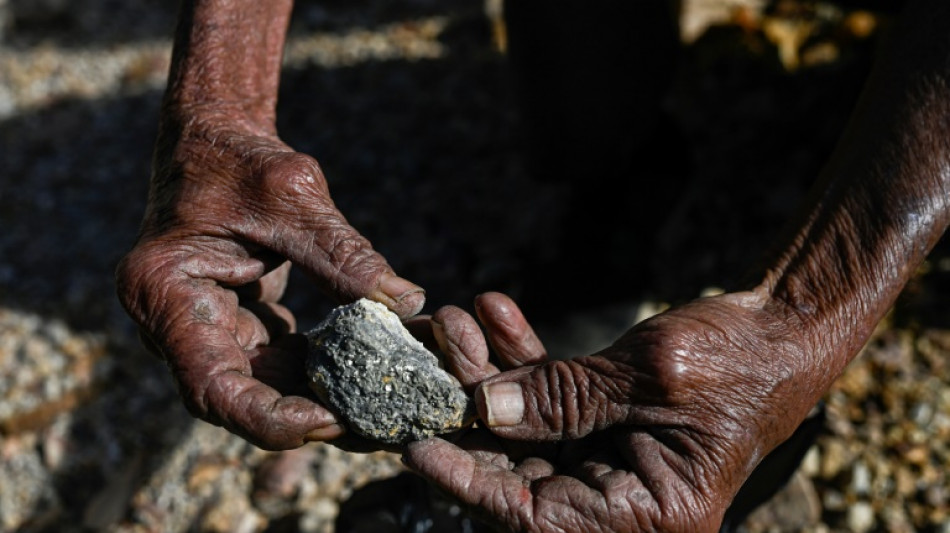
President's push to scrap gold mining ban causes outcry in El Salvador / Photo: Daniela RODRIGUEZ - AFP

 Reusser retains world time-trial title

 Man City outgun Sunderland despite Brobbey hat-trick, Liverpool win at Bournemouth

 Top US, Chinese economic officials meet ahead of Trump-Xi summit

 Erdogan's LGBTQ crackdown 'first step of election campaign': activist

 Mass drone barrage on Moscow kills two

 82-year-old dies after beach fight in Greece over sun lounger

 US warns of rapid escalation in Mideast war

 Iran 'put hearts on the court' to win Asian Games basketball bronze

 School girl Yu helps China dominate in Asian Games swimming openers

 Myanmar win first Asian Games teqball gold as Spain great Puyol watches

 China's 13-year-old Yu scorches to first major gold at Asian Games

 Russians vote on last day of parliamentary elections

 Hong Kong pays final respects to former city leader Tung

 Typhoon put people off Asian Games opening ceremony, official says

 China's 13-year-old Yu cruises as Asian Games swimming begins

 AI 'warning shots' focus Beijing on national security risks

 Philippine tribe in limbo over US-led tech hub

 Leo XIV, first US pope transcends his restrained style

 Singer Ed Sheeran says Gaza situation 'unjustifiable' following controversy

 In 'Tenzing', a Sherpa mountaineer gets his due

 Gridko's New Live Drive PTO Roll-Off Trailer Wins the Heavy-Duty TRAILmakER Award 2026 at NATDA Awards

 Chile's Bachelet quits race to be next UN chief

 Raphinha treble fires perfect Barca to win at Sevilla

 Thiam makes winning heptathlon return at Decastar meet

 Czechs beat USA to qualify for Davis Cup finals

El Salvador's gang-busting strongman President Nayib Bukele has set out on a new mission: to kickstart his country's sputtering economy by inviting back the mining companies that were barred seven years ago.
El Salvador was the first country in the world to ban the mining of metals in 2017, warning of the harmful effects of the chemicals used in mining, like cyanide and mercury.
The move by Bukele's predecessor, former left-wing rebel Salvador Sanchez Ceren, reflected the growing rejection of mining by rural communities in central America, devastated by the industry's adverse health and environmental effects.
Costa Rica and Honduras have both banned open-pit mining and Panama declared a moratorium on new mining concessions last year after mass protests over plans for a huge copper mine.
But on November 27, the populist Bukele signaled he wanted to change course.
In a series of posts on the social network X he claimed that El Salvador, a country of 6.6 million people, had "potentially" the largest gold deposits per square kilometer in the world.
"God placed a gigantic treasure underneath our feet," he wrote, arguing that the mining ban was "absurd."
Bukele cited a study -- written by unknown authors and which he did not publish -- that he said showed that mining a mere 4 percent of the country's gold deposits would bring in $131 billion, "equivalent to 380 percent of GDP."
"If we make responsible use of our natural resources, we can change the economy of El Salvador overnight," he added a few days later.
- 'Huge risk' -
Since El Salvador dollarized its remittances-reliant economy in 2001, it has registered annual growth of between just 2 and 3.5 percent.
Twenty-seven percent of Salvadorans live in poverty, according to the United Nations Economic Commission for Latin America and the Caribbean, and 70 percent of the workforce operates in the informal sector.
Bukele, in power since 2019, took a huge gamble by investing hundreds of millions of dollars of taxpayer money in bitcoin and making the cryptocurrency legal tender in 2021 -- the first country in the world to do so.
But most Salvadorans have shunned the cryptocurrency. Additionally, the country's adoption of bitcoin hampered Bukele's talks with the International Monetary Fund over a $1.3 billion loan.
He now appears to be pinning his hopes for a recovery on mining.
But he faces a stiff challenge from environmentalists who have won several victories over mining companies.
"It's one thing to put a mine in the Atacama Desert (in Chile) and another thing to open an open-pit mine in Chalatenango," said Pedro Cabezas, leader of the Central American Alliance Against Mining.
Chalatenango is a community north of the capital San Salvador that successfully opposed a gold mine project in 2006.
Antonio Pacheco, of the Association of Economic and Social Development NGO, which has pioneered the fight against mining, said that Bukele's proposal to mine areas along the mighty Lempa River, which supplies water for San Salvador, represented a "tremendous risk" to residents.
- 'Generate employment' -
In the former gold mining town of Santa Rosa de Lima, where US miner Commerce Group had its environmental licence revoked in 2006 over river pollution, Bukele's plan elicited a mixed response.
"I think that this could cause the area to prosper... it would generate employment," Ruben Delgado, a 55-year-old construction worker, told AFP.
Jose Torres, a 72-year-old artisanal miner who extracts gold nuggets from disused mining tunnels by hand, said he feared losing his income to multinationals.
The nearby San Sebastian River was contaminated by industrial mining, and remains polluted to this day as artisanal mining continues.
Economist Carlos Acevedo, former president of the Central Bank of El Salvador, commented that the "spectacular" figures presented by Bukele created the impression that El Salvador "is sitting on a gold mine."
He said that the 50 million ounces of gold touted by Bukele as a fraction of the country's reserves could pay off El Salvador's external debt -- which accounts for 85 percent of GDP -- four times over.
But he added that there was "no recipe for generating growth from one day to the next" and that any boon for El Salvador would depend on how much royalties mining companies paid.
T.Wright--AT



