With blasts and grit, Colombia fights gold mines run by crime gangs / Photo: JOAQUIN SARMIENTO - AFP

 Reusser retains world time-trial title

 Man City outgun Sunderland despite Brobbey hat-trick, Liverpool win at Bournemouth

 Top US, Chinese economic officials meet ahead of Trump-Xi summit
 Erdogan's LGBTQ crackdown 'first step of election campaign': activist

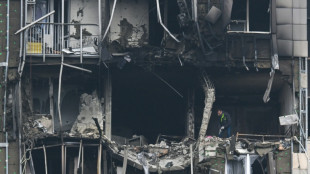 Mass drone barrage on Moscow kills two

 82-year-old dies after beach fight in Greece over sun lounger

 US warns of rapid escalation in Mideast war

 Iran 'put hearts on the court' to win Asian Games basketball bronze

 School girl Yu helps China dominate in Asian Games swimming openers

 Myanmar win first Asian Games teqball gold as Spain great Puyol watches

 China's 13-year-old Yu scorches to first major gold at Asian Games

 Russians vote on last day of parliamentary elections

 Hong Kong pays final respects to former city leader Tung

 Typhoon put people off Asian Games opening ceremony, official says

 China's 13-year-old Yu cruises as Asian Games swimming begins

 AI 'warning shots' focus Beijing on national security risks

 Philippine tribe in limbo over US-led tech hub

 Leo XIV, first US pope transcends his restrained style

 Singer Ed Sheeran says Gaza situation 'unjustifiable' following controversy

 In 'Tenzing', a Sherpa mountaineer gets his due

 Gridko's New Live Drive PTO Roll-Off Trailer Wins the Heavy-Duty TRAILmakER Award 2026 at NATDA Awards

 Chile's Bachelet quits race to be next UN chief

 Raphinha treble fires perfect Barca to win at Sevilla

 Thiam makes winning heptathlon return at Decastar meet

 Czechs beat USA to qualify for Davis Cup finals

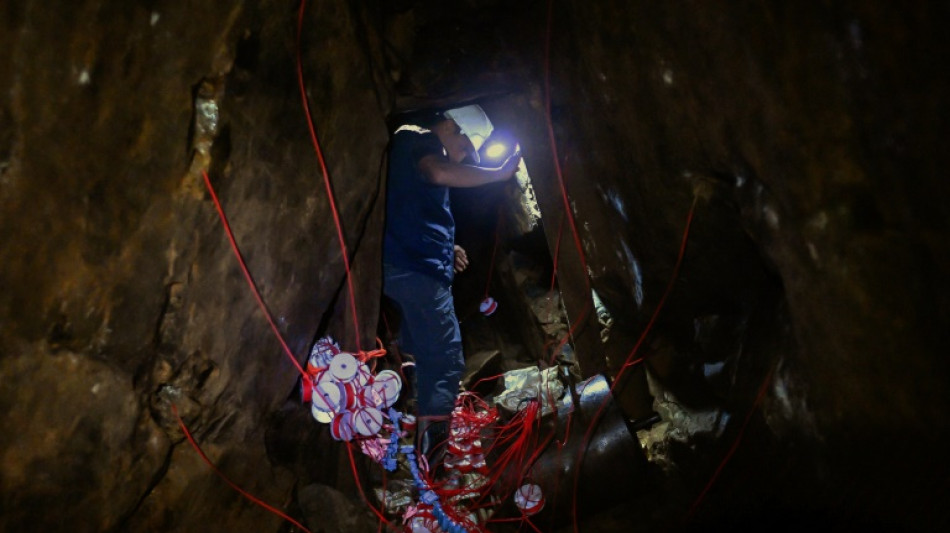
A thin detonating cord snakes its way into an illegal gold mine drilled high up on a mountain near the Colombian city of Cali, exploding with a roar and destroying a lucrative source of money for armed groups that include leftist rebels.
The blast brings down the walls of a tunnel leading into the pit in Farallones National Park, which features a stretch of the Andes that runs just outside Colombia's third largest city.
The entrance is now blocked by tons of rubble, putting that mine out of commission.
It took the engineers, police and city officials assigned to knock it out 10 hours to hike up to the mine, which was dug at an altitude of 3,400 meters (11,000 feet).
Wildcat miners operating under the control of local crime gangs and leftist rebels have been running mines like this for decades in these mist-covered mountains.
To isolate the gold, they use mercury, a toxic liquid metal that is polluting the water used in Cali, home to 2.2 million people.
"All that mercury goes into the ground" and ends up in rivers that supply its drinking water, said the chief engineer of the blasting operation, who for safety reasons did not want to give his name.
AFP accompanied the blasting team on a three-day climb in the mountains, with mules carrying the equipment.
The government estimates that 85 percent of the gold that Colombia exports comes from unlicensed mines.
The above-board mines yielded at least 248 tons of gold from 2017 to 2022, according to the United Nations.
In the Cali region, the grueling, freezing work of climbing a mountain to dig into it for gold is done by local people employed by local crime gangs.
These in turn pay a tax to rebels who have formed renegade, offshoot groups from the once powerful guerrilla army known as the FARC, which laid down its weapons under a historic 2016 peace accord after decades of fighting.
These FARC dissidents thus run a large network of illegal mines that extends beyond the Cali region.
- Working at an altitude -
While engineers prepare to set off the blast with a thick string of red cables, rifle-toting police wearing gas masks protect them.
The explosives themselves were brought to the site by helicopter.
One man sounds a siren to warn a blast is coming, then another activates a detonator that triggers the explosion and a cloud of white smoke.
As they camp at night, the team members see the lights of Cali in the distance, which hosted a UN conference on biodiversity in October and November.
Missions like this to take out unauthorizied mines have intensified in recent months.
Cali's deputy secretary for security, Alvaro Pretel, said crews have destroyed 11 fully operating mines and another 27 that were in the process of being dug.
The mine that AFP saw destroyed was no longer active, as miners had abandoned it under pressure from law enforcement.
- Water and mercury -
This particular spot high up in the mountains is the source of seven rivers that supply the city with water, said Pretel.
And just in the last year, nearly a ton of mercury was used in the mines outside Cali, he added.
The shiny, dangerous metal, he said, "sooner or later ends up in the drinking water of the people of Cali."
The government agency that oversees Colombia's national parks found around 420 digging pits in the Farallones park in 2019, Pretel said.
In 2022, the United Nations said it detected 69,000 hectares (170,500 acres) of land in Colombia where illegal gold mining was underway.
In May, officials said they found excessive levels of mercury and arsenic -- which is also used in gold mining -- near an aqueduct that routes to the city.
Experts say illegal mining can be even more lucrative than trafficking in cocaine.
At times, authorities have found mines with as many as 1,000 people working in them, who threw projectiles as police tried to move in and shut down the operation, said Gustavo Escobar, head of a police unit tasked with fighting illegal mining.
W.Nelson--AT