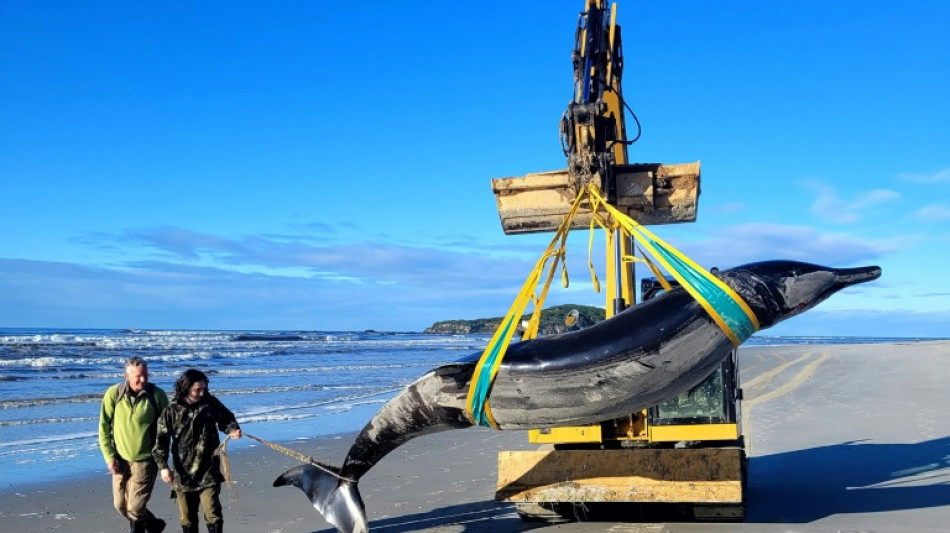
New Zealand scientists dissect world's rarest whale / Photo: New Zealand Department of Conservation - AFP

 UK House Prices Fall 1.2% as London Records Sharpest Annual Decline

 Get Huge: Looksmaxxing to Death Docuseries Details Tony Huge's Thailand Crimes

 IIM Indore Announces IPMAT 2027 Exam Date for April 24

 Quick Pressure-Cooker Beef Stew and Rice Minestrone Soup Recipes

 Trifecta Gold Reports 2026 Exploration Results from the Liam and Lois Projects, Tombstone Gold Belt, Yukon

 Christmas Day Shifts More than Double as Americans Return to In-Person Holiday Celebrations
 Fulcrum Metals PLC Announces Publication of Updated Investor Presentation
 InterContinental Hotels Group PLC Announces Transaction in Own Shares - November 11

 6 Pieces of Furniture Worth Investing In
 AmeriLife Welcomes Finance Veteran Richard Dziadzio as Chief Financial Officer; Names Jim Quinn President & Chief Transformation Officer

 XCF Global Hosts USDA at New Rise Renewables Reno as Facility Surpasses 4.4 Million Gallons Since Restart
 Green Leaf Innovations (OTC: GRLF) Meets OTCID Disclosure Requirements Following Profitable Q2 2026 Results
Ethur Takes On Hiring Fraud With Facial Biometrics Identity Checks and Connected Payroll and Bank Data
 Olivier Martinez Seeks Increased Child Support from Halle Berry Following Custody Change

 Joe Biden Makes Surprise Appearance at Trinity College Dublin for Hunter's Medal

New Zealand scientists on Monday began dissecting a whale considered the rarest in the world, a species so elusive that only seven specimens have ever been documented.
The dead spade-toothed whale washed ashore on New Zealand's South Island earlier this year, offering a chance to study a deep-sea mammal that has never been seen alive.
Measuring five metres (16.4 feet) long, the whale was winched off the beach in July and has sat in a special freezer since.
Whale expert Anton van Helden said it was the first time scientists had been able to dissect a complete spade-toothed specimen, which belongs to the family of beaked whales.
"This is a remarkable and globally significant opportunity," he said.
The week-long dissection will help to fill in gaps about the whale's behaviour, its diet, and even its basic anatomy.
"Beaked whales are the most enigmatic group of large mammals on the planet," said Van Helden.
"They are deep divers that are rarely seen at sea, which presents real challenges for researching these marine animals.
"This one is the rarest of the rare -- only the seventh specimen known from anywhere in the world, and the first opportunity we have had to undertake a dissection like this."
New Zealand's conservation department said the spade-toothed whale was the "rarest whale in the world".
The species was first described in 1874 from just a lower jaw and two teeth collected from the Chatham Islands off the east coast of New Zealand.
That sample, along with skeletal remains of two other specimens found in New Zealand and Chile, enabled scientists to confirm a new species.
Because so few specimens have been found and there have been no live sightings, the spade-toothed whale is classified as "data deficient" under the New Zealand Threat Classification System.
N.Walker--AT