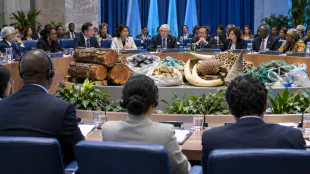
Nations warn of deadlock at landmark plastic pollution talks / Photo: Roland de Courson - AFP

 The Dice Box Recommends Winter Board Games for Sneinton Market Lounge

 Government Overspends €607 Million on International Protection Accommodation in 2024
 Palestinians Salvage Cultural Heritage from Gaza Rubble Amid Widespread Destruction

 Guardian Metal Resources PLC Announces Proposed Spin-Out of Non-Tungsten Projects

 Fulcrum Metals PLC Announces New Critical Mineral Recoveries Expand Potential
 Fulcrum Metals PLC Announces Publication of Updated Investor Presentation

 Christmas Day Shifts More than Double as Americans Return to In-Person Holiday Celebrations

 Police Investigate Bedford Parent for Hallway Incident After Playoff Loss
 Regal Cinemas Launches 4DX Screenings for 'Heated Rivalry' Amid Immersive Theater Trend

Diplomats warned Saturday that a majority of countries could walk away from talks on the world's first plastic pollution agreement if a handful of delegations continue resisting calls to compromise.
Nearly 200 countries are in South Korea's Busan for negotiations on a deal to curb plastic pollution.
But efforts to reach the landmark agreement are locked over several key sticking points, particularly reducing production and phasing out chemicals believed or known to harm human health.
Over 100 countries back those measures, and insist a treaty without them will fail to solve the pollution crisis.
But around a dozen nations -- mostly producers of plastic precursors derived from fossil fuels -- are strongly opposed.
As a result, just a day before talks are supposed to end, the draft text remains full of opposing views and contradictory language.
And frustration is growing.
"The overwhelming majority of delegates here demand an ambitious treaty," said Panama's delegation head Juan Carlos Monterrey Gomez.
"If the reduction of production is not there, there is no treaty."
"We cannot let a few loud voices derail the process," he added.
- 'Ready to walk away' -
A diplomat from the High Ambition Coalition, which groups dozens of countries seeking a strong deal, echoed that sentiment.
"We are a large group uniting around key effective elements, and getting ready to walk away," he told AFP, speaking on condition of anonymity to discuss closed-door deliberations.
He warned that "some countries" were actively considering calling a vote, which would circumvent the UN's traditional approach of agreement by consensus and could "raise a lot of eyebrows."
It was a possibility being increasingly discussed as a "last resort," said the Democratic Republic of Congo's J.M. Bope Bope Lapwong.
"I think that if we can't reach an agreement, we'll be obliged to go to a vote. We cannot come all this way, all these kilometres, to fail," he told AFP.
"True, it's not the usual way at UN meetings, and we will do it to our shame -- because when you negotiate, you don't expect to win it all."
More than 90 percent of plastic is not recycled, while plastic production is expected to triple by 2060.
Environmental groups have pushed ambitious countries to move to a vote if progress stalls, arguing that countries like Saudi Arabia and Russia have not offered any compromises during talks.
Neither delegation responded to repeated requests by AFP for comment.
"A handful of governments... are looking backwards and refusing to take the steps necessary for us all to advance," said Greenpeace's Graham Forbes.
"I think we are at a very risky moment right now of being sold out, and that would be an absolute catastrophe."
But observers warned that calling a vote would be a risky strategy that could alienate even some countries in favour of a strong treaty.
Another option would be for the diplomat chairing the talks to simply gavel through an agreement over the objections of a handful of holdouts, they said.
But that too holds risks, potentially embittering the remaining diplomatic process and jeopardising adoption of a treaty down the road.
"We don't want to move outside the framework of the United Nations," said an official from the French environment ministry.
"We hope we will find agreement between now and tomorrow and that's the option that we're focused on," he added.
"A lot can happen in 24 hours."
E.Hall--AT