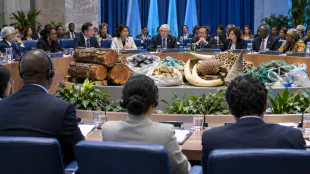
'Very, very slow': plastic treaty talks grind forward / Photo: - - YONHAP/AFP

 The Dice Box Recommends Winter Board Games for Sneinton Market Lounge

 Government Overspends €607 Million on International Protection Accommodation in 2024
 Palestinians Salvage Cultural Heritage from Gaza Rubble Amid Widespread Destruction

 Guardian Metal Resources PLC Announces Proposed Spin-Out of Non-Tungsten Projects

 Fulcrum Metals PLC Announces New Critical Mineral Recoveries Expand Potential
 Fulcrum Metals PLC Announces Publication of Updated Investor Presentation

 Christmas Day Shifts More than Double as Americans Return to In-Person Holiday Celebrations

 Police Investigate Bedford Parent for Hallway Incident After Playoff Loss
 Regal Cinemas Launches 4DX Screenings for 'Heated Rivalry' Amid Immersive Theater Trend

Negotiations on a first global treaty to curb plastic pollution are moving "very, very slowly", diplomats and observers told AFP on Wednesday, threatening the chances of reaching an agreement.
Delegates from nearly 200 countries are meeting in South Korea's Busan with the goal of reaching a deal by December 1, after two years of talks.
But the first full day of work in four "contact groups" tasked with refining language for the treaty ended up with discussions "going around in circles," said Eirik Lindebjerg, global plastics policy manager at WWF.
"Contact group discussions are moving too slow," he told AFP.
That view was echoed by several diplomats, who spoke on condition of anonymity to describe closed-door negotiations.
"It's very, very slow, with the usual countries constantly slowing down the process," said one delegate from a Latin American delegation.
Submissions to the contact groups made clear that Saudi Arabia, Iran and Russia -- suppliers of raw materials used to make plastics -- were among the countries seeking significant amendments, including deleting a portion of the treaty aimed at limiting new production.
In a submission, Saudi Arabia warned supply restrictions "extend beyond" the treaty's focus on plastic pollution and risked creating "economic disruptions."
Others involved in the talks warned of growing frustration.
"There is a difference between protecting one's interests and willfully impeding progress in the talks," a delegate from a small island state said.
A European diplomat meanwhile warned that the tenor of discussions so far suggested it would be "very, very tough at the end" of the talks.
"I think that we will come to a very difficult situation in two days' time at the latest," added another delegate.
Still there were some bright spots, said Lindebjerg, including on proposals to potentially limit "problematic" products and chemicals.
"This can take us far in eradicating harmful and unnecessary plastic items that have been poisoning humanity and nature," he said.
"Now, the progressive majority of countries represented here... must act in unison and not compromise," he added.
While UN agreements are generally reached by consensus, he warned that a binding treaty "supported by the majority of governments will be far more effective than a weak and voluntary-based treaty supported by all governments."
That view was echoed by a second European diplomat.
"The key to success is to create an agreement that has the support of the vast majority," he told AFP.
That "will force the small group (of opposing countries) to try to destroy it or to be a noisy and unsatisfied minority for a treaty that they will eventually sign."
W.Morales--AT