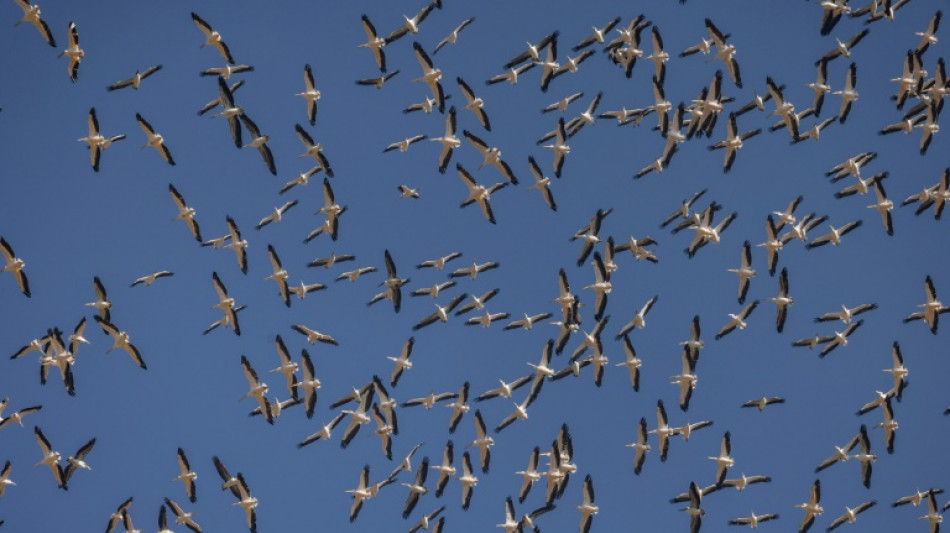
Nature pays price for war in Israel's north / Photo: Menahem KAHANA - AFP

 Reusser retains world time-trial title

 Man City outgun Sunderland despite Brobbey hat-trick, Liverpool win at Bournemouth

 Top US, Chinese economic officials meet ahead of Trump-Xi summit
 Erdogan's LGBTQ crackdown 'first step of election campaign': activist

 Mass drone barrage on Moscow kills two

 82-year-old dies after beach fight in Greece over sun lounger

 US warns of rapid escalation in Mideast war

 Iran 'put hearts on the court' to win Asian Games basketball bronze

 School girl Yu helps China dominate in Asian Games swimming openers

 Myanmar win first Asian Games teqball gold as Spain great Puyol watches

 China's 13-year-old Yu scorches to first major gold at Asian Games

 Russians vote on last day of parliamentary elections

 Hong Kong pays final respects to former city leader Tung

 Typhoon put people off Asian Games opening ceremony, official says

 China's 13-year-old Yu cruises as Asian Games swimming begins

 AI 'warning shots' focus Beijing on national security risks

 Philippine tribe in limbo over US-led tech hub

 Leo XIV, first US pope transcends his restrained style

 Singer Ed Sheeran says Gaza situation 'unjustifiable' following controversy

 In 'Tenzing', a Sherpa mountaineer gets his due

 Gridko's New Live Drive PTO Roll-Off Trailer Wins the Heavy-Duty TRAILmakER Award 2026 at NATDA Awards

 Chile's Bachelet quits race to be next UN chief

 Raphinha treble fires perfect Barca to win at Sevilla

 Thiam makes winning heptathlon return at Decastar meet

 Czechs beat USA to qualify for Davis Cup finals

Across northern Israel's lush, green nature reserves, the ecological toll of the war between Israel and Hezbollah militants is laid bare: wild boar hit by shrapnel, trees reduced to ashes and swathes of charred vegetation.
In the Hula Valley, home to a unique migration sanctuary for birds, a flock of common cranes and their cacophony of calls fill the air -- but smoke billows in the distance and their sounds soon compete with the whir of Israeli military helicopters overhead.
The impact is particularly clear at the Agamon Hula Valley Nature Reserve, where all that remains in some areas after more than a year of Hezbollah rocket fire from Lebanon are burned plants and cinder-strewn soil.
Inbar Rubin, field director at the reserve, worries about the war's effects on birds.
"The noises of war, the sounds of interceptions, of (rockets) falling and the loud booms -- these are the sounds that birds hear," Rubin said. "It's a huge source of stress."
The war has driven visitors away from the reserve, which sits approximately 30 kilometres (19 miles) from the border with Lebanon.
"People say to me, 'Wow, the birds must be happier because there are no people,' but the damage the war does to nature is a million times more than the damage visitors do."
The reserve is an internationally known resting spot for hundreds of millions of birds migrating from Europe and Asia to Africa and back during the spring and autumn seasons.
It is home to pelicans, ducks, eagles and other birds of prey, as well as flamingos, which Rubin said is "a fairly new phenomenon".
But she noted that fewer birds were stopping at the sanctuary than in previous seasons, adding there was "much less nesting than in normal years" and reduced mating.
- Paradise lost? -
Hezbollah began launching low-intensity attacks on Israel last year, in solidarity with its ally Hamas following the Palestinian militant group's October 7, 2023 attack.
After nearly a year of trading cross-border fire with Hezbollah, Israel widened the focus of its operations from Gaza to Lebanon, launching a massive aerial campaign and sending ground forces across the border.
The bombing has devastated villages in Lebanon, especially areas along its southern border with Israel, where Hezbollah holds sway.
Around 50,000 cranes came to the reserve the previous winter, said longtime ornithologist Yossi Leshem, "and for them, it was really paradise".
But after the Israel-Hezbollah war started, he added, the number of birds arriving dropped by 70 percent.
"It is a real threat," said Leshem, also the founder of an international bird migration research centre. The fighting and fires have also caused food resources for the birds to dwindle.
"Even if the war will stop in a year now -- and I hope it will stop as soon as possible... the impact can be felt for many more years," he told AFP.
In the long term, however, the conflict would not ultimately change the birds' pattern of migration, Leshem said. The birds passing through will be "less successful and so on, but finally, when the war stops, it (migration) goes on".
The damage is not limited to the reserve.
Israel's nature and parks authority has assessed that since the October 7 Hamas attack, around 92,400 acres (37,400 hectares) of nature reserves, national parks, forests and open areas have been burned across the country.
"The damage to nature is of course extensive and in numbers we are not used to," said Amit Dolev, an ecologist for the authority's northern district.
Israel's military has said nearly 16,000 projectiles, including exploding drones, have been fired into the country from Lebanese territory, many sparking wildfires.
Others, shot down by Israel's military, have sent shrapnel flying into open areas.
- Nature's resilience -
At the nature reserve of Tel Dan, adjacent to the Lebanese border, around 17 acres (seven hectares) out of 400 have been devastated by fires ignited by rockets.
On the banks of the burbling Dan stream, beside the silhouette of a burnt-out blackthorn tree, Ramadan Issa, who manages the reserve, said he had spent the last year putting out fires and rescuing animals injured or distressed by the fighting.
He pointed to suffering wildlife including porcupines, snakes and wild boars injured or killed by missiles or shrapnel, as well as the destruction of ancient trees.
But on the charred earth where he stood, small green blades of grass and vegetation were already sprouting.
"Nature is strong," Issa said. "It can grow back very fast and after the first (winter) rains, a lot will start to come back."
Ch.Campbell--AT



