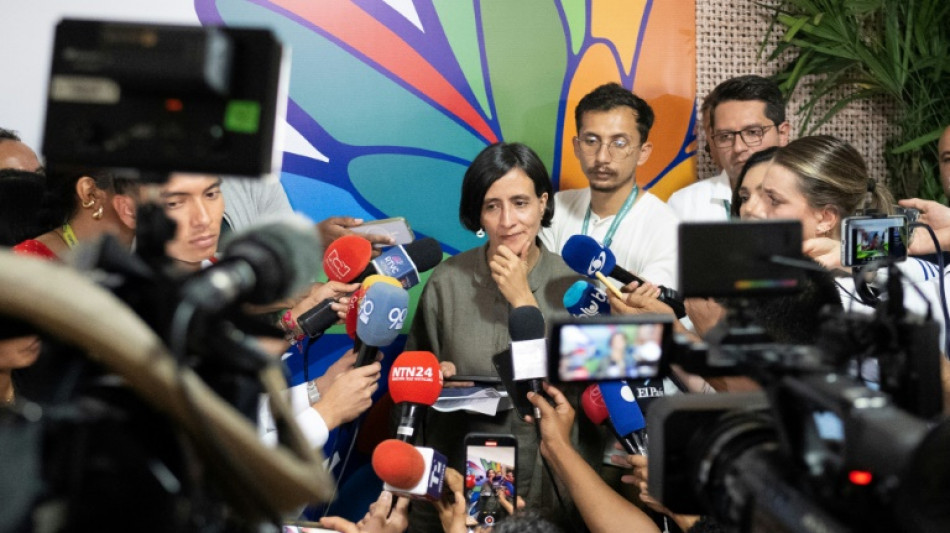
UN talks on saving nature stumble on finance hurdle / Photo: Luis ACOSTA - AFP

 Germany's Merz vows to stay course despite new vote losses

 Man City outgun Sunderland despite Brobbey hat-trick, Man Utd rescue Fulham draw

 Mourinho blames ref committee for Real Madrid derby defeat

 Maresca craves a 1-0 win after eight-goal Man City thriller

 Atletico Madrid beat Real Madrid in tense derby clash

 Reusser retains world time-trial title

 Man City outgun Sunderland despite Brobbey hat-trick, Liverpool win at Bournemouth

 Top US, Chinese economic officials meet ahead of Trump-Xi summit

 Erdogan's LGBTQ crackdown 'first step of election campaign': activist

 Mass drone barrage on Moscow kills two

 82-year-old dies after beach fight in Greece over sun lounger

 US warns of rapid escalation in Mideast war

 Iran 'put hearts on the court' to win Asian Games basketball bronze

 School girl Yu helps China dominate in Asian Games swimming openers

 Myanmar win first Asian Games teqball gold as Spain great Puyol watches

 China's 13-year-old Yu scorches to first major gold at Asian Games

 Russians vote on last day of parliamentary elections

 Hong Kong pays final respects to former city leader Tung

 Typhoon put people off Asian Games opening ceremony, official says

 China's 13-year-old Yu cruises as Asian Games swimming begins

 AI 'warning shots' focus Beijing on national security risks

 Philippine tribe in limbo over US-led tech hub

 Leo XIV, first US pope transcends his restrained style

 Singer Ed Sheeran says Gaza situation 'unjustifiable' following controversy

 In 'Tenzing', a Sherpa mountaineer gets his due

The world's biggest nature conservation conference closed in Colombia on Saturday with no agreement on a roadmap to ramp up funding for species protection.
The 16th Conference of Parties (COP16) to the UN's Convention on Biological Diversity (CBD) was suspended by its president Susana Muhamad as negotiations ran almost 12 hours longer than planned and delegates started leaving to catch flights.
The exodus left the summit without a quorum for decision-making, but CBD spokesman David Ainsworth told AFP it will resume at a later date to consider outstanding issues.
The conference, the biggest meeting of its kind yet, with around 23,000 registered delegates, was tasked with assessing, and ramping up, progress toward an agreement reached in Canada two years ago to halt humankind's rapacious destruction of nature's bounty.
The Kunming-Montreal Global Biodiversity Framework that emerged from that meeting had set 23 targets to be met in just over five years from now.
They include placing 30 percent of land and sea areas under protection and 30 percent of degraded ecosystems under restoration by 2030, reducing pollution, and phasing out agricultural and other subsidies harmful to nature.
The Canada summit had also agreed that $200 billion per year be made available to protect biodiversity by 2030, including the transfer of $30 billion per year from rich to poor nations.
The actual total for 2022 was about $15 billion, according to the Organization for Economic Cooperation and Development (OECD).
On top of that, nations have pledged about $400 million to a Global Biodiversity Framework Fund (GBFF) created last year to meet the UN targets.
In Cali, negotiators were split largely between poor and rich country blocs as they haggled over increased funding and other commitments.
The biggest ask from the summit -- to lay out a detailed funding plan -- turned out to be a bridge too far.
Muhamad, Colombia's environment minister, had offered a draft text proposing the creation of a dedicated biodiversity fund, which was rejected by the European Union, Switzerland and Japan.
Developing nations had insisted on the creation of a dedicated biodiversity fund, saying they are not adequately represented in existing mechanisms including the GBFF, which they say are also too onerous.
- 'Clock is ticking' -
The meeting did manage to coalesce around the creation of a fund to share the profits of digitally sequenced genetic data taken from plants and animals with the communities they come from.
Such data, much of it from species found in poor countries, is notably used in medicines and cosmetics that can make their developers billions, very little of which ever trickles back down.
Delegates also approved the creation of a permanent body to represent the interests of Indigenous people under the UN's Convention on Biological Diversity.
Representatives of Indigenous peoples, many in traditional dress and headgear, broke out in cheers and chants as the agreement was gaveled through.
But the talks on biodiversity funding stumbled even as new research presented to coincide with COP16 showed that more than a quarter of assessed plants and animals are now at risk of extinction.
Only 17.6 percent of land and inland waters, and 8.4 percent of the ocean and coastal areas, are estimated to be protected and conserved.
UN chief Antonio Guterres, who had stopped over in Cali for two days with five heads of state and dozens of ministers to add impetus to the talks, reminded delegates that humanity has already altered three-quarters of Earth's land surface and two-thirds of its waters.
"The clock is ticking. The survival of our planet's biodiversity -- and our own survival -- are on the line," he said.
The meeting was held amid a massive security deployment following threats from a Colombian guerrilla group with its base of operations near Cali. No incidents were reported.
A.Anderson--AT



