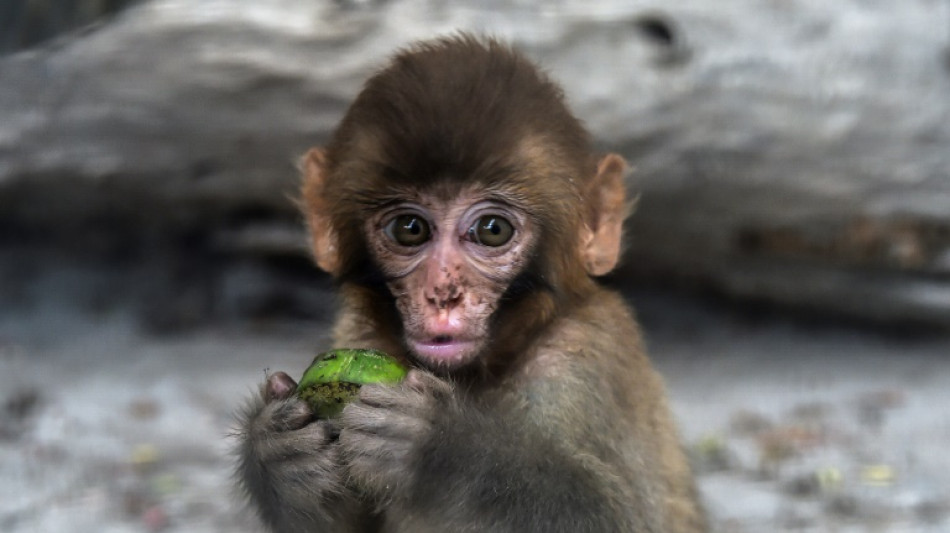
Not enough time in universe for monkeys to pen Shakespeare: study / Photo: Asif HASSAN - AFP

 Germany's Merz vows to stay course despite new vote losses

 Man City outgun Sunderland despite Brobbey hat-trick, Man Utd rescue Fulham draw

 Mourinho blames ref committee for Real Madrid derby defeat
 Maresca craves a 1-0 win after eight-goal Man City thriller

 Atletico Madrid beat Real Madrid in tense derby clash

 Reusser retains world time-trial title

 Man City outgun Sunderland despite Brobbey hat-trick, Liverpool win at Bournemouth

 Top US, Chinese economic officials meet ahead of Trump-Xi summit

 Erdogan's LGBTQ crackdown 'first step of election campaign': activist
 Mass drone barrage on Moscow kills two

 82-year-old dies after beach fight in Greece over sun lounger

 US warns of rapid escalation in Mideast war

 Iran 'put hearts on the court' to win Asian Games basketball bronze

 School girl Yu helps China dominate in Asian Games swimming openers

 Myanmar win first Asian Games teqball gold as Spain great Puyol watches

 China's 13-year-old Yu scorches to first major gold at Asian Games

 Russians vote on last day of parliamentary elections

 Hong Kong pays final respects to former city leader Tung

 Typhoon put people off Asian Games opening ceremony, official says

 China's 13-year-old Yu cruises as Asian Games swimming begins

 AI 'warning shots' focus Beijing on national security risks

 Philippine tribe in limbo over US-led tech hub
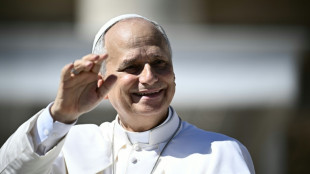
 Leo XIV, first US pope transcends his restrained style

 Singer Ed Sheeran says Gaza situation 'unjustifiable' following controversy

 In 'Tenzing', a Sherpa mountaineer gets his due

If a monkey types randomly at a keyboard for long enough, it will eventually write the complete works of Shakespeare.
This thought experiment has long been used to express how an infinite amount of time makes something that is incredibly unlikely -- but still technically possible -- become probable.
But two Australian mathematicians have deemed the old adage misleading, working out that even if all the chimpanzees in the world were given the entire lifespan of the universe, they would "almost certainly" never pen the works of the bard.
The "infinite monkey theorem" has been around for more than a century, though its origin remains unclear. It is commonly attributed to either French mathematician Emile Borel or British anthropologist Thomas Huxley, and some even think the general idea dates back to Aristotle.
For a light-hearted but peer-reviewed study published earlier this week, the two mathematicians set out to determine what happens if generous yet finite limits were placed on the monkey typists.
Their calculations were based on a monkey spending around 30 years typing one key a second at a keyboard with 30 keys -- the letters of the English language plus some common punctuation.
The "heat death" of the universe was assumed to take place in around a googol of years -- that is a one followed by 100 zeroes.
Other more practical considerations -- such as what the monkeys would eat, or how they would survive the Sun engulfing Earth in a few billion years -- were set aside.
- Monkey labour falls short -
There was only around a five percent chance that a single monkey would randomly write the word "banana" in their lifetime, according to the study in the journal Franklin Open.
Shakespeare's canon includes 884,647 words -- none of them banana.
To broaden out the experiment, the mathematicians turned to chimpanzees, the closest relative of humans.
There are currently around 200,000 chimps on Earth, and the study presumed this population would remain stable until the end of time.
Even this massive monkey workforce fell very, very short.
"It's not even like one in a million," study co-author Stephen Woodcock of the University of Technology Sydney told New Scientist.
"If every atom in the universe was a universe in itself, it still wouldn't happen."
And even if many more chimps who typed much quicker were added to the equation, it was still not plausible "that monkey labour will ever be a viable tool for developing written works of anything beyond the trivial," the authors wrote in the study.
The study concluded by saying that Shakespeare himself may have inadvertently given an answer as to whether "monkey labour could meaningfully be a replacement for human endeavour as a source of scholarship or creativity".
"To quote Hamlet, Act 3, Scene 3, Line 87: 'No'."
E.Rodriguez--AT