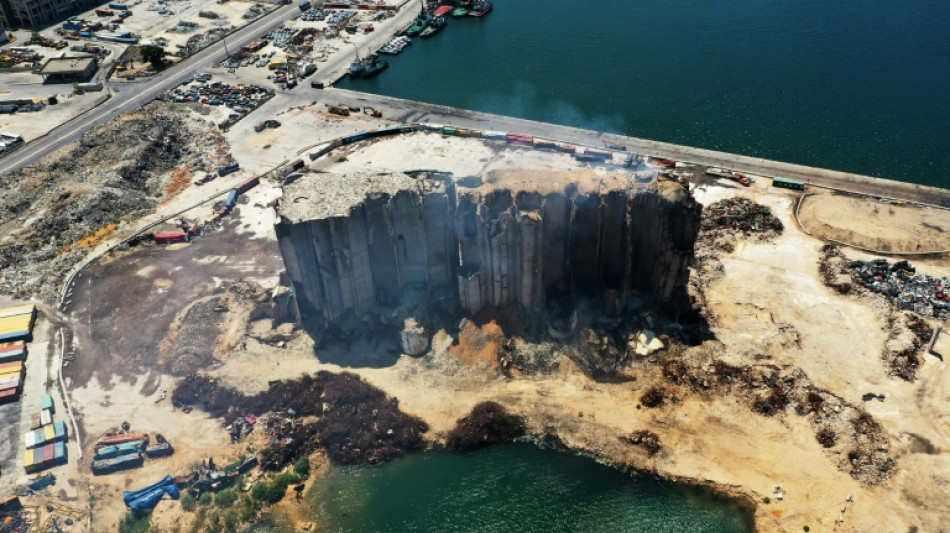
'Timebomb' ship highlights hazard of dangerous cargoes / Photo: - - AFP

 Germany's Merz vows to stay course despite new vote losses

 Man City outgun Sunderland despite Brobbey hat-trick, Man Utd rescue Fulham draw

 Mourinho blames ref committee for Real Madrid derby defeat

 Maresca craves a 1-0 win after eight-goal Man City thriller
 Atletico Madrid beat Real Madrid in tense derby clash
 Reusser retains world time-trial title

 Man City outgun Sunderland despite Brobbey hat-trick, Liverpool win at Bournemouth

 Top US, Chinese economic officials meet ahead of Trump-Xi summit
 Erdogan's LGBTQ crackdown 'first step of election campaign': activist
 Mass drone barrage on Moscow kills two

 82-year-old dies after beach fight in Greece over sun lounger

 US warns of rapid escalation in Mideast war

 Iran 'put hearts on the court' to win Asian Games basketball bronze

 School girl Yu helps China dominate in Asian Games swimming openers
 Myanmar win first Asian Games teqball gold as Spain great Puyol watches

 China's 13-year-old Yu scorches to first major gold at Asian Games
 Russians vote on last day of parliamentary elections
 Hong Kong pays final respects to former city leader Tung

 Typhoon put people off Asian Games opening ceremony, official says

 China's 13-year-old Yu cruises as Asian Games swimming begins

 AI 'warning shots' focus Beijing on national security risks

 Philippine tribe in limbo over US-led tech hub

 Leo XIV, first US pope transcends his restrained style

 Singer Ed Sheeran says Gaza situation 'unjustifiable' following controversy

 In 'Tenzing', a Sherpa mountaineer gets his due

A damaged ship, spurned by European ports because of its potentially explosive cargo, has been stranded in the North Sea for weeks while authorities work out what to do with it.
The Maltese-flagged Ruby is the latest example of an unwanted vessel left in limbo because no-one dares to handle it. Such vessels, sometimes nicknamed "timebombs", remain stuck for weeks, even months.
Ruby, a Handymax bulk carrier, has 20,000 tonnes of ammonium nitrate on board. That is more than seven times the amount of ammonium nitrate -– used in fertilisers as well as in explosives -- that detonated in Lebanon in 2020, devastating the port of Beirut.
After the vessel set off from the Russian port of Kandalaksha on August 22, it ran into a storm in the Barents Sea and limped, damaged, into the Norwegian port of Tromso for damage inspection.
It was subsequently ordered to leave and proceed with the aid of a tug to another port elsewhere for repairs.
It was turned away by Lithuania, which insisted the ship must offload its volatile cargo first, and continued southwards.
Since September 25, it has been anchored off southeastern England near the Dover Strait, which is one of world's busiest shipping lanes.
- Combustion agent -
British coastguards said the Ruby was seaworthy, stressing: "The vessel has appropriate safety certificates approved by the vessel's flag state and is able to make its own way."
But it has remained stuck in mooring since September, with its mainly Syrian crew still on board.
The Ruby's Dubai-based managers said they hoped to offload the cargo in a UK port so the vessel could be put in dry dock for repairs.
"It has been logistically challenging to find an adequate solution, which partly explains the delay," the managing company told AFP.
Ports willing to accept a potentially hazardous load are few and far between.
"People associate it (the Ruby) with Beirut but I think it's entirely possible to manage this situation," said Eric Slominski, an expert in shipping dangerous goods.
The Ruby's cargo was destined to make fertiliser while the ammonium nitrate in Beirut had been specifically intended to manufacture explosives, he pointed out.
"It's not a product you can mess around with but it isn't explosive," Nicolas Tanic, from French marine pollution organisation Cedre, said of the Ruby's cargo.
"It's a combustion agent for fuelling fires," said Tanic, whose organisation has analysed the ship's load.
- Erika disaster -
He said the chemical compound's Russian origins and haunting memories of the Beirut port disaster had triggered alarm and a media frenzy.
But the French shipowners' body said ports could have other reasons too for spurning the Ruby.
"If a vessel gets grounded in your channel, it shuts your port. If it grounds at one of your docks, the dock's unusable for a couple of months. It’s a big risk to accept a vessel in difficulty," said managing director Laurent Martens.
In addition, unloading a cargo like the Ruby's is a lengthy operation that "costs hundreds of thousands of euros", Martens explained.
In the wake of the Erika disaster in 1999 -- when an oil tanker of that name broke apart off the western coast of France -- the European Union tightened its laws on maritime safety.
The Erika spilled around 20,000 tonnes of heavy fuel oil into the sea, polluting 400 kilometres (250 miles) of coastline and killing between 150,000 and 300,000 seabirds.
EU states are now required to provide places of refuge for ships in distress to avoid environmental pollution.
But the rules are subject to interpretation.
In 2012, France denied access to the MSC Flaminia for a month while it drifted, crewless, off the coast of Brittany after a fire on board the ship, which was carrying 151 containers labelled "dangerous" goods.
The stricken vessel was ultimately towed to the Germany port of Wilhelmshaven.
In 2015, the same North Sea port provided haven to the Purple Beach, which had burst into flames with 5,000 tonnes of fertiliser on board.
The Purple Beach spent nearly two years in Germany while it was inspected and the authorities cast around for somewhere to send the fertiliser.
H.Gonzales--AT



