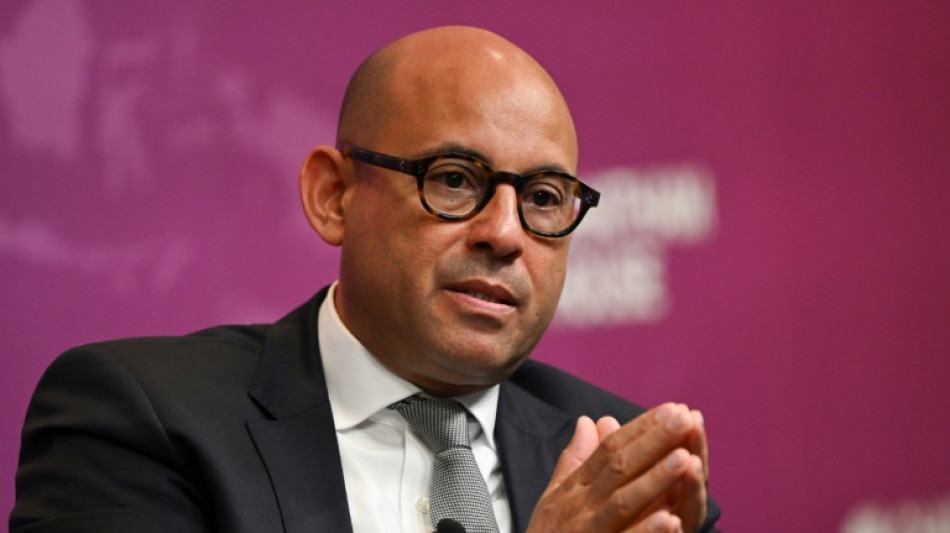
Public money 'must be at core' of new climate pact: UN's Stiell / Photo: JUSTIN TALLIS - AFP

 Germany's Merz vows to stay course despite new vote losses
 Man City outgun Sunderland despite Brobbey hat-trick, Man Utd rescue Fulham draw

 Mourinho blames ref committee for Real Madrid derby defeat
 Maresca craves a 1-0 win after eight-goal Man City thriller
 Atletico Madrid beat Real Madrid in tense derby clash
 Reusser retains world time-trial title

 Man City outgun Sunderland despite Brobbey hat-trick, Liverpool win at Bournemouth

 Top US, Chinese economic officials meet ahead of Trump-Xi summit
 Erdogan's LGBTQ crackdown 'first step of election campaign': activist

 Mass drone barrage on Moscow kills two

 82-year-old dies after beach fight in Greece over sun lounger

 US warns of rapid escalation in Mideast war

 Iran 'put hearts on the court' to win Asian Games basketball bronze

 School girl Yu helps China dominate in Asian Games swimming openers

 Myanmar win first Asian Games teqball gold as Spain great Puyol watches

 China's 13-year-old Yu scorches to first major gold at Asian Games

 Russians vote on last day of parliamentary elections

 Hong Kong pays final respects to former city leader Tung

 Typhoon put people off Asian Games opening ceremony, official says

 China's 13-year-old Yu cruises as Asian Games swimming begins

 AI 'warning shots' focus Beijing on national security risks

 Philippine tribe in limbo over US-led tech hub

 Leo XIV, first US pope transcends his restrained style

 Singer Ed Sheeran says Gaza situation 'unjustifiable' following controversy

 In 'Tenzing', a Sherpa mountaineer gets his due

The UN's climate chief said Thursday that money from rich countries "must be at the core" of a new deal to increase funding for poorer nations to combat global warming.
The developing world needs trillions of dollars to help fund clean energy and prepare for climate change, but the world cannot agree how to raise the money.
It is hoped nations can resolve this at next month's UN COP29 climate summit despite rifts over how much is needed, what is covered, who pays for it, and how.
Wealthy nations most responsible for global warming to date, like the United States and European Union, are obligated to pay and face pressure to raise their existing commitment of $100 billion a year.
But they say they cannot foot the bill alone, and want others to help meet whatever 'climate finance' goal is inked when nearly 200 nations gather for COP29 in Azerbaijan.
"It's not my job to prejudge what the new goal will look like," said Simon Stiell, executive secretary of the UN Framework Convention on Climate Change (UNFCCC), which convenes the COP negotiations but does not influence its decisions.
"But it's clear public finance must be at the core. As much of this finance as possible needs to be grant or concessional, and must be made more accessible to those who need it most."
Developing countries -- most of the world in UNFCCC terms, from powerful emerging markets like China to low-lying island states -- say historic polluters are morally obligated to dig deep into their pockets.
They are also legally bound under the Paris climate agreement of 2015 to take the lead in providing and mobilising such money.
But some donors are under financial and political constraint, and have baulked at demands they commit huge sums of new money from their budgets.
They want private investment to play a much bigger role and for China, the oil-rich Gulf states, and other wealthy emerging markets to also help fill the pot.
Stiell said who pays and how much could be ironed out at COP29 "but we are not -- we are not -- going there to renegotiate the Paris Agreement".
Azerbaijan on Monday said developing countries needed trillions of dollars in climate finance but a goal of hundreds of billions in public money would be more "realistic".
The hosts expect more than 100 heads of state and government to attend the two-week summit in its capital Baku, which gets underway on November 11.
P.A.Mendoza--AT