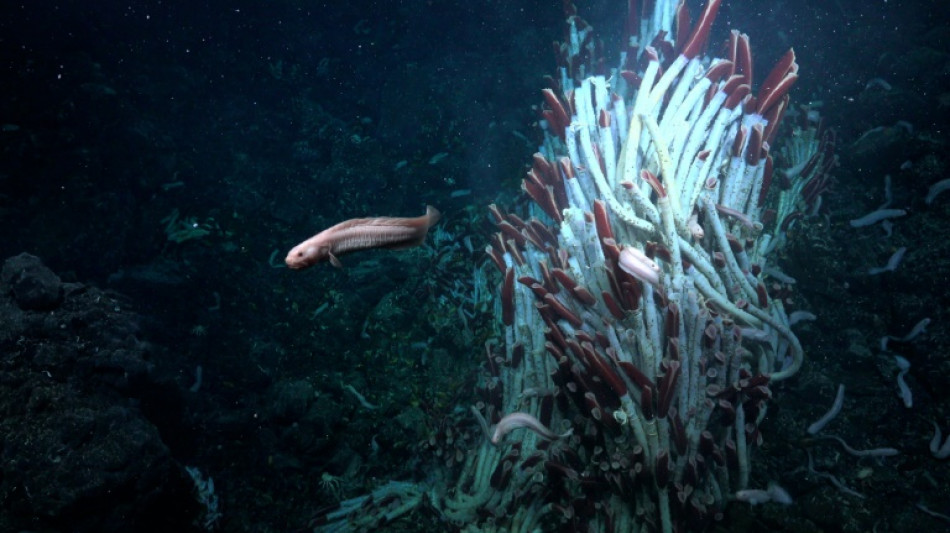
Worms and snails handle the pressure 2,500m below the Pacific surface / Photo: Handout - Schmidt Ocean Institute/AFP

 Germany's Merz vows to stay course despite new vote losses

 Man City outgun Sunderland despite Brobbey hat-trick, Man Utd rescue Fulham draw

 Mourinho blames ref committee for Real Madrid derby defeat

 Maresca craves a 1-0 win after eight-goal Man City thriller

 Atletico Madrid beat Real Madrid in tense derby clash

 Reusser retains world time-trial title

 Man City outgun Sunderland despite Brobbey hat-trick, Liverpool win at Bournemouth

 Top US, Chinese economic officials meet ahead of Trump-Xi summit

 Erdogan's LGBTQ crackdown 'first step of election campaign': activist

 Mass drone barrage on Moscow kills two

 82-year-old dies after beach fight in Greece over sun lounger

 US warns of rapid escalation in Mideast war

 Iran 'put hearts on the court' to win Asian Games basketball bronze

 School girl Yu helps China dominate in Asian Games swimming openers

 Myanmar win first Asian Games teqball gold as Spain great Puyol watches

 China's 13-year-old Yu scorches to first major gold at Asian Games

 Russians vote on last day of parliamentary elections

 Hong Kong pays final respects to former city leader Tung

 Typhoon put people off Asian Games opening ceremony, official says

 China's 13-year-old Yu cruises as Asian Games swimming begins

 AI 'warning shots' focus Beijing on national security risks

 Philippine tribe in limbo over US-led tech hub

 Leo XIV, first US pope transcends his restrained style

 Singer Ed Sheeran says Gaza situation 'unjustifiable' following controversy

 In 'Tenzing', a Sherpa mountaineer gets his due

Giant worms found wriggling under the Pacific seabed have unveiled a thriving ecosystem in a fiercely hostile environment, according to a study published by Nature.
The team found the booming community 2,515 metres (8,250 feet) below the surface just off the coast of central America.
An underwater oasis has been created under a chain of mountains that run from north-to-south in the Pacific. In this part of the chain, two tectonic plates are moving away from each other, opening up hydrothermal vents that let out water heated by magma and loaded with chemical compounds.
The seabed zone was first discovered in the 1970s. But the latest research found tube worms and molluscs that thrive despite water pressure 250 times greater than at the surface and the total darkness.
The inhabitants of the animal Atlantis live off the nutrients produced by bacteria on the seabed.
Scientists are now trying to understand how the tube worm larvae get around so quickly to colonise new areas around the vents created after each underwater eruption.
- Underwater zoo -
One theory is that the larvae get under the crust with cold deep-sea water where it mixes with the hotter water created by earthquakes and eruptions and "and then they get spilled out at the surface and settle", said Monika Bright, a marine biology professor at the University of Vienna and co-author of the Nature study.
The scientists used a remote-controlled submarine, with its own digger for lifting rocks, to collect samples and sea floor images.
"While trying to collect the rocks we discovered that there are cavities below," Bright told AFP.
The cavities hid an underwater zoo of adult worms, limpets in shells, polychaetes, or bristle worms, and marine snails.
Bright said the team's work showed that "unexpected discoveries" can be made even at places that have been studied for more than 30 years, "probably just because nobody was thinking to look into the crust for animals before."
The cavities are about 10 centimetres (four inches) deep and worms up to 41cm long were found.
Bright said the conditions were similar to those at the surface where tube worms live. "The temperatures we measured were up to 25 degrees Celsius, oxygen was present and also toxic hydrogen sulphide in moderate concentrations."
The study said "larvae can disperse in cavities to potentially colonize lava cracks and the seafloor, or even settle and grow to adults and thereby proliferate" in the shallow vents.
Bright said the researchers believe the animals might not go down very far because the temperature rises, there is less oxygen and higher concentrations of hydrogen sulphide the deeper they go.
"It is important to know who lives there and to be able to protect them from deep-sea mining," said Bright. "This fauna is unique and should be protected."
Ch.P.Lewis--AT