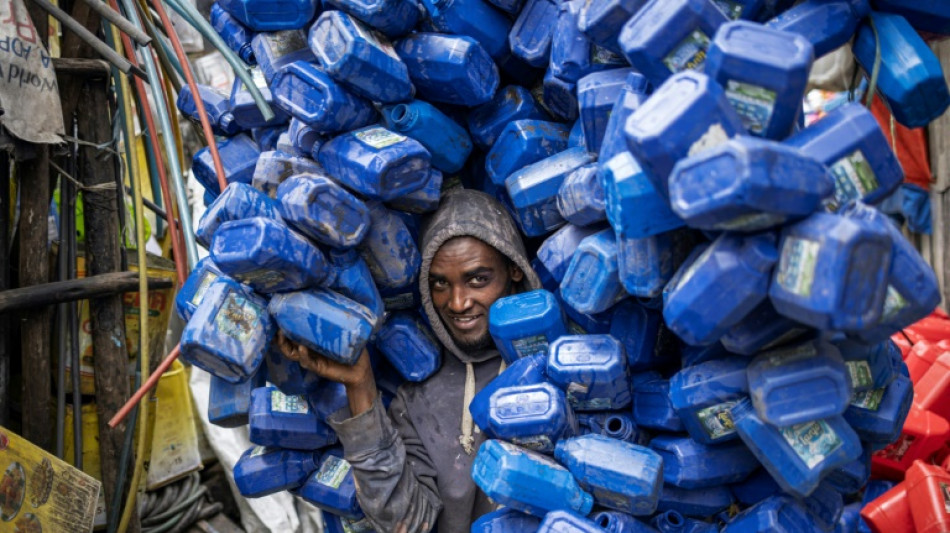
Ethiopia's 'korale' recyclers turn waste into money / Photo: Michele Spatari - AFP

 Germany's Merz vows to stay course despite new vote losses

 Man City outgun Sunderland despite Brobbey hat-trick, Man Utd rescue Fulham draw

 Mourinho blames ref committee for Real Madrid derby defeat

 Maresca craves a 1-0 win after eight-goal Man City thriller
 Atletico Madrid beat Real Madrid in tense derby clash
 Reusser retains world time-trial title

 Man City outgun Sunderland despite Brobbey hat-trick, Liverpool win at Bournemouth

 Top US, Chinese economic officials meet ahead of Trump-Xi summit
 Erdogan's LGBTQ crackdown 'first step of election campaign': activist
 Mass drone barrage on Moscow kills two

 82-year-old dies after beach fight in Greece over sun lounger

 US warns of rapid escalation in Mideast war
 Iran 'put hearts on the court' to win Asian Games basketball bronze

 School girl Yu helps China dominate in Asian Games swimming openers
 Myanmar win first Asian Games teqball gold as Spain great Puyol watches

 China's 13-year-old Yu scorches to first major gold at Asian Games
 Russians vote on last day of parliamentary elections

 Hong Kong pays final respects to former city leader Tung

 Typhoon put people off Asian Games opening ceremony, official says
 China's 13-year-old Yu cruises as Asian Games swimming begins

 AI 'warning shots' focus Beijing on national security risks
 Philippine tribe in limbo over US-led tech hub

 Leo XIV, first US pope transcends his restrained style

 Singer Ed Sheeran says Gaza situation 'unjustifiable' following controversy

 In 'Tenzing', a Sherpa mountaineer gets his due
With a tattered bag on his back, Dereje Enigdamekonen trawled the endless alleyways of the Merkato market in Addis Ababa, calling for the Ethiopian capital's abundant scrap.
"Korale, korale," he shouted at regular intervals.
It's a made-up word in Amharic that is now used for the thousands of collectors, almost all men, who hunt out everything from used jerry cans and electrical equipment to shoes, shovels and any other unwanted bric-a-brac.
These objects are then either restored, stripped for spare parts, or transformed into something new -- giving new life to what would otherwise be polluting litter.
Dereje, 45, has been doing this work for a year, rain or shine, saying he buys "everything that can be reused".
For a kilogramme of collected metal, he can get about 40 birr ($0.30) and for jerry cans, depending on the size, between three and 25 birr.
"Waste can be transformed into money," he said with a smile.
After wandering for hours, the korales converged on an area of Merkato called Minalesh Tera, which translates from Amharic as "What do you have?".
Here, the narrow alleys of Merkato, one of Africa's largest open-air markets, are lined with tiny tin-shack shops as far as the eye can see.
The recyclers sell their daily finds to middlemen like Tesfaye Getahun, who was in the middle of dismantling a huge printer.
With heavy blows of a mallet, he isolated the motherboard and some aluminium parts.
Whether it is computers or old televisions, Tesfaye said he recycles everything.
"They aren't used anymore, and if left like that, they can cause environmental pollution. But if they are disassembled and sold for parts, it helps prevent pollution," he said.
Addis Ababa produces about 400,000 tonnes of waste annually, according to 2020 figures from the United Nations Development Programme (UNDP), of which only 70 percent is picked up by the official waste management system.
- 'Help the environment' -
Tamirat Dejene was almost lost among piles of jerry cans in his shop.
The 21-year-old, who has been collecting plastic for four years, said he earns between 500 and 1,000 birr ($4 to $8.50) a day.
That can be a godsend in a country where more than a third of its 120 million people live below the poverty line, according to the World Bank.
"We earn our living and we also help the environment because these items are not biodegradable," said Tamirat.
"It is also beneficial for Addis Ababa: if this waste were not collected, the city's landfills would overflow. So we earn our living while providing a solution," he added.
The objects made in Minalesh Tera are then sold in shops in the capital and all over the country.
Some go even further.
Biruk Shimeles, 31, buys scrap metal to make aluminium charcoal stoves which he sells in Sudan, Djibouti and Somalia.
"This work protects the community from waste by transforming it into a business opportunity," said Biruk.
H.Romero--AT