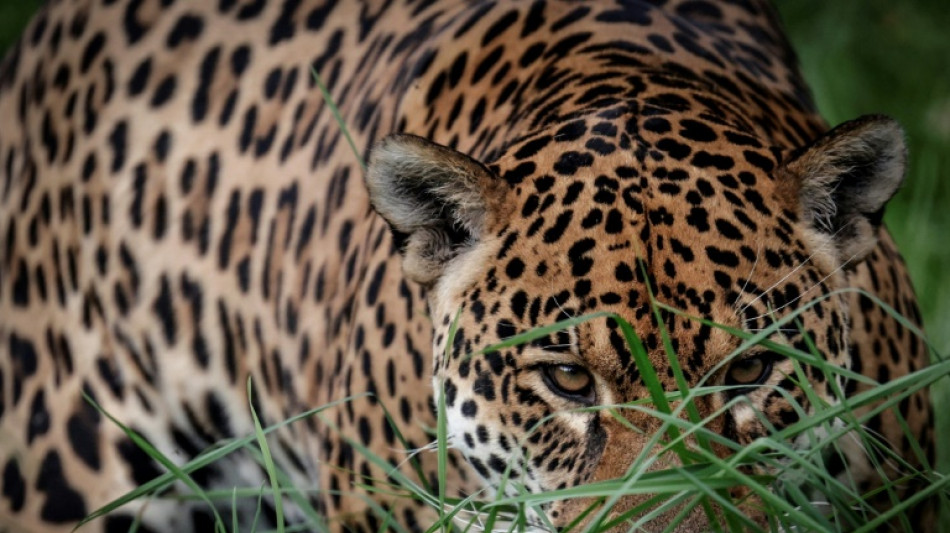
Wildlife populations plunge 73% since 1970: WWF / Photo: STEPHANE DE SAKUTIN - AFP

 Liverpool boss Iraola urges Isak to raise his level

 Evenepoel wins record 4th straight world time-trial title

 France's Macron, Canada's Carney announce closer ties

 Carrick defends troubled Man Utd after Fulham escape

 Horror movie 'Resident Evil' tops N. American box office

 Germany's Merz vows to stay course despite new vote losses

 Man City outgun Sunderland despite Brobbey hat-trick, Man Utd rescue Fulham draw

 Mourinho blames ref committee for Real Madrid derby defeat

 Maresca craves a 1-0 win after eight-goal Man City thriller

 Atletico Madrid beat Real Madrid in tense derby clash
 Reusser retains world time-trial title

 Man City outgun Sunderland despite Brobbey hat-trick, Liverpool win at Bournemouth

 Top US, Chinese economic officials meet ahead of Trump-Xi summit

 Erdogan's LGBTQ crackdown 'first step of election campaign': activist

 Mass drone barrage on Moscow kills two

 82-year-old dies after beach fight in Greece over sun lounger

 US warns of rapid escalation in Mideast war

 Iran 'put hearts on the court' to win Asian Games basketball bronze

 School girl Yu helps China dominate in Asian Games swimming openers

 Myanmar win first Asian Games teqball gold as Spain great Puyol watches

 China's 13-year-old Yu scorches to first major gold at Asian Games

 Russians vote on last day of parliamentary elections

 Hong Kong pays final respects to former city leader Tung

 Typhoon put people off Asian Games opening ceremony, official says

 China's 13-year-old Yu cruises as Asian Games swimming begins

Wild populations of monitored animal species have plummeted over 70 percent in the last half-century, according to the latest edition of a landmark assessment by WWF published on Thursday.
Featuring data from 35,000 populations of more than 5,000 species of mammals, birds, amphibians, reptiles and fish, the WWF Living Planet Index shows accelerating declines across the globe.
In biodiversity-rich regions such as Latin America and the Caribbean, the figure for animal population loss is as high as 95 percent.
The report tracks trends in the abundance of a large number of species, not individual animal numbers.
It found that populations under review had fallen 73 percent since 1970, mostly due to human pressures.
The index has become an international reference and arrives just ahead of the next UN summit on biodiversity, which will spotlight the issue when it opens in Colombia later this month.
"The picture we are painting is incredibly concerning," said Kirsten Schuijt, Director General of WWF International, at a press briefing.
- Tipping points -
"This is not just about wildlife, it's about the essential ecosystems that sustain human life," said Daudi Sumba, chief conservation officer at WWF.
The report reiterates the need to simultaneously confront the "interconnected" crises of climate change and nature destruction, and warned of major "tipping points" approaching certain ecosystems.
"The changes could be irreversible, with devastating consequences for humanity," he said, using the example of deforestation in the Amazon, which could "shift this critical ecosystem from a carbon sink to a carbon source."
"Habitat degradation and loss, driven primarily by our food system, is the most reported threat in each region, followed by overexploitation, invasive species and disease," the report said.
Other threats include climate change, in particular in Latin America and the Caribbean, and pollution, notably in North America, Asia and the Pacific.
- 'Incredibly concerning' -
The biggest decline is found in populations of freshwater species, followed by terrestrial and marine vertebrates.
"We have emptied the oceans of 40 percent of their biomass," said Yann Laurans of WWF France.
Continent by continent, the average decline reached 95 percent in Latin America and the Caribbean, followed by Africa, down 76 percent, and then Asia and the Pacific, which declined 60 percent.
The reduction in populations is "less spectacular" in Europe, Central Asia and North America.
Some populations have stabilised or even expanded thanks to conservation efforts and the reintroduction of species, the report said.
The European bison, for example, disappeared in the wild in 1927 but in 2020 numbered 6,800 thanks to large-scale breeding and successful reintroduction, mainly in protected areas.
While calling the overall picture "incredibly concerning," Schuijt added: "The good news is that we're not yet past the point of no return."
She pointed to global efforts including a breakthrough pact landed at the last UN meeting on biodiversity in 2022 to protect 30 percent of the planet by 2030 from pollution, degradation and climate change.
But she warned, "all of these agreements have checkpoints in 2030 that are in danger of being missed."
Several scientific studies published by the journal Nature have accused WWF of methodological biases in its index that lead to an exaggerated extent of the decline of animals.
"We remain really confident of its robustness," said Andrew Terry of the Zoological Society of London at a press briefing, highlighting the use of a "range of indicators, looking at extinction risk, biodiversity and ecosystem health to really broaden that picture".
M.Robinson--AT



