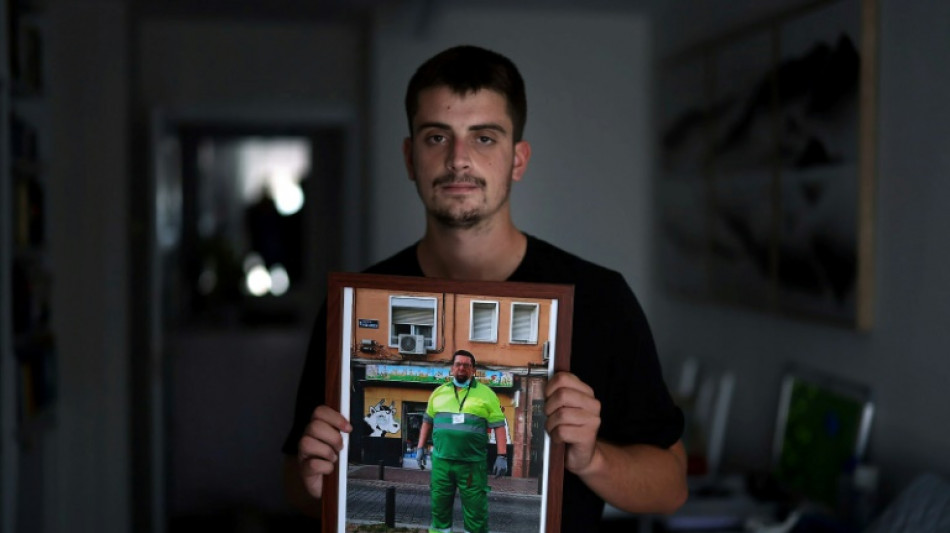
Tragedy of Madrid street sweeper highlights how heatwaves kill / Photo: Thomas COEX - AFP

 Liverpool boss Iraola urges Isak to raise his level

 Evenepoel wins record 4th straight world time-trial title

 France's Macron, Canada's Carney announce closer ties
 Carrick defends troubled Man Utd after Fulham escape

 Horror movie 'Resident Evil' tops N. American box office

 Germany's Merz vows to stay course despite new vote losses

 Man City outgun Sunderland despite Brobbey hat-trick, Man Utd rescue Fulham draw

 Mourinho blames ref committee for Real Madrid derby defeat

 Maresca craves a 1-0 win after eight-goal Man City thriller

 Atletico Madrid beat Real Madrid in tense derby clash
 Reusser retains world time-trial title

 Man City outgun Sunderland despite Brobbey hat-trick, Liverpool win at Bournemouth

 Top US, Chinese economic officials meet ahead of Trump-Xi summit

 Erdogan's LGBTQ crackdown 'first step of election campaign': activist

 Mass drone barrage on Moscow kills two

 82-year-old dies after beach fight in Greece over sun lounger

 US warns of rapid escalation in Mideast war

 Iran 'put hearts on the court' to win Asian Games basketball bronze

 School girl Yu helps China dominate in Asian Games swimming openers

 Myanmar win first Asian Games teqball gold as Spain great Puyol watches

 China's 13-year-old Yu scorches to first major gold at Asian Games

 Russians vote on last day of parliamentary elections

 Hong Kong pays final respects to former city leader Tung

 Typhoon put people off Asian Games opening ceremony, official says

 China's 13-year-old Yu cruises as Asian Games swimming begins

Three hours into his shift as a street sweeper in Madrid on a summer afternoon when temperatures went above 40 degrees Celsius (104 Fahrenheit), Jose Antonio Gonzalez fainted from heatstroke. He died the next day in hospital.
With the Spanish capital on heatwave alert, the 60-year-old had set out for work that day in July 2022 with two two-litre bottles of water and a spray bottle to cool off.
"He knew he had to keep hydrated. But that day, it obviously wasn't enough," Gonzalez's son Miguel Angel told AFP.
Gonzalez had only recently started a one-month contract as a street sweeper. He normally worked the cooler morning shift but had swapped shifts as a favour to a colleague and began at 2 pm, when temperatures were at their highest.
His death made headlines in Spain and thrust the spotlight on the threat posed by scorching temperatures, especially to outdoor workers and the more vulnerable.
- Organs began to fail -
When emergency services arrived in the working-class neighbourhood in southeastern Madrid where Gonzalez had collapsed, they found his body temperature was 41.6 degrees Celsius.
They applied ice to his neck and armpits to try to cool him down, hydrated him with a saline solution and put him under a hypothermic blanket before rushing him to hospital, said a spokeswoman for Madrid's emergency services.
His liver and kidneys were already failing by the time his family arrived at his bedside and doctors gave them "no hope", Miguel Angel said.
"His back was purple as if he'd been on the ground for a long time... He had a lot of equipment around him, like an ice shield and several fans. He was lying down with his eyes covered," he said.
Gonzalez died on July 16, 2022. His death certificate said he suffered fatal organ failure due to high body temperatures. His death was classified as a workplace accident.
"When body temperature rises above 40 degrees Celsius, the defence mechanisms we have to combat heat, such as sweating, stop working," the spokesman for the Spanish Society of General and Family Physicians (SEMG), Lorenzo Armenteros del Olmo, told AFP.
In scorching temperatures the body pushes blood quickly to the skin where it can release heat, reducing the flow to internal organs.
- 'Hard to talk' -
"It affects the whole body and that's when the organs start to fail," said Eduard Argudo, an intensive care doctor at Barcelona's Vall d'Hebron hospital, adding quick medical care is key to avoiding irreversible organ failure.
"Sometimes the damage is such that, even if we manage to control the temperature, we can't reverse the damage to the organs," he told AFP.
"Heatstroke is a medical emergency, and these patients always go into intensive care," he added, warning it has a "high mortality rate".
With climate change likely to drive temperatures even higher in coming years, the dangers look set to rise even further.
Miguel Angel said that a few days before his father died, he crossed paths with him on the train as Gonzalez was coming home and "he told me it was hard for him to talk because of the heat he was feeling".
"When he got home, after greeting us, the first thing he would do is go to the swimming pool to cool off," his son added.
Gonzalez's death shook up public opinion in Spain and led Madrid city hall to adopt measures halting outdoor work during heatwaves as well as to avoid working in the hottest hours of the day during.
A Madrid park now bears his name.
Miguel Angel said that after his father passed away he was on his computer and saw he had recently done a Google search on "What to do about heatstroke".
J.Gomez--AT



