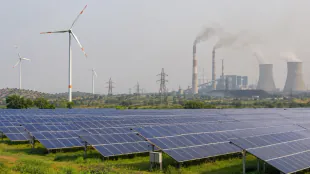
UN chief warns of 'rising tide of misery' from swelling seas / Photo: Kerem Yücel - AFP/File

 Fire in Northern China Apartment Building Kills 14

 Apple’s 20th Anniversary iPhone to Skip Action Button for Camera Control Integration

 Family of Woman Who Died at Voting Station Condemns Official Silence

 Karen Wazen Launches First Standalone Boutiques in Cairo

 New 401k Gold IRA Investment Guide Explains the Best Way to Invest in Gold for Retirement (2026 Update)

 InterContinental Hotels Group PLC Announces Transaction in Own Shares - November 09

 First Drive: 2027 BMW i760 xDrive Review

 Gary, Indiana Blackout Exposes FEMA Relief Disparities Along Racial Lines

 Turkish Energy Minister Highlights Qatar as Key Partner for Regional and Global Energy Security

 London Museum Granted 24/7 License Ahead of November Opening

UN chief Antonio Guterres warned on Wednesday that surging sea levels are creating "a rising tide of misery," as a coalition of small island nations declared that their sovereignty must be respected even if their lands are subsumed.
Nearly a billion people worldwide live in low-lying coastal areas, increasingly vulnerable to storm surges, coastal erosion and flooding -- while Pacific islands face growing threats to their economic viability and even existence.
Since the beginning of the 20th century, the global mean sea level has risen faster than in any prior century over at least the past 3,000 years, a direct consequence of human-caused global warming triggering the melting of ice on land and the thermal expansion of seawater.
"Rising seas mean a rising tide of misery," said Guterres, speaking at a summit that placed sea-level rise at the top of the international agenda at the UN General Assembly.
Over the past century, as global temperatures have risen about one degree Celsius (1.8F), sea levels have gone up 160 to 210 millimeters (six to eight inches) -- with about half of that amount occurring since 1993, according to NASA.
According to a study cited by the UN's Intergovernmental Panel on Climate Change, five nations -- the Maldives, Tuvalu, the Marshall Islands, Nauru and Kiribati -- may become uninhabitable by 2100, creating 600,000 stateless climate refugees.
Guterres warned of "communities swamped, fresh water contaminated, crops ruined, infrastructure damaged, biodiversity destroyed and economies decimated -- with sectors such as fisheries, agriculture and tourism pummeled."
These effects are already being felt, he said -- pointing to hundreds of island families in Panama forced to relocate to the mainland, and people in Saint Louis, Senegal, who are abandoning their homes, schools, businesses and mosques to the encroaching tide.
- Legal protections -
Feleti Teo, prime minister of the tiny Pacific archipelago of Tuvalu, added that rising seas pose "an existential threat to our economies, to our culture and heritage, and to the land that nourished our ancestors for centuries."
Flooding has increased soil salinity, reducing crop yields and weakening trees. Infrastructure such as roads and power lines has been washed away. "Higher land on which to rebuild does not exist," he said.
Low-lying nations are seeking to "affirm that statehood cannot be challenged under any circumstances of sea-level rise," and that their 200-nautical-mile maritime zones remain intact even if land mass diminishes.
Island nations are also pushing for legal protections to safeguard the human rights of forcibly displaced people, ensure financial support for adaptation efforts, and establish programs that preserve their culture.
"Since 1989, we've been sounding the alarm on the climate crisis and sea level rise while facing its devastating impacts," added Samoan Prime Minister Fiame Naomi Mata'afa in a statement.
"Through it all, we've stayed firm -- our states, maritime zones and rights remain intact under international law, no matter the rising seas: we are here to stay."
Guterres urged countries to commit to ambitious new climate targets to keep global warming within 1.5 degrees Celsius — particularly the G20 nations, responsible for 80 percent of global emissions.
"We cannot leave the hopes and aspirations of billions of people dead in the water."
F.Ramirez--AT