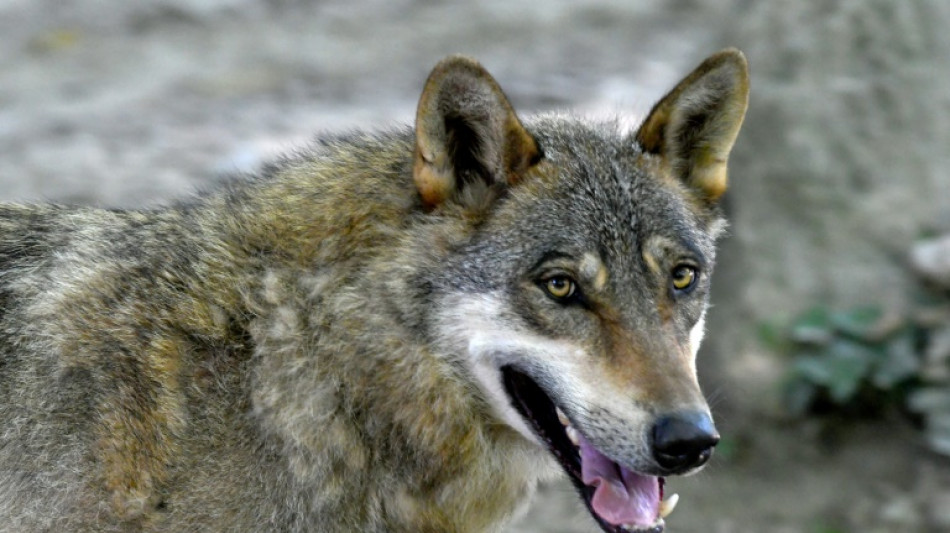
EU states back plan to downgrade wolf protection status / Photo: DENIS LOVROVIC - AFP

 Liverpool boss Iraola urges Isak to raise his level

 Evenepoel wins record 4th straight world time-trial title

 France's Macron, Canada's Carney announce closer ties

 Carrick defends troubled Man Utd after Fulham escape

 Horror movie 'Resident Evil' tops N. American box office

 Germany's Merz vows to stay course despite new vote losses

 Man City outgun Sunderland despite Brobbey hat-trick, Man Utd rescue Fulham draw

 Mourinho blames ref committee for Real Madrid derby defeat

 Maresca craves a 1-0 win after eight-goal Man City thriller
 Atletico Madrid beat Real Madrid in tense derby clash

 Reusser retains world time-trial title

 Man City outgun Sunderland despite Brobbey hat-trick, Liverpool win at Bournemouth

 Top US, Chinese economic officials meet ahead of Trump-Xi summit

 Erdogan's LGBTQ crackdown 'first step of election campaign': activist

 Mass drone barrage on Moscow kills two

 82-year-old dies after beach fight in Greece over sun lounger

 US warns of rapid escalation in Mideast war

 Iran 'put hearts on the court' to win Asian Games basketball bronze

 School girl Yu helps China dominate in Asian Games swimming openers

 Myanmar win first Asian Games teqball gold as Spain great Puyol watches

 China's 13-year-old Yu scorches to first major gold at Asian Games

 Russians vote on last day of parliamentary elections

 Hong Kong pays final respects to former city leader Tung

 Typhoon put people off Asian Games opening ceremony, official says

 China's 13-year-old Yu cruises as Asian Games swimming begins

EU member states on Wednesday voted in favour of lowering the protection status of wolves, in a move decried by conservationists that paves the way for a relaxation of strict hunting rules.
Representatives for the bloc's 27 countries backed a proposal to push for changes to an international wildlife convention that would see the species downgraded from "strictly protected" to "protected".
The European Commission, which initially put forward the plan, welcomed its approval by a qualified majority of member states during a meeting in Brussels.
Grey wolves were virtually exterminated in Europe a century ago but, thanks to conservation efforts, numbers have rebounded, triggering howls of protest from farmers angered at livestock losses.
"Adapting the protection status will be an important step to address the challenges posed by increasing wolf population while keeping the overall objective to achieve and maintain a favourable conservation status for the species," commission spokesman Adalbert Jahnz told reporters.
In 2023, there were breeding packs of grey wolves in 23 European Union countries, with a total population estimated at around 20,300 animals, bringing the elusive creatures into more frequent contact with humans.
In announcing plans to revise the species' status last year, Commission chief Ursula von der Leyen said the "concentration of wolf packs in some European regions has become a real danger especially for livestock".
Last year, von der Leyen herself lost her beloved pony Dolly to a wolf that crept into its enclosure on her family's rural property in northern Germany -- leading some to suggest the matter had become personal.
The wolf became a "strictly protected" species under the 1979 Bern Convention, which the EU is a party to.
The text allows for the animal to be killed or captured only when it poses a threat to livestock, health or safety.
The commission's proposal would loosen such rules by demoting wolves to "protected" species.
Despite protests from animal rights activists, this would allow hunting to resume under strict regulation.
- 'Politically motivated' -
More than 300 environmental and animal protection groups opposed the move arguing it was premature since while population numbers have grown, their recovery is still ongoing.
"We see this as a proposal that is politically motivated and not at all based on science," Sabien Leemans, senior policy officer at environmental group WWF, told AFP.
This year has seen rolling protests by farmers in Brussels and around Europe against the bloc's tightening environmental requirements.
Wednesday's vote, once formally adopted by the bloc's environment ministers, will give the EU a mandate to push for a change in the Bern Convention at its next standing committee meeting scheduled for December.
A two-thirds majority is required to alter the text, which was signed by 50 countries, including the 27 EU members.
If the convention is changed, the commission will then be allowed to move to amend related EU rules.
B.Torres--AT