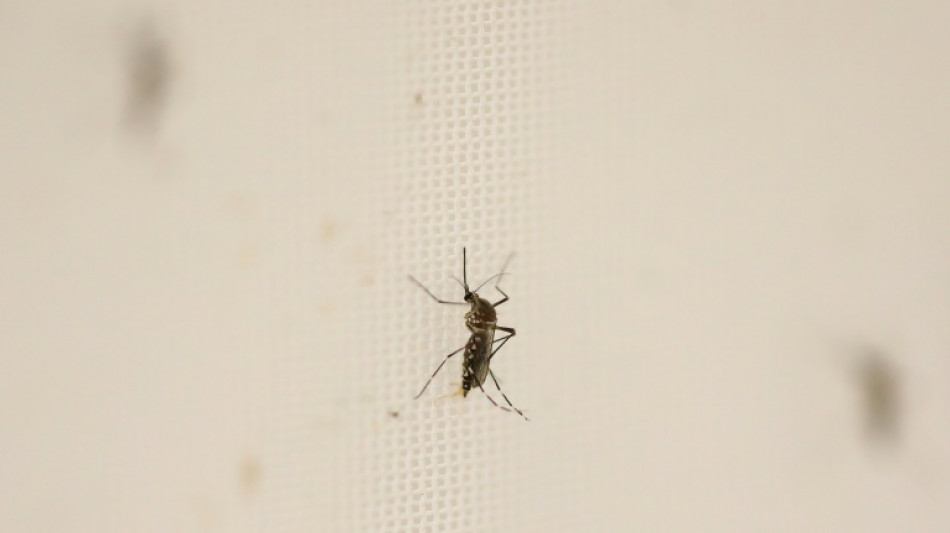
'Virus hunters' track threats to head off next pandemic / Photo: JAIME SALDARRIAGA - AFP/File

 Liverpool boss Iraola urges Isak to raise his level

 Evenepoel wins record 4th straight world time-trial title

 France's Macron, Canada's Carney announce closer ties

 Carrick defends troubled Man Utd after Fulham escape

 Horror movie 'Resident Evil' tops N. American box office

 Germany's Merz vows to stay course despite new vote losses

 Man City outgun Sunderland despite Brobbey hat-trick, Man Utd rescue Fulham draw

 Mourinho blames ref committee for Real Madrid derby defeat

 Maresca craves a 1-0 win after eight-goal Man City thriller

 Atletico Madrid beat Real Madrid in tense derby clash

 Reusser retains world time-trial title

 Man City outgun Sunderland despite Brobbey hat-trick, Liverpool win at Bournemouth

 Top US, Chinese economic officials meet ahead of Trump-Xi summit

 Erdogan's LGBTQ crackdown 'first step of election campaign': activist

 Mass drone barrage on Moscow kills two

 82-year-old dies after beach fight in Greece over sun lounger

 US warns of rapid escalation in Mideast war

 Iran 'put hearts on the court' to win Asian Games basketball bronze

 School girl Yu helps China dominate in Asian Games swimming openers

 Myanmar win first Asian Games teqball gold as Spain great Puyol watches

 China's 13-year-old Yu scorches to first major gold at Asian Games

 Russians vote on last day of parliamentary elections

 Hong Kong pays final respects to former city leader Tung

 Typhoon put people off Asian Games opening ceremony, official says

 China's 13-year-old Yu cruises as Asian Games swimming begins

A global network of doctors and laboratories is working to pinpoint emerging viral threats, including many driven by climate change, in a bid to head off the world's next pandemic.
The coalition of self-described "virus hunters" has uncovered everything from an unusual tick-borne disease in Thailand to a surprise outbreak in Colombia of an infection spread by midges.
"The roster of things that we have to worry about, as we saw with Covid-19, is not static," said Gavin Cloherty, an infectious disease expert who heads the Abbott Pandemic Defense Coalition.
"We have to be very vigilant about how the bad guys that we know about are changing... But also if there's new kids on the block," he told AFP.
The coalition brings together doctors and scientists at universities and health institutions across the world, with funding from healthcare and medical devices giant Abbott.
By uncovering new threats, the coalition gives Abbott a potential headstart in designing the kinds of testing kits that were central to the Covid-19 response.
And its involvement gives the coalition deep pockets and the ability to detect and sequence but also respond to new viruses.
"When we find something, we're able to very quickly make diagnostic tests at industry level," Cloherty said.
"The idea is to ringfence an outbreak, so that we would be able to hopefully prevent a pandemic."
The coalition has sequenced approximately 13,000 samples since it began operating in 2021.
In Colombia, it found an outbreak of Oropouche, a virus spread by midges and mosquitoes, that had rarely been seen there before.
Phylogenetic work to trace the strain's family tree revealed it came from Peru or Ecuador, rather than Brazil, another hotspot.
"You can see where things are moving from. It's important from a public health perspective," said Cloherty.
- Difficult and costly -
More recently, the coalition worked with doctors in Thailand to reveal that a tick-bourne virus was behind a mysterious cluster of patient cases.
"At the time, we didn't know what virus caused this syndrome," explained Pakpoom Phoompoung, associate professor of infectious disease at Siriraj Hospital.
Testing and sequencing of samples that dated back as far as 2014 found many were positive for severe fever with thrombocytopenia syndrome (SFTSV).
"Less than 10 patients had (previously) been diagnosed with SFTSV in Thailand... we don't have PCR diagnosis, we don't have serology for this viral infection diagnosis," Pakpoom told AFP.
Diagnosing it "is difficult, labour intensive and also is costly".
And there is a growing need to track these threats as climate change expands the range of infectious disease globally.
The link between climate change and infectious disease is well-established and multi-faceted.
Warmer conditions allow vectors like mosquitoes to live in new locations, more rain creates more breeding pools, and extreme weather forces people into the open where they are more vulnerable to bites.
Human impact on the planet is also driving the spread and evolution of infectious disease in other ways: biodiversity loss forces viruses to evolve into new hosts, and can push animals into closer contact with humans.
- 'You have to be vigilant' -
Phylogenetic analysis of the SFTSV strain in Thailand gives a snapshot of the complex interplay.
It showed the virus had evolved from one tick with a smaller geographic range into the hardier Asian longhorned tick.
The analysis suggested its evolution was driven largely by pesticide use that reduced the numbers of the original tick host.
Once the virus evolved, it could spread further in part because Asian longhorned ticks can live on birds, which are travelling further and faster because of changing climate conditions.
"It's almost like they're an airline," said Cloherty.
Climate change's fingerprints are in everything from record outbreaks of dengue in Latin America and the Caribbean to the spread of West Nile Virus in the United States.
While the coalition grew from work that preceded the pandemic, the global spread of Covid-19 offered a potent reminder of the risks of infectious disease.
But Cloherty fears people are already forgetting those lessons.
"You have to be vigilant," he said.
"Something that happens in Bangkok could be happening in Boston tomorrow."
O.Ortiz--AT



