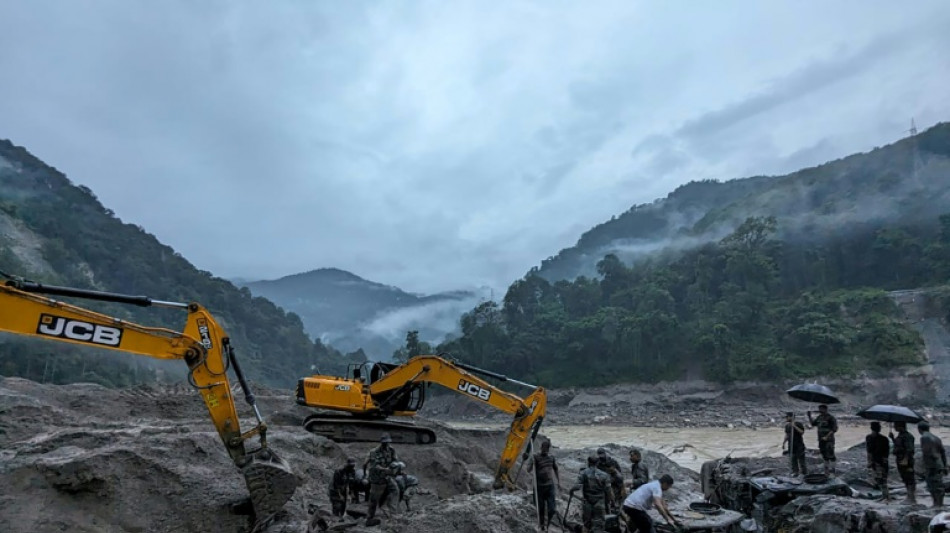
India launches flood warning systems at Himalayan glacial lakes / Photo: - - India's Ministry of Defence/AFP/File

 Braves clinch division title as Red Sox reach MLB playoffs
 Bordeaux-Begles hammer Stade Francais despite Jalibert injury

 Milan and Juventus end blips with home wins

 Bridgeman wins PGA Biltmore title with sizzling 61

 Williams injured as Bears shut down by Vikings

 US warns of rapid escalation in Middle East war

 Germany's far-right AfD celebrates another state election win

 Russia vows revenge for election-day attacks as poll shows ruling party win

 Spaun late shows snatches PGA Championship win

 Conceicao strikes as Juventus beat Atalanta

 Britain, Zverev-inspired Germany, Spain complete Davis Cup finals

 Man Utd salvage Fulham draw as pressure mounts on Carrick

 Spanish civil war drama 'The Black Ball' wins at Toronto festival

 Germany's Merz shaken by far-right and far-left gains in state votes

 Macron welcomes Canada's Carney to French Atlantic territory

 Fiorentina frustrate Napoli with Serie A draw, Como upset

 Five-star Man City top Premier League after Sunderland thriller

 Ukrainian drones hit Moscow on last day of Russian elections

 Multi-Asset Trading Venue Monochrome Exchange Announces IEO of Its Native Token, $MCR

 South Korea break Japan hearts to win Asian Games basketball gold
 Acosta takes first victory at Austrian MotoGP

 PSG president Nasser al-Khelaifi under investigation in France for conflict of interest

 China swim sensation, 13, sets Games record after Japan win early

 Drones hit Moscow as Russians go to the polls

 New England boss Fleming says 'wrong' to ask Stokes to end retirement

India is setting up high-tech warning systems at nearly 200 Himalayan glacial lakes at risk of bursting their banks, a deadly threat exacerbated by climate change, disaster officials said Tuesday.
India's Himalayas contain at least 7,500 glacial lakes, many of which pose risks of dangerous flash floods.
Teams from India's National Disaster Management Authority (NDMA) are targeting 190 high-altitude lakes deemed to be the most dangerous in a mission slated to take three years.
"We have already made significant strides in mitigating risks", Safi Ahsan Rizvi, a senior NDMA official directing the mission, told AFP.
A glacial lake outburst flood (GLOF) is the sudden release of water that has collected in former glacier beds.
These lakes are formed by the retreat of glaciers, a naturally occurring phenomenon turbocharged by the warmer temperatures of human-caused climate change.
One expedition is currently working to install early warning systems around six high-risk lakes in the northeastern state of Sikkim, where at least 77 people died in such a flood in October 2023.
"We have done 20 lakes so far, and will complete 40 this summer," Rizvi said.
The project will also include "lowering lake levels" of accumulated water and ice slush in lakes.
Teams include experts from the army and multiple government agencies, including the Indian Space Research Organisation, geologists, hydrologists, computing engineers and weather specialists.
India's air force is also expected to join the mission later, flying heavy equipment into remote sites.
- 'Catastrophic impacts' -
The mission will cover the Himalayan regions in India, from Kashmir and Ladakh in the north to Arunachal Pradesh in the northeast, many in areas bordering China.
Climate change is driving the disappearance of glaciers, with half the Earth's 215,000 glaciers projected to melt by the end of the century, even if warming can be capped at 1.5 degrees Celsius above pre-industrial levels.
The volume of glacial lakes has jumped by 50 percent in 30 years, according to a 2020 study based on satellite data.
A study, published in Nature Communications, found that 15 million people live within 50 kilometres (31 miles) of a glacial lake and within one kilometre of potential flooding from a breach.
The risk was greatest in the "High Mountains Asia" region across 12 countries, including India, Pakistan, China and Nepal.
That is partly because more people live closer to glacial lakes in the region than in other parts of the world, making warning times even shorter.
Last month a glacial lake outburst in neighbouring Nepal's Everest region sent a devastating flood of frigid water through the village of Thame, sweeping away buildings.
However, residents were forewarned and there were no casualties.
The International Centre for Integrated Mountain Development (ICIMOD) said it was a clear example of the "catastrophic impacts" increasing global temperatures were having on people who had done the least to contribute to the greenhouse gases driving it.
M.King--AT



